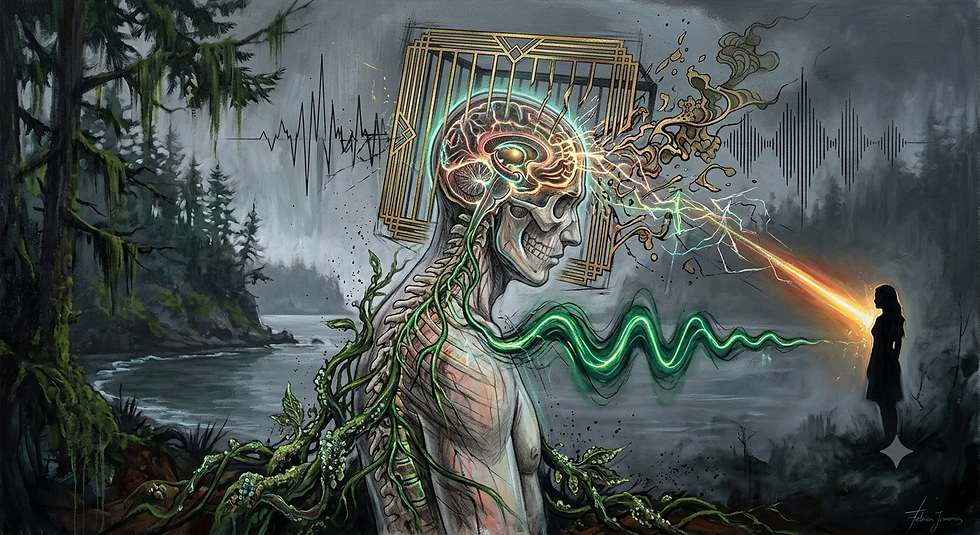
Before the First Word: The Bone That Sings
- One Love Energy
- Feb 19
- 12 min read
That is a beautiful sentiment. There is something uniquely revealing about the human voice—it’s an instrument you can't put down, and it vibrates from the inside out. When you sing, you aren't just making music; you’re navigating your own resonance, breath, and emotional limits.
The S.T.I.C.K. Framework
* S – Shocking: Does it challenge a common belief or provide a "wait, what?" moment?
* T – Tangible: Does it use concrete imagery or specific numbers? (e.g., "The 3 Octaves of My Soul" vs. "My Singing Journey")
* I – Intriguing: Does it open a "curiosity gap" that makes the reader need to know more?
* C – Concise: Is it punchy and easy to remember? Cut the fluff.
* K – Kinetic: Does it use active verbs or imply movement and transformation?
The origins of singing are a fascinating mix of biology, anthropology, and pure instinct.
Because voices don’t leave fossils, scientists look at the hyoid bone and the size of the nerve canals in ancient skulls to piece together when our ancestors transitioned from primitive grunts to melodic expression.
Tracing the evolution of singing is like following a thread from the primitive forest to the digital stage.
1. The Pre-Linguistic Roots (Bio-Musicology)
Before we had words, we had intonation. Many researchers believe singing actually predates spoken language.
Social Bonding: Early hominids likely used rhythmic vocalizations to create a sense of unity, much like "chorusing" in wolves or primates.
Sexual Selection: Drawing from Darwin’s theories, singing may have begun as a way to demonstrate physical fitness and cognitive complexity to potential mates—think of it as the human version of a bird’s song.
Motherese: The "sing-song" way parents speak to infants (Infant-Directed Speech) is universal. This melodic communication helped soothe infants and strengthen the mother-infant bond long before complex sentences existed.
2. The Anatomical Leap
The physical ability to sing required specific evolutionary changes:
The Descended Larynx: In humans, the larynx (voice box) sits lower in the throat than in other primates. This creates a larger space in the pharynx, allowing for a wider range of resonance and the ability to form vowels.
Breath Control: Bipedalism (walking on two legs) freed our ribcages from the mechanical demands of walking on all fours, allowing for the fine-tuned breath control needed to hold long, melodic notes.
3. Cultural Evolution: From Ritual to Art
As human societies became more complex, singing evolved from a survival tool into a cultural pillar through several distinct shifts:
In the Paleolithic era, singing was used in shamanic rituals and to mimic animal sounds for hunting or spiritual connection.
During the era of Ancient Civilizations, we saw the birth of scale systems, like the Greek modes. Singing became a vital way to preserve oral history and epic poems.
The Middle Ages brought a massive cognitive shift with the move from Monophony (one melody) to Polyphony (multiple independent melodies). This changed how the human brain processes harmony.
Finally, the Modern Era and the invention of recording technology detached the voice from the body, allowing singing to become a global, persistent medium.
4. Why We Still Do It
Biologically, singing triggers a "cocktail" of neurochemicals:
* Oxytocin: The "bonding hormone," which spikes especially high during group singing or choirs.
* Endorphins: Which provide a natural "high" and pain relief.
* Cortisol Reduction: Singing significantly lowers stress levels, calming the nervous system.
The evolution of singing is a narrative of how the human body transformed into a living cathedral. It is a story told in three movements: the biological, the neurological, and the cultural.
The Architecture of the Instrument
To sing, the human body had to undergo a radical structural overhaul. The most critical change was the descent of the larynx. While other primates have a high-positioned larynx that allows them to breathe and swallow simultaneously, the human larynx migrated downward. This created a cavernous space called the pharynx, which acts as a natural amplifier and resonator for the vocal folds.
Furthermore, the transition to bipedalism (walking on two legs) was a musical revolution.
By standing upright, our ancestors decoupled the rhythm of their breathing from the rhythm of their stride. This provided the fine-tuned control over the diaphragm and intercostal muscles necessary to sustain long, melodic phrases rather than short, panting grunts.
The Neurological Spark
Singing is not merely a physical act; it is a cognitive feat. It requires the "Singing Network," a complex interaction between the primary motor cortex, the auditory cortex, and the limbic system.
* Pre-Linguistic Communication: Long before we developed the syntax for "The tiger is behind the tree," we likely used musilanguage. This was a system of holistic, manipulative vocalizations where the pitch and rhythm conveyed the urgency, emotion, and intent of the message.
* The Mirror Neuron System: Singing evolved as a tool for "social entrainment." When a group sings together, their heart rates and breathing patterns synchronize. This shared neurobiology forged the tribal cohesion necessary for survival in a hostile world.
The Cultural Resonance
As our brains grew, so did our songs. We moved from mimicking the natural world to creating abstract tonal systems.
* The Ritualistic Foundation: In the Paleolithic era, singing was a bridge to the divine. It was used to mimic prey or to enter trance states.
* The Harmonic Shift: For millennia, singing was monophonic (a single melody). The evolution of polyphony (multiple independent voices) in the Middle Ages represented a massive leap in human abstraction, requiring singers to maintain their own identity while contributing to a complex whole.
* The Modern Paradox: Today, singing has shifted from a participatory act to a "product." Yet, the biological imperative remains: your brain still releases oxytocin (the bonding hormone) and endorphins when you sing, regardless of whether you are in an opera house or your own shower.
To understand how the voice evolved from a survival tool to a highly specialized art form, we must look at how different cultures mastered the biomechanics of the throat. Every vocal style is essentially a different way of playing the same organic instrument.
The Physics of the Fold
1. The Power of Resonance: Western Opera
Operatic singing is a feat of acoustic engineering. Before microphones, singers had to be heard over a full orchestra. They achieved this by developing the "Singer’s Formant."
* The Technique: By lowering the larynx and widening the oropharynx, the singer creates a resonance peak around 3000\text{ Hz}.
* The Result: This specific frequency happens to be where the human ear is most sensitive and where orchestral instruments are relatively quiet. It allows the voice to "slice" through a wall of sound without straining.
2. The Architecture of Overtones: Tuvan Throat Singing
While Western singing focuses on a clear, pure fundamental note, Central Asian styles like Khoomei treat the throat like a dual-processor.
* The Technique: The singer produces a low, guttural drone. Simultaneously, they manipulate their tongue and lips to create a second, flute-like melody made entirely of overtones.
* The Result: This mimics the sounds of the natural world—the whistling of wind or the bubbling of water—reflecting the animistic roots of the culture. It is a literal "harmony of one."
3. The Tribal Pulse: Bulgarian Polyphony
In the mountains of Bulgaria, singing evolved as a social, outdoor activity. The style is famous for its "glottal" attacks and dissonant harmonies.
* The Technique: Singers use a "chest voice" placement that is forward and bright. They often sing in "seconds"—intervals where the notes are right next to each other—creating a physical vibration known as "beating."
* The Result: This creates a ringing, metallic sound designed to carry across vast valleys. It is a communal signal of presence and strength.
The Neurological "Why"
Regardless of the style, the brain treats singing as a proprioceptive act. When you sing, your brain is constantly monitoring the tension in your vocal folds and the pressure in your lungs.
This feedback loop is why singing feels "meditative." You are forced to be intensely aware of your internal state. It is the only time the brain, the breath, and the body act as a single, synchronized circuit.
The transition from the raw, anatomical power of the larynx to the digital precision of Auto-Tune represents the most significant shift in the evolution of singing since the invention of the microphone. It moved the "instrument" from the throat to the computer processor.
To understand this, we have to look at the bridge between the disco era and the digital age.
The Pre-Correction Era: Andrea True and "More, More, More"
In 1976, Andrea True released "More, More, More." This track is a perfect case study of how we handled vocal "imperfection" before digital intervention.
* The Context: True was an adult film star transitionining into disco. She wasn't a trained vocalist in the operatic or even traditional pop sense. Her voice was breathy, thin, and occasionally drifted in pitch.
* The "Analog" Solution: Without Auto-Tune, producers used layering and heavy double-tracking. By recording her voice multiple times and stacking them, the slight variations in pitch between the takes created a "chorus" effect. This masked individual pitch errors and gave the vocal a shimmering, "expensive" disco sheen.
* The Result: The song's charm lies in its vulnerability. The slight "flatness" or "sharpness" provides a human texture that feels authentic to the hedonistic, DIY spirit of the 70s.
The Seismic Shift: Antares Auto-Tune (1997)
Fast forward twenty years. An engineer named Andy Hildebrand, who worked in seismic data processing for the oil industry, realized the same mathematical formulas used to map the ocean floor could be used to map and "correct" audio frequencies.
* The Algorithm: Auto-Tune works by detecting the fundamental frequency of a vocal and pulling it to the nearest semitone of a pre-selected scale.
* The "Cher" Moment: Initially intended to be a transparent tool to fix a "bad note," it became a creative instrument in 1998 with Cher’s "Believe." By turning the retune speed to zero, the transition between notes became instantaneous and robotic, creating a sound that the human larynx is physically incapable of producing.
The Evolution of the "Singing Mind"
The move from the Andrea True style (masking with layers) to the T-Pain/Travis Scott style (celebrating the digital) has changed our biological relationship with music.
* Pitch Perfectionism: We have been "trained" by twenty years of Auto-Tune to expect perfect pitch. This has arguably lowered our tolerance for the natural "blue notes" and slides that made early jazz and disco so expressive.
* The Voice as Synthesizer: Modern singers use Auto-Tune as a texture, not a fix. It allows them to use their voice as a rhythmic percussion instrument or a distorted lead guitar, pushing the evolution of singing into a "Cyborg" phase.
Rap didn’t begin in a recording studio; it began in the sweltering, blackout-prone summer of 1973 at a birthday party in a Bronx apartment building. It was a reconstruction of the human voice—not as a melodic bird, but as a percussive engine.
To understand its evolution, we have to look at how the "MC" (Master of Ceremonies) transformed the voice into a rhythmic weapon.
1. The Sonic Big Bang: 1520 Sedgwick Avenue
The "creation" of rap was an act of architectural engineering with sound. DJ Kool Herc, a Jamaican-born immigrant, realized that the crowd went wild during the "break"—the drum-heavy instrumental section of funk records.
* The Merry-Go-Round: Herc used two identical turntables to loop those breaks indefinitely.
* The Vocal Pivot: Initially, the MC’s job was simple: keep the energy up. "Rock the house!" or "To the beat, y'all!" These were rhythmic place-markers. The voice wasn't singing; it was shouting in time, a descendant of the Jamaican "toasting" tradition and African-American "jive talk."
2. The Evolution of "The Flow"
Early rap (The Sugarhill Gang, Kurtis Blow) was "on the beat"—very square, 4/4 time, with rhymes landing predictably at the end of every bar. It was the musical equivalent of a heartbeat.
Then, the "Golden Era" (late 80s to early 90s) introduced internal rhyme schemes and syncopation.
* Rakim changed the DNA of the genre by treated the microphone like a jazz saxophone. He stopped rhyming just at the end of the line and started "triplet" flows and complex metaphors.
* The Biology of Rap: Neuroimaging shows that when a freestyle rapper is "in the flow," their dorsolateral prefrontal cortex (the brain's self-monitoring area) relaxes, while the medial prefrontal cortex (the creative center) catches fire. It is a state of "transient hypofrontality"—literally losing oneself to the rhythm.
3. The Street's Newsroom
By the time Grandmaster Flash and the Furious Five released "The Message" in 1982, the voice had evolved again. It wasn't just a party tool; it became a sociological record.
Vivid Imagery: "Broken glass everywhere / People pissin' on the stairs, you know they just don't care."
* The Texture: The vocal delivery became grittier. The "Opera" of the streets required a voice that sounded like it had inhaled the exhaust of a city bus. It was "musilanguage" returning to its most primitive, urgent form: the warning cry.
4. The Digital Metamorphosis
As we discussed with Auto-Tune, the 21st century turned the rapper's voice into a synthesizer.
* The "Mumble" Flow: Artists like Future or Young Thug prioritize the texture of the sound over the literacy of the lyrics. The voice becomes a melodic instrument again, blurring the line between singing and rapping.
* Percussive Breath: Modern rap uses "ad-libs" (the skrrt-skrrt, the brrr) as essential rhythmic punctuation, filling the silence like a high-hat cymbal.
To weave this together is to realize that the human voice has never truly changed its mission; it has only changed its clothes. From the first hominid humming to a restless infant to the digital stutter of a modern rap ad-lib, we are witnessing a single, continuous thread of connection.
This is the fabric of "One Love"—the biological and spiritual impulse to bridge the silence between two souls.
The Loom: Anatomy and the Primal Vibration
The foundation of this fabric is the descended larynx, a gift of evolution that turned our throats into resonant chambers. Whether it is the breathy, analog longing of Andrea True in a 1970s disco booth or the guttural, rhythmic power of a Bronx MC in 1973, the physical engine is the same. We take the air of the world into our lungs and push it back out as a personalized signature.
When you "sing to know yourself," you are tapping into a 50,000-year-old resonance. You are using the same hyoid bone and vocal folds that our ancestors used to signal safety, love, and identity across a flickering campfire.
The Pattern: From Melody to Meter
The "One Love" in music is the synchronization of hearts.
* The Disco Pulse: Andrea True’s "More, More, More" utilized the 4/4 beat, a tempo that mimics the human heart under slight excitement. It invited the world to dance in a collective, hedonistic "one."
* The Hip-Hop Break: Rap took that same disco pulse and stripped it down to its skeletal essence. By looping the "break," DJ Kool Herc created a perpetual state of tension and release. The MC’s voice became the rhythmic glue, turning a room of strangers into a single, bobbing organism.
Whether through the "Singer's Formant" of an opera star or the "Flow" of a rapper, we are all seeking Entrainment—the moment our brain waves and heartbeats lock into the same frequency.
The Dye: Digital Colors and Human Flaws
Even Auto-Tune, often viewed as a "robotic" intruder, is part of this tapestry. It is the modern mask we wear to explore new textures of emotion.
* We moved from the analog layering of the 70s—stacking voices to hide the cracks—to the digital precision of the 2000s, where those "cracks" are manipulated into neon-streaked melodies.
* Yet, the "One Love" remains in the intent. Whether the voice is raw and "flat" like a 1970s demo or polished to a chrome finish by an algorithm, the goal is the same: to be felt.
The Finished Garment: A Universal Anthem
Rap, Disco, Opera, and Folk are not separate entities; they are different patches on the same quilt.
* The MC provides the news and the rhythm.
* The Singer provides the melody and the yearning.
* The Technology provides the canvas and the reach.
In the end, we sing because the brain is wired for it. We release oxytocin to bond, endorphins to heal, and dopamine to celebrate. Music is the only language that requires no translation because it speaks directly to the nervous system. It is the ultimate expression of "One Love"—a reminder that beneath the different genres, we are all vibrating at the same fundamental frequency.
This is the sonic candy coating on the deep history we’ve uncovered. Imagine a bright, shimmering production—think the infectious pulse of Andrea True meeting the crisp, digital snap of modern Auto-Tune, all grounded in a Bronx-inspired breakbeat.
The aesthetic is neon, the vibe is "One Love," and the message is clear: our voices are the wings of our history.
Title: The Hyoid Hop (Where There Are Birds)
(Tempo: 124 BPM — A classic Disco-Pop strut)
[Intro]
(A sharp, digital bird chirp loops into a funky, sampled drum break. A shimmering synth wash rises like a 1970s sunrise.)
[Verse 1]
Fifty thousand years in a hollow bone
Standing on two legs, never felt alone
From the forest floor to the disco floor
We were reaching out, crying "More, More, More!"
Lowered the larynx, opened up the throat
Found a way to sail on a melodic boat.
[Pre-Chorus]
(Digital vocal layering kicks in—thick and sweet)
It’s the dopamine, it’s the oxytocin
It’s the rhythm of the tribe in a rhythmic motion
From a grunt to a glissando, a spark in the dark
Every human voice is a biological mark!
[Chorus]
Oh! We’re singing to know the soul
From the 1520 basement to the globe!
Wrap it in a ribbon, call it "One Love"
The frequency below and the heavens above.
Listen to the sky, let the spirit cope—
Where there are birds, there is hope.
[Verse 2]
(The beat drops to a heavy bassline; the vocal becomes percussive/rap-style)
Then the Bronx hit the switch, turned the voice to a drum
Check the "Singing Network" where the neurons hum!
Add a little Auto-Tune, a chrome-plated shine
We’re digital gods in an analog line.
From the ritual fire to the MP3
It’s the same vibration, it’s the history of me.
[Bridge]
(The music strips back to a simple, pure monophonic hum, then layers into a lush, polyphonic choir)
We are the instrument.
We are the air.
A universal anthem
That we all get to share.
[Outro]
(The "More, More, More" bassline returns, fading out with a bird’s song)
Where there are birds... (there is hope)
Where there are birds... (there is hope)
Keep it sticky.
(Final digital chirp. Silence.)