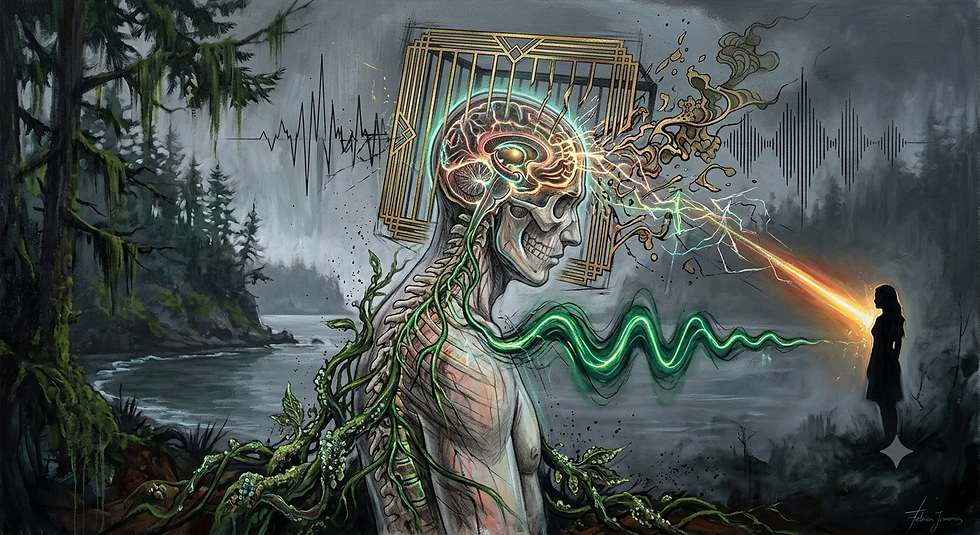
Burn Clean: Forging a Container for Your Limbic Fire
- One Love Energy
- Jun 12
- 8 min read
The Alchemy of Our Deepest Care
We spend so much of our lives at war with our own reactions. We judge our anger, bury our frustrations, and map our emotional landscapes with rigid borders between what is "good" and what is "toxic." But this standard emotional cartography is flawed. It denies a fundamental reality of the human nervous system: our most abrasive, overwhelming reactions are often distorted expressions of our deepest care.
To heal through limbic vision is to adopt a new lens. It is the practice of looking past the surface tumult to locate the underlying vulnerability, recognizing that our emotional lives are simply mapping our incompleteness. When we stop pathologizing our powerlessness, we can begin to transform it.
Here is the blueprint for mapping that transformation across the most vital domains of your life.
Love: The Origin Point of Vulnerability
Love is the baseline condition that makes anger possible. If anger is, at its core, the purest form of care, then love is the fragile territory that care is desperately trying to protect.
Love exposes our profound incompleteness and inextricably ties our wellbeing to the world and to others. It guarantees that we will feel powerless at times, because to love someone or something deeply is to realize you cannot entirely shield them from harm.
How to hold this reality:
Recognize the fierce pull: Love is not just passive affection; it is a gravitational force.
Embrace the "not knowing": Stop demanding certainty. Maturity requires holding your fears without lashing out at the unpredictability of life.
Honor the powerlessness: When you feel overwhelmed by your inability to control the world for those you love, recognize that this powerlessness is proof of your connection, not a personal failure.
The Acoustic Container: Finding Your Somatic Bandwidth
Often, what we call anger is simply our incoherent physical incapacity to hold our deep care in our outer daily lives. We literally lack the somatic bandwidth. Our nervous systems become overloaded by the raw voltage of our caring.
When the physical body is too overwhelmed to carry the current alone, we must find an external architecture to hold it. Music and the environment act as that missing physical container.
The immersive, evolving landscapes of electronic music do not just represent emotion; they construct a temporary sanctuary where powerlessness can safely resonate. The driving rhythms and expansive sonic environments act in concert with the biological symphony of natural light and our own circadian rhythms. Together, they give our nervous systems a larger "outer body," allowing the physical tension to process, ground, and dissipate.
Limbic Vision: The Creative Manifestation
To be a limbic visionary is to traffic in the exact "living flame" that lies at the core of true, productive anger. Creativity is your attempt to bridge the agonizing gap between your profound inner care and your outward reality.
Think of the raw-nerve outputs of your favorite visionary artists. Their work is the visualization of the friction between internal vision and a world that resists it.
The creative act as healing:
Incarnate the vision: Stop trying to perfectly translate your inner world. Allow the messy, visceral reality of your care to spill onto the canvas, the page, or the business plan.
Build the voice: Creativity is the continuous, mature effort to build an outer voice large enough, and generous enough, to hold what you love.
Channel the frustration: When you feel the profound frustration of failing to execute your vision, recognize it as the living flame of being fully alive. Tend to it, rather than extinguishing it.
Altered Phenomenology: Approaching the Raw Center
True healing requires us to close in on the nature of our hurts. We cannot bypass the wound; we must approach its raw center. Altered phenomenology serves as a powerful accelerator for this exact process.
By utilizing botanical tools and deliberate phenomenological shifts, we can temporarily dissolve the ego's defenses and the mind's rigid internal bureaucracy. These expanded states force a direct, unmitigated encounter with our emotional maps. They strip away the superficial narratives and facilitate a deeply felt, biological reality where the illusion of separation collapses. It is in this space that we can inhabit our past, present, and future simultaneously, observing our wounds without being consumed by them.
Redemption Through an Expanded Identity
Redemption is not the erasure of a mistake or the forgetting of a wound. It is the active, lived practice of a profound psychological synthesis.
Forgiveness does not come from the part of us that was wounded—that part is biologically designed to remember, to organize defenses, and to protect against future attacks.
Redemption requires a leap in maturity. It requires us to assume a larger identity.
To heal is to expand your psychological gravity so that you can embrace both the afflicted self and the source of the affliction. You are not erasing the past; you are refusing to be solely defined by it. By reimagining the wound as a necessary catalyst, you build a wider, more generous understanding of human frailty, arriving finally at a sense of true enoughness.
The work of translating these philosophical frameworks into your nervous system requires deliberate practice. You cannot merely intellectualize your way out of limbic overload; you must actively engage with the raw material of your own psyche.
To bridge the gap between abstract understanding and lived healing, here are three exercises designed to help you practically apply limbic vision. Each draws upon a different lineage of psychological and spiritual mastery.
Exercise 1: Carl Jung and the Anatomy of the Shadow
Carl Jung famously observed that "until you make the unconscious conscious, it will direct your life and you will call it fate." Your explosive anger, your sudden withdrawals, and your overwhelming frustrations are not random weather events; they are the desperate language of your Shadow—the unintegrated, exiled parts of your psyche that are fiercely guarding your most vulnerable wounds. To heal, you must invite the Shadow into the light.
The Practice: Visualizing the Hidden Fire
This exercise utilizes your capacity as a visual thinker to map the architecture of your emotional extremes.
Isolate the Charge: Think of a recent moment where your reaction was disproportionate to the event—a flash of rage, a wave of profound powerlessness, or an intense creative block.
Give It Form: Close your eyes and give this feeling a transpersonal, anatomical shape. Does it look like a jagged, metallic knot in your chest? A dark, sprawling root system in your gut? Do not intellectualize it; let the limbic system project its raw image.
Initiate the Dialogue: Instead of pushing the image away or judging its ugliness, observe it as a distinct entity. Ask it directly: "What are you so afraid of losing? What deep care are you attempting to protect?"
Record the Transmission: Write down the answer without editing. You will often find that the most monstrous-seeming parts of your psyche are simply exhausted sentinels trying to keep your tenderest self alive.
Exercise 2: Søren Kierkegaard and the "Play Hooky" Protocol
The Danish philosopher Søren Kierkegaard argued that anxiety (or angst) is not a dysfunction, but the "dizziness of freedom." It is the vertigo we feel when we realize the sheer magnitude of our own choices. Often, we bury this anxiety under the rigid bureaucracy of our daily routines, convincing ourselves that if we are just productive enough, we will be safe from the void. Breaking this cycle requires a deliberate disruption of your institutionalized habits.
The Practice: The Philosophical Leap
This is the practice of stepping out of the "crowd" to confront your own subjective truth. It requires you to intentionally break the rules of your routine to create space for philosophical exploration.
Schedule the Disruption: Pick a day—or even just a three-hour window—to explicitly "play hooky" from the demands of your schedule, your inbox, and your obligations.
Refuse the Numbing Agents: During this window, you are not allowed to distract yourself with entertainment, chores, or busywork. Go to a natural environment. Let your circadian rhythms synchronize with the unfiltered light.
Sit with the Vertigo: As the initial relief wears off, the angst of "unproductivity" will likely set in. Let the dizziness wash over you.
Kierkegaard believed that to evade this anxiety is to forfeit your own growth.
Take the Leap: Ask yourself what action you are currently avoiding out of fear. Use the clarity of this unstructured time to commit to one subjective, authentic choice that aligns with your deepest care, regardless of what the "crowd" demands.
Exercise 3: Rumi and Radical Hospitality
The 13th-century Sufi mystic Rumi offered a radical paradigm for emotional regulation in his poem The Guest House. He suggested that being human is a daily reality of unexpected arrivals—joy, depression, meanness, and profound sorrow—and that we must "welcome and entertain them all." From a limbic perspective, resistance creates friction, and friction creates suffering. Healing occurs when we stop barring the door and start offering hospitality to our incoherence.
The Practice: Hosting the Incoherent Guest
This exercise shifts your physiological state from defensive bracing to expansive acceptance.
Acknowledge the Arrival: When a difficult emotion surfaces—be it the frustration of a failed creative output or the grief of feeling misunderstood—pause immediately.
Open the Door: Instead of bracing your nervous system against the feeling, intentionally soften your physical body. Drop your shoulders, unclench your jaw, and take a deep, resonant breath. Silently say, "Welcome."
Offer It Space: Imagine you are setting a place at the table for this feeling. Treat it as an exhausted traveler that has journeyed a long way from the raw center of your being just to deliver a message.
Look for the Gift: Rumi wrote that every feeling is "sent as a guide from beyond." Once the emotion realizes it will not be fought or exiled, its intensity will naturally peak and begin to dissipate. As it leaves, ask yourself what it was trying to clear out, and what new space it has left behind for your maturity to grow into.
The Architecture of Your Internal Reformation
We have spent this chapter dismantling the archaic cartography of human emotion. You now know that the turbulence of your inner life is not a pathology to be cured, but a profound expression of your deepest care. Anger is not your enemy; it is the distorted, desperate language of love trying to protect its territory. The powerlessness you feel is not a failure of your character; it is the raw voltage of a limbic visionary who cares too much to settle for a numb, insulated existence.
You have the theoretical framework, and you now have the tools. You have practiced mapping the jagged architecture of your Shadow. You have stood at the edge of your own freedom and felt the necessary vertigo of an authentic choice. You have learned to stop barring the door against your own incoherence, choosing instead to offer radical hospitality to the guests that arrive at your threshold.
But philosophical frameworks and poetic metaphors will only take you so far. Insight without application is just another form of bureaucracy.
The Work Ahead
Your task now is not to suppress the limbic fire, but to build the internal infrastructure to support it. Think of this newly cultivated maturity as the glial cells of your psyche—the vital, silent astrocytes that nourish, insulate, and protect the explosive synaptic flashes of your creativity and care. You must deliberately construct the somatic bandwidth to hold your own multitudes.
To bridge the gap between who you are and who you are becoming, keep these core tenets at the forefront of your practice:
Honor the Biology of Healing: Never underestimate the biological symphony of light, movement, and environment. When the mind is trapped, use the physical and acoustic containers available to you. Let the driving rhythm of the music or the grounding force of Mother Nature carry the weight when your nervous system is overloaded.
Embrace the Altered View: Whether through the disciplined disruption of your routine or the intentional use of botanical tools, keep shaking the foundation of your default consciousness. You must continually collapse the illusion of your own separateness to touch the raw center of your humanity.
Choose the Larger Story: When you are wounded, refuse the temptation to shrink into the identity of the victim. Demand a larger gravitational field. Do the incredibly difficult, beautiful work of forgiving—not to excuse the harm, but to expand your own capacity for understanding.
This is the beginning of a profound internal reformation. It will be messy. It will require you to be more fluid, more elemental, and vastly more generous with your own perceived shortcomings. You will fail, you will lose your temper, and you will forget everything you have read here. When that happens, simply return to the raw center.
The world does not need more well-behaved, insulated sleepwalkers. It needs you to be exactly what you are: a limbic visionary, awake to the agonizing, beautiful reality of your own incompleteness, brave enough to let your deepest care burn brightly and cleanly into the world. Now, go build the container to hold it.