Defiant Harmonies: How Shared Sound Rewires the Isolated Brain
The Mathematics of Selfishness and the Meaning of the Choir
It is a fundamental truth of the human condition that between stimulus and response, there is a space. In that space lies our freedom and our power to choose our attitude.
Evolutionary biologists now observe this phenomenon in the laboratory, noting that the ability to look at an encounter, evaluate the other, and choose a tailored action—the "opponent-specific response"—is the biological bedrock of cooperation. Science sees a mechanism for survival. I see the dawn of human responsibility.
In the cold mathematics of game theory, the so-called Prisoner’s Dilemma dictates that the rational choice is always to betray your fellow man. To hoard the rations, to conserve your energy, to defect. Yet, even in the darkest and most punishing environments of human history, we have seen that the purely selfish man ultimately perishes from a lack of inner purpose. Those who walked through the barracks comforting others, who gave away their last piece of bread, proved that we are not wholly determined by our drives or our environment. Biology has finally proven mathematically what the human spirit has always known: we are not built for isolation; we are built for resonance.
Consider the phenomenon of music through this lens. To the strict biological determinist, making music is an absurd expenditure of vital energy. It burns calories, it distracts from the gathering of resources, and it requires vulnerability. But man is not driven merely by the will to survive; he is driven by the will to meaning.
When we sing together, when we align our rhythms in a shared physical space, we are engaging in the highest form of self-transcendence. We are stepping out of the prison of our isolated suffering and declaring to another human being, “I hear you. I will adjust the very vibration of my being to harmonize with yours.”
Music is the audible manifestation of our capacity to recognize the humanity in another and respond to it.
This is the ultimate antidote to the defector. In a musical ensemble, the selfish individual who plays only for his own glory, ignoring the tempo and trampling the melody of the group, is instantly recognized. He isolates himself by his very dissonance. The community does not need elaborate rules or violent enforcement to survive him; it simply adjusts its response, turning its attention and trust toward those who are willing to listen. The cooperative community endures because it is a profound act of altruism to silence one's own ego so that a collective beauty might emerge.
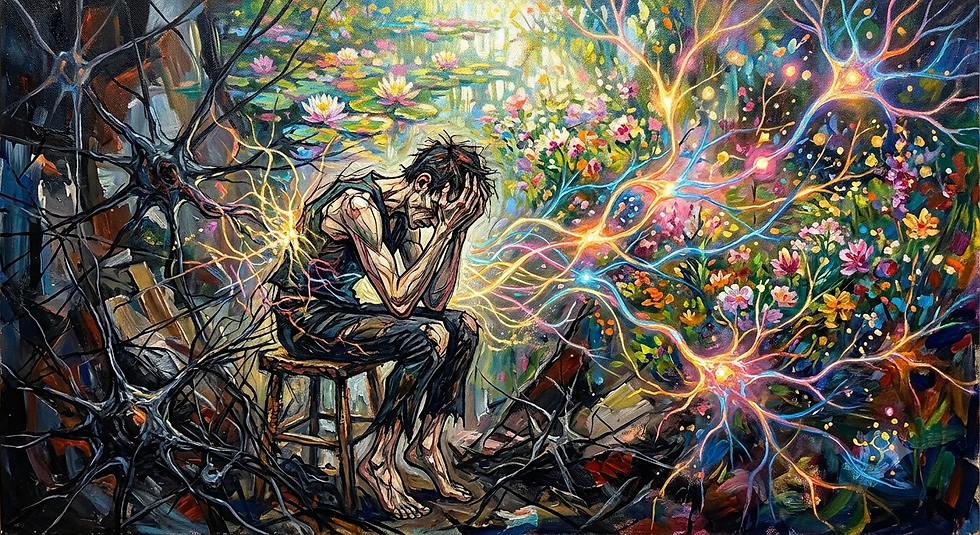
Ultimately, music is not merely an art form; it is a psychological survival strategy. It fosters healing because it reminds the despairing individual that they are not alone in the void. When we suffer deeply, we shrink inward. Trauma whispers that the world is a zero-sum game, that everyone is a defector, and that trust is a fool's errand.
But then, a rhythm begins. A voice calls out, and another answers in a complementary chord. The nervous system—attuned to the ancient, evolutionary truth that cooperation is life—begins to calm. We realize that the world is not solely populated by betrayers.
Evolution did not curse us with an inescapable selfishness. It gifted us the capacity to discriminate, to recognize the spark of the logos in the other, and to respond in kind.
Music is the undeniable, resounding proof that even in a world that often appears indifferent and cruel, we still possess the ultimate freedom: the freedom to choose harmony.
Modernity breeds a quiet agony: the weight of anonymity. We drift through superficial encounters, desperate for a tether.
Music provides that anchor. It is not merely acoustics; it is the architecture of identity.
When we align with a sound—whether a sprawling, collective improvisation or a stark, subterranean pulse—we wear an existential badge. We broadcast a shared frequency, signaling to others that we speak the same spiritual vocabulary.
This mutual recognition births the fandom. It is a spontaneous, cooperative network forged in shared devotion.
Within this sanctuary, traditional hierarchies collapse. A crowd swaying in unison is no longer a mass of strangers. It is a living neurobiological circuit.
We recognize fellow listeners as kin. The biological reflex to trust is triggered instantly. In the presence of our tribe, we finally drop our armor.
From this profound belonging, defiant beauty emerges. It is the beauty of collective effervescence.
Consider the rituals of a devoted subculture: the exchange of handmade art, the excavation of lore, the obsessive archiving of live recordings. These are not trivial hobbies. They are an economy of altruism.
By investing our creative energy into the music, we generate value. The masterpiece is not just the song; it is the intricate human web the song sustains.
Here, within this woven safety, true healing occurs.
Suffering lies. It tries to convince us our pain is entirely unique, demanding our total isolation.
But when we stand shoulder-to-shoulder, roaring a chorus that articulates our unspoken grief, that illusion shatters. Music provides the indestructible vessel for our collective vulnerability.
Whether we find catharsis in a driving, dissonant bassline or the soaring release of a harmonious chord, the neurochemical flood is the body’s reward for finding its people. We are not healed by erasing our pain, but by witnessing it carried by the collective.
To belong to a musical community is an act of ultimate defiance. It is a rebellion against the void.
Biology may drive us to survive, but shared resonance gives that survival its meaning. Fandom is living proof that we need not navigate the labyrinth alone.
By choosing our sound, we choose our people. And in that choice, we build a resilient sanctuary where the human cry for meaning is met, at last, by a roaring, harmonious crowd.