Entropic Elegance: Balancing the Triple-Network Tension Between Skeptic and Dreamer
- One Love Energy
- Mar 21
- 3 min read
Entropic Elegance: Balancing the Triple-Network Tension Between Skeptic and Dreamer
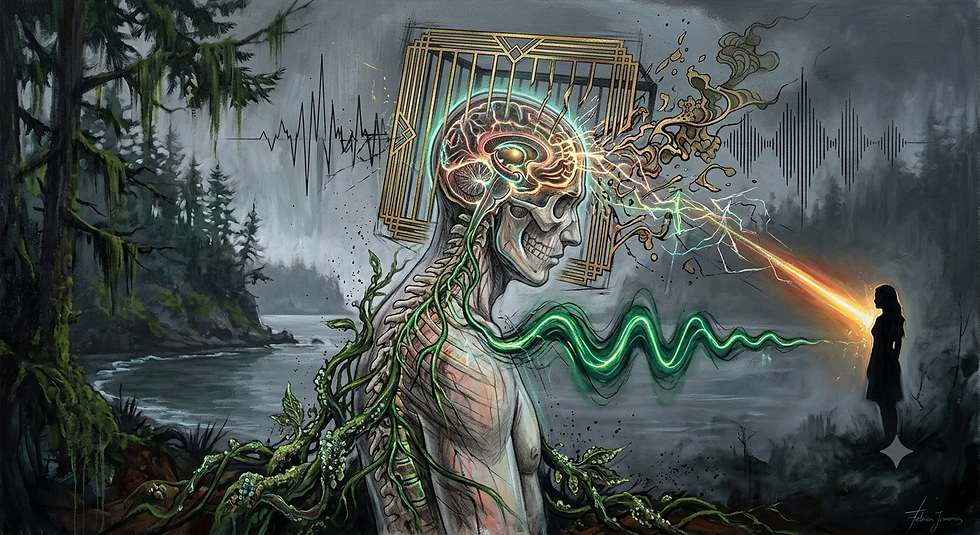
To understand the architecture of a breakthrough, we must first discard the myth that science is a cold, linear progression of facts. True discovery is a rebellious act—a chaotic collision between the disciplined mind and the wild, unmapped territories of imagination. At the center of this collision sits a neurobiological Triple Network that functions much like a jazz trio: a generative soloist, a skeptical editor, and a conductor who knows exactly when to let the music break the rules.
When we map this scientific thought-loop against the consciousness-altering mechanics of psilocybin, we find a striking symmetry. Both states—the flash of a novel hypothesis and the psychedelic "Aha!"—rely on the same fundamental reshuffling of our neural deck.
The Triple Network: A Brain in Three Acts
The modern neuroscience of creativity suggests that original thinking isn't a single "lightbulb" moment, but a high-stakes negotiation between three major brain systems:
The Generative Engine (Default Mode Network): This is the internal theater of memory and simulation. It’s where the brain plays hooky from the present moment to wander through "what-if" scenarios. In the context of a scientist, this network generates the raw material for a new theory.
The Analytical Sieve (Executive Control Network): This is the gatekeeper. Its job is to inhibit the obvious, the cliché, and the "boring" answers. It demands plausibility and rigor, ensuring that a "novel" idea isn't just new, but also functional.
The Sacred Clown (Salience Network): Functioning as the conductor, this network identifies which internal flashes of insight are actually relevant to the external problem. It is the "Sacred Clown" of the brain—the disruptor that notices the pattern no one else saw and forces the rest of the brain to pay attention.
Psilocybin: Greasing the Wheels of Discovery
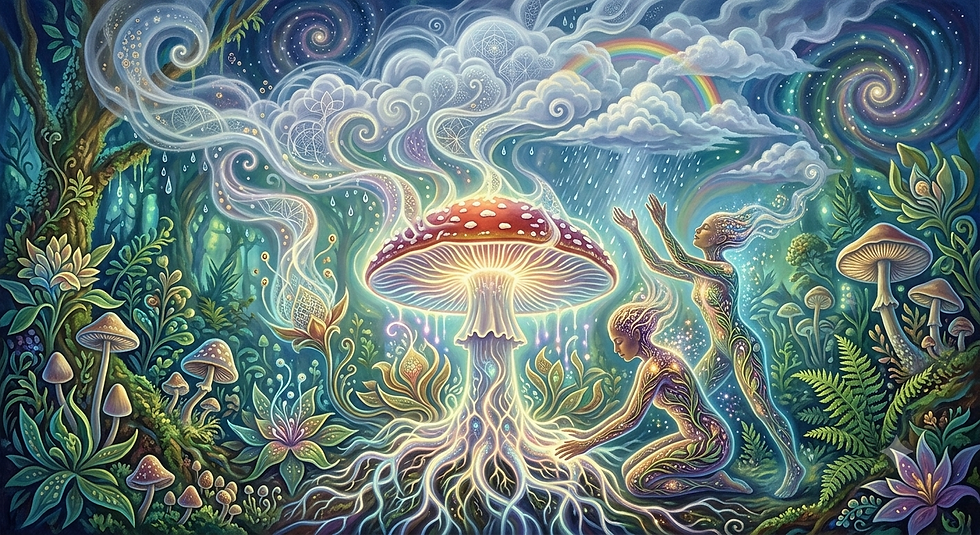
The synergy between scientific rigor and the psychedelic experience becomes clear when we look at how psilocybin interacts with these same networks. Psilocybin famously induces what researchers call "The Entropic Brain." By decreasing the rigid, within-network connectivity of the Default Mode Network, the molecule temporarily dissolves our habitual explanations of reality.
In this state, the "filter" of the thalamus is bypassed, and the global, between-network communication of the brain sky-rockets. For the scientist, this is like taking the analytical "sieve" and temporarily replacing it with a wider, more inclusive net. It allows for semantic control—the ability to search long-term memory for distant associations—to operate without the usual "noise" of pre-conceived notions.
The Bridge: Scientific creativity requires "Response Inhibition"—the ability to stop yourself from choosing the easiest explanation. Psilocybin facilitates this by making the "habitual" path through the brain physically harder to travel, forcing the mind to forge new, original connections.
The Synthesis of Rigor and Revelation
Ultimately, the "Scientific Psychonaut" is someone who has learned to master the tension between these states. Whether through the disciplined training of a STEM major or the chemical "unfiltering" of a mushroom, the goal remains the same: to foster increased cooperation between the dreamer and the skeptic.
By allowing the Default Mode Network to propose the impossible while the Executive Control Network refines the plausible, we arrive at the "original explanation." The "Sacred Clown" within the Salience Network then bridges the two, ensuring that the revelation isn't lost in the clouds but is instead grounded in a new, transformative understanding of the world.
Science is not just about finding the right answer; it is about having the courage to ask a question that breaks the existing mold. In that moment of "creative hypothesis," the scientist and the sacred clown are one and the same—daring to imagine a truth that the world hasn't yet learned to see.