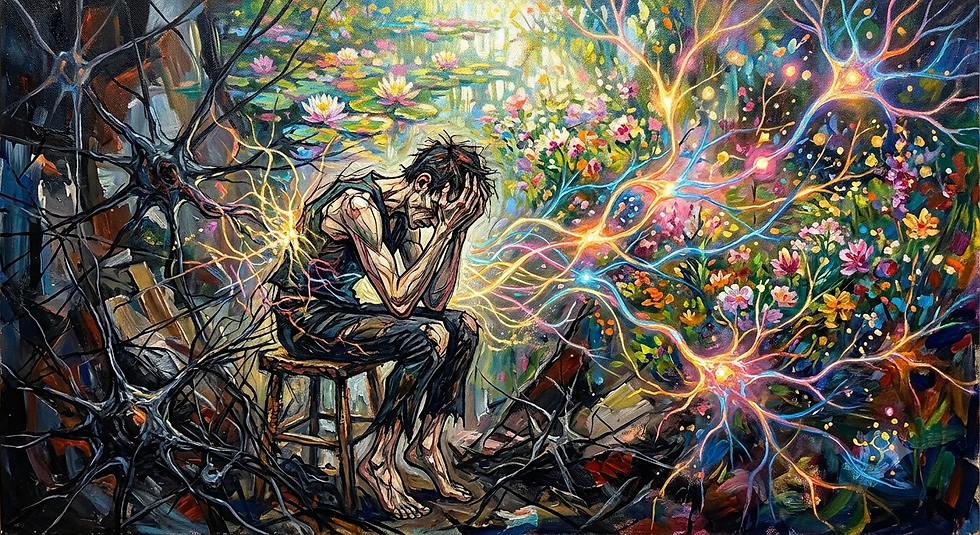
In Defense of the Messy Journey: Music, Molecules, and the Human Margin
The Syncopation of Intimacy: Love is the ultimate exercise in lived uncertainty. It cannot be automated or optimized. To love someone is to step into a space where you cannot predict the next token with absolute certainty. It requires us to doubt our own isolation, to risk failure, and to find harmony in the messy, unscripted choreography of two distinct minds navigating a shared space.
The Space Between the Notes: Music is not just a sequence of frequencies; it is a dialogue of tension and release. A perfect MIDI file played by a computer can be mathematically flawless, yet feel entirely dead. What makes music human is the slight micro-hesitations of the performer, the breath before the crescendo, and the intentional dissonance that demands resolution.
The Human Margin: Artificial intelligence excels at finding the shortest distance between two points because it operates under the assumption that a correct, static answer already exists.
But love isn't a problem to be solved. A musical composition is not an equation to be balanced. A psilocybin journey is not a shortcut to enlightenment, and a cannabis-fueled reverie is not a waste of processing power.
These experiences are valuable precisely because they are inefficient. They force us back into the radical, messy doubt of the lived journey. They remind us that we are not biological machines designed to output error-free answers—we are conscious entities meant to be beautifully, irrevocably changed by the struggle of the climb.
Music and Love: The Resonant Architecture of Friction
What is the point of a song or a romance? If the goal were simply efficiency, we would skip to the final chord of a symphony or the predictable end of a relationship. But we don't, because the value is entirely in the unfolding.
Cannabis and the Expansion of the "J-Space"
In cognitive science, the "J-space" represents that quiet, hidden workspace where concepts exist as pure potential before they are compressed into rigid, predictable language.
Slowing the Processing Speed: Cannabis acts as a gentle dilator of this internal workspace. It takes the straight, hyper-efficient line of analytical computation and bends it into a scenic route.
The Beauty of the Non-Sequitur: Under the influence of cannabis, the brain's predictive coding model relaxes. The "next token" of your thoughts becomes delightfully unpredictable. A conversation is no longer a transaction of information; it becomes a playground of free association, sensory appreciation, and cognitive tangents.
Embracing the Transition: By widening the gap between stimulus and response, cannabis allows us to inhabit the transition state. It reminds us that the half-formed idea, the lingering chord, or the unhurried glance is often far more interesting than the conclusion we were rushing toward.
Psilocybin and Radical Doubt (The Cognitive Demolition)
If cannabis gently widens the road, psilocybin completely dismantles the highway infrastructure. It is the molecular equivalent of Descartes’ radical doubt—a profound questioning of our sensory baseline and our very sense of self.
Quieting the Default Mode Network: Psilocybin temporarily dials down the brain's primary predictive engine (the Default Mode Network). The rigid, highly-trained "algorithm" of who you are—your biases, your defense mechanisms, your past conditioning—is suspended.
Lived Uncertainty: This is not a simulated calculation; it is a raw, lived encounter with the unknown. In this state, you cannot simply compute your way forward. You must feel your way through.
Rebirth through Friction: The therapeutic power of the psychedelic experience doesn't come from a clean, mathematically optimized revelation. It comes from the struggle—the surrender to vulnerability, the confrontation of shadow, and the awe of ego dissolution. We do not emerge with better data; we return as entirely different thinkers because we survived the transition.
What is the point of a song or a romance? If the goal were simply efficiency, we would skip to the final chord of a symphony or the predictable end of a relationship. But we don't, because the value is entirely in the unfolding.
When we look at the human relationship with music, love, psilocybin, and cannabis, we find ourselves looking at the ultimate champions of the detour.
These are not tools for finding the "most probable path" to a solution. Instead, they are deliberate disruptions of our internal algorithms. They are the avenues through which we actively choose to lose the trail, rewrite the code, and embrace the beautifully inefficient process of becoming.
Here is a creative map of how these four elements reconstruct our personal Descartes-inspired equation:
"I doubt, therefore I think, therefore I am." > —
Or, perhaps in this context: