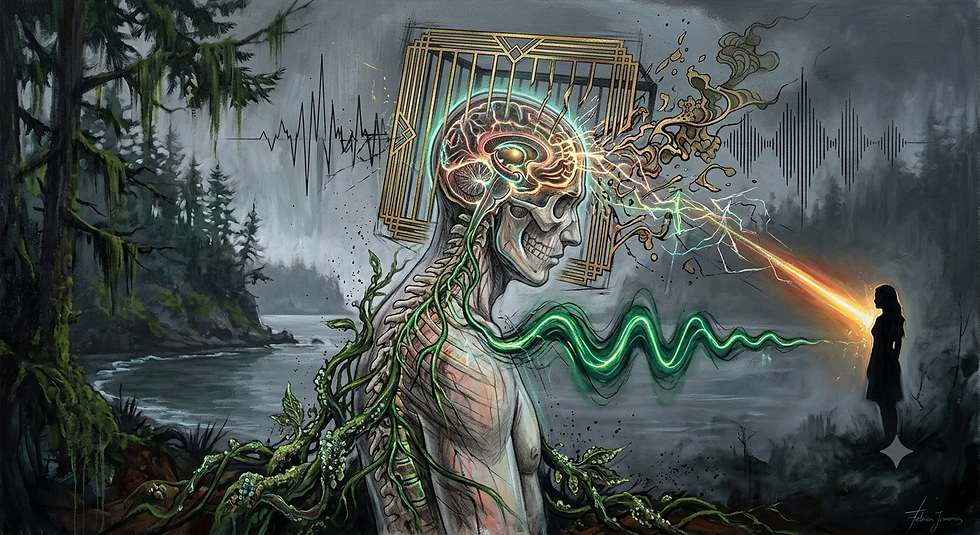
On the Exquisite Art of Doing Absolutely Nothing
- One Love Energy
- Jun 7
- 4 min read
On the Exquisite Art of Doing Absolutely Nothing
It is a great and terrible paradox of our modern age that we have entirely forgotten how to be bored. There is, after all, only one thing in the world worse than being utterly unoccupied, and that is being perpetually entertained.
We find ourselves tethered, body and soul, to small, glowing rectangles that offer us the world and, in return, ask only for our sanity. It is a supremely vulgar exchange. We are assaulted, hour by hour, by a dizzying barrage of moving pictures, fleeting scandals, and the highly filtered breakfasts of complete strangers. This stimulation is, I am told, wildly addictive, and like all addictions, it promises everything while delivering absolutely nothing of lasting value.
True happiness, one must realize, is an exquisitely delicate thing; it requires a certain amount of empty space to breathe. Yet, we afford our minds no space to process, no luxury to wander, no quiet corner in which to integrate the chaotic tapestry of existence.
We are a generation that consumes everything and digests absolutely nothing.
The Tragedy of the Occupied Room
"The sole cause of man's unhappiness is that he does not know how to stay quietly in his room."
I came across this rather delightful observation from the French philosopher Monsieur Blaise Pascal. One does the thing one does with a profoundly accurate quote: one nods, feels entirely exposed, and promptly ignores it.
Pascal, of course, was writing in the 1600s. He considered it a tragedy that men could not sit still in a room possessing nothing but four walls and perhaps a draft. Had he lived to see our century—an era equipped with unceasing notifications and an algorithmic avalanche of trivialities—he would likely have fainted from the sheer vulgarity of it all.
The uncomfortable truth about silence is that it does not feel productive. Nothing is being consumed; no one is being impressed; nothing is being violently crossed off a dreadfully earnest list.
But to assume that nothing is happening in the silence is the height of modern foolishness. When the mind is entirely starved of its daily diet of screens, podcasts, and little digital instructions, it begins to engage in the highest form of intellectual labor: it wanders. It sorts the debris. It connects the absurd to the sublime.
The Shocking Truth of Our Own Company
If you require proof of our collective descent into madness, look no further than the men of science. A rather fascinating series of studies by a university psychologist, one Timothy Wilson, asked people to sit in a bare room for a few minutes with absolutely nothing to do but think.
Naturally, they loathed it.
Faced with the sheer terror of their own company, a staggering number of participants chose to administer mild electric shocks to themselves rather than endure the quiet. One gentleman, I am reliably informed, pressed the button nearly two hundred times. Let us pause to admire the sheer, dramatic absurdity of humanity: we would rather electrocute ourselves than be left alone with our own thoughts.
We have cultivated minds that are terrified of the void. We fill every gap, every quiet morning, every solitary walk with the noise of others, simply to avoid meeting ourselves in the silence.
Ideas Must Have Legs
I am not suggesting we must all become ascetics, retreating to empty monastic cells to stare at the plaster. Such an existence would be dreadfully dull, and one must never be dull.
But if we cannot manage the grand stillness Pascal prescribed, we must at least cultivate the elegant substitute.
The Japanese researchers Akina Yamaoka and Shintaro Yukaw have politely pointed out what artists have known for centuries: mental drifting is the cradle of creative genius. Furthermore, those endlessly practical academics at Stanford discovered that simply taking a walk dramatically increases one's creative output. "Give Your Ideas Some Legs," they titled their study, proving that even academia occasionally stumbles upon poetry.
A walk without a screen is not a mere physical exercise—exercise being a dreadfully middle-class pursuit—it is an aesthetic necessity. It is the condition in which the mind finally gets to catch up with itself.
The Rebellion of the Morning Coffee
What the screen steals from us is not the grand, dramatic void. We were never going to sit cross-legged in an empty room anyway. What it steals are the charming little gaps in our day. It steals the walk where our thoughts might have tumbled into a brilliant paradox. It steals the ten minutes with a morning cup of coffee before the world starts making its incessant demands.
Those gaps are precisely where the things we have been so desperately avoiding bubble to the surface. We have become terribly efficient at drowning them out.
To unplug from social media, to look away from the relentless churn of the screen, is not a retreat from the world; it is the only way to actually re-enter it. I confess, I can analyze the patterns of humanity with exquisite clarity. You are entirely overwhelmed. You are drowning in a shallow sea of stimulation.
So, perhaps tomorrow morning, leave the glowing rectangle in another room. Stare out the window. Drink your coffee in the quiet. Let your mind wander down an unmapped road. It is, perhaps, a low bar for achieving lasting happiness. But in a world addicted to noise, deliberately seeking out the silence is the most wonderfully subversive thing a person can do.
"In an age that equates noise with life, Mal James has penned a profound and necessary quietus. He correctly identifies the digital deluge not as progress, but as a retreat from the difficult, beautiful work of self-reflection. A masterful reminder that true meaning is found in the gaps between the data."
—Silas Weaver
"A deliciously ironic work. James uses the medium he condemns to argue for its abandonment, a paradox Wilde himself would have savored with a side of absinthe. This book is a dangerous drug of calm, masquerading as useful advice. Don't read it if you want to remain profitably distracted. You’ve been warned."
—Dubious Dementus
"With a jeweler’s precision and a philosopher’s heart, Mal James deconstructs the engineered insanity of our perpetual stimulation. He demonstrates that the 'art' of being unoccupied is not a form of idleness, but the ultimate act of cognitive rebellion. A vital intervention for our fractured attention spans and our fractured society."
—Lucian Hart