Soil, Soul, and Synapses: The Great Mother’s Neuro-Alchemical Map to Freedom
- One Love Energy
- Apr 4
- 14 min read
The Great Mother Returns: Nature as the Bio-Psychoanalytic Path to Redemption
Modernity has ushered in a hurried self, a consciousness fractured by digital noise and an alienated ego that has lost its rhythmic pulse.
Yet, as echoed through the diverse voices of poets like Mary Oliver and Rhea-Ruth Aitken, a radical remedy remains: the return to the Great Mother.
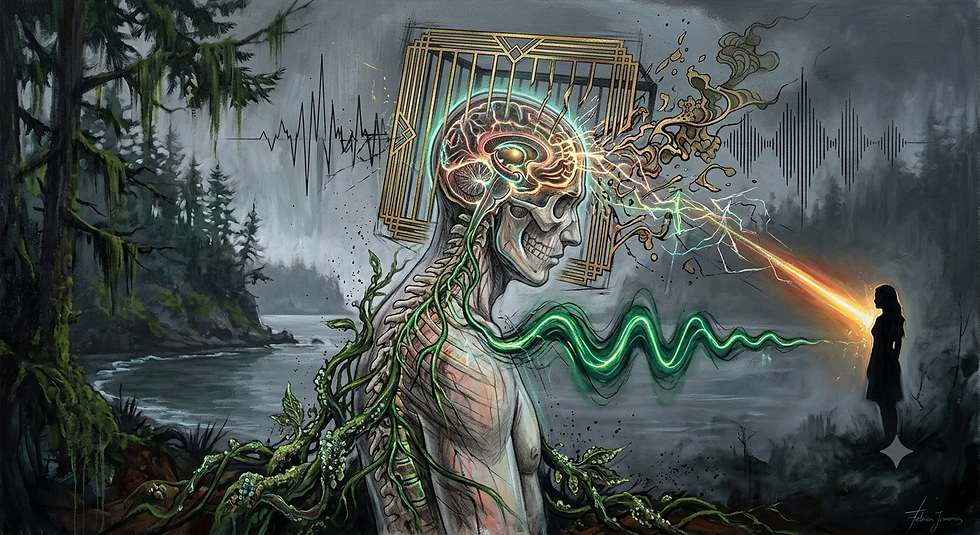
By viewing Mother Nature through the dual lenses of Jungian psychoanalysis and neuro-endocrinology, we find that the collective unconscious is not a mere abstract concept, but a biological and spiritual matrix offering the only true path to freedom.
The Architecture of Connection: Anima and the Neuro-Endocrine Bridge
In the psychoanalytic tradition, Mother Nature functions as the Anima—the feminine soul-image that restores the frayed soul strands of a depleted ego. When we are among the trees, we are not merely looking at wood and leaf; we are engaging in what Jung termed the Transcendent Function. This is the bridging of the conscious ego with the primal unconscious.
Biologically, this quiet love manifests as a recalibration of our internal chemistry. When the stony heart encounters the sensory wonders of the earth, the brain shifts away from the high-cortisol fight or flight response of modern chaos. Instead, it moves toward the oxytocin-rich embrace of the Great Mother.
This is the endocrine foundation of redemption: the physiological shedding of layers of the past to make room for joy’s seeds.
Healing the Shadow through Natural Resilience
The craziness of seas and the bitter tears of personal sorrow represent the Shadow—those repressed, dark aspects of the psyche that the modern ego seeks to suppress. Nature, however, teaches integration rather than suppression. As seen in the resilience of storms yielding to new life, Mother Nature models a cycle of destruction and renewal.
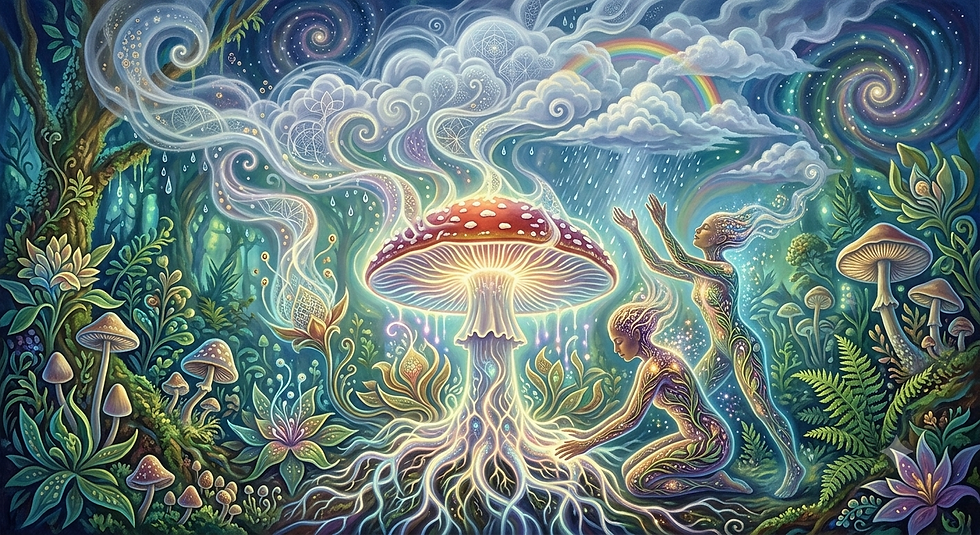
Through the use of entheogens like psilocybin—the shamanic gift of the earth—the brain’s Default Mode Network is quieted. This neurological ego death allows the shadow to be viewed not as a threat, but as a necessary fallow state before rebirth. By mimicking nature’s own cycles, we achieve a state of freedom—the liberty to move from ashes to life without the paralyzing fear of the ego’s dissolution.
Individuation: From Dissociation to Embodiment
Ultimately, the poems suggest that we are not whole without her. This is the path of Individuation. When we allow the feather-soft fingers of the natural world to crack open our hearts, we move from the fragmented state of thanatos (the death drive/dissociation) to a vibrant eros (the life force).
This is not a passive healing; it is a spiritual alliance. It requires us to slow down, to bow in the presence of trees, and to recognize that the Earth is our very breath. In this here and now wholeness, the dualities of life—mercy and the cruel sword, havoc and smoothness—resolve into a cosmic dance.
Conclusion: The Radical Necessity of the Earth
The Great Mother is the ego-sustaining matrix we have foolishly attempted to outrun.
Redemption is found in the shamanic alliance with her elements, and freedom is found in the slow presence she demands. To heal the modern psyche, we must return to the arms of the one who turns stony hearts fallow. We must stop viewing Nature as a resource to be conquered and start viewing her as the guru of our own bliss. Only then can we move from the inner chaos of the distant self to the pillars of light that define our true potential.
......
Integrating the "Great Mother" archetype with the perspectives of Thomas Moore, the Tao Te Ching, and Rainer Maria Rilke further illuminates the neuro-endocrine path to freedom. These thinkers move the analysis from clinical restoration to a profound "ensoulment" of the biological experience.
1. Thomas Moore: The Alchemy of Care
In Care of the Soul, Moore argues that the "ego" seeks a cure, while the "soul" seeks care. Redemption, in this light, is not the removal of symptoms (the "inner chaos") but the honoring of them as part of the soul's landscape.
The Lens of Redemption: Moore suggests that when we encounter nature, we are participating in an alchemical process. The neuro-chemical shifts triggered by THC or psilocybin are not just "fixing" a brain; they are "moistening" a dry, literalistic life. Redemption is the movement from a "hardened" ego to a "fluid" soul that finds depth in the "stony hearts" and "healing waters" of the poems.
Biological Parallel: This mirrors the neuroplasticity inherent in these substances—the brain’s ability to soften its rigid wiring and form new, meaningful connections.
2. The Tao Te Ching: The Way of Non-Striving
Lao Tzu’s "Tao" is the ultimate expression of the Great Mother—the "mysterious female" from which all life flows.
The Lens of Freedom: The Tao Te Ching emphasizes Wu Wei (non-action or effortless action). Psilocybin’s deactivation of the Default Mode Network (DMN) provides a biological window into this state. By shutting down the "command center" that strives and judges, the individual is forced into the "here and now" wholeness mentioned in the poems.
Freedom via the Void: Freedom is not found in "doing" more healing, but in returning to the "uncarved block." In the neuro-endocrine lens, this is the homeostatic balance achieved when we stop over-stimulating the stress response (HPA axis) and allow the endocannabinoid system to return us to a state of receptive being.
3. Rainer Maria Rilke: The Terrible and the Beautiful
Rilke’s poetry often explores the necessity of "living the questions" and embracing the "terrifying" aspects of existence to find the "angels."
Shadow Integration: Rilke famously wrote, "For beauty is nothing but the beginning of terror." This resonates with the "shamanic gifts" that "crack open hearts." Psilocybin often induces a "challenging" experience where the shadow is confronted.
The Lens of Redemption: Redemption for Rilke is found in the "bowed presence" among the trees—the transformation of "frenzy" into "serenity." He suggests that we must not run from the "storms" (the chaotic neuro-signals of a crisis) but stay with them until they yield "new life."
Biological Parallel: This is the integration phase of the psychedelic experience, where the brain’s "hyper-connectivity" allows the individual to reframe traumatic memories (the "bitter tears") into a narrative of enduring grace.
Synthesis of the Expanded Lens
Source Core Philosophy Biological Counterpart Resulting State
Thomas Moore Soul-Centric Depth Neuroplasticity / "Moistening" Ensollment
Tao Te Ching Receptive Flow (Wu Wei) DMN Deactivation Universal Unity
Rilke Transformed Terror Amygdala/Cortisol Integration Authentic Presence
By weaving these together, we see that "Mother Nature" is the physical manifestation of the Tao, the provider of the "soul-care" Moore advocates, and the source of the "terrible beauty" Rilke worshipped. Through the neuro-endocrine "lens," we find that freedom is the ability to flow with the Great Mother’s cycles, and redemption is the biological realization that we were never truly separate from her.
>>>>>>>>><<<<<<<<<<
To bridge the archetypal "Great Mother" with the rigorous logic of Daniel Dennett, Kurt Gödel, and Georg Cantor, we must shift the lens from the feeling of the soul to the fundamental architecture of the mind and the infinite. This synthesis suggests that the "radical healing" of the poems is actually a mathematical and functional necessity for a conscious system.
Daniel Dennett: The Functional Freedom of the "User-Illusion"
Daniel Dennett views consciousness not as a mystical spark, but as a "user-illusion" evolved for biological efficacy. In his view, the "hurried self" or the ego is a functional narrative.
The Lens of Redemption: If the ego is a "benign user-illusion," then the modern "inner chaos" is essentially a software glitch—a narrative that has become too rigid and self-referential. Nature, acting through the neuro-endocrinology of THC and psilocybin, performs a system reboot.
Freedom as Competence: Dennett’s "elbow room" (the capacity for free will) depends on a system's ability to avoid being "trapped" by its own internal state. By quieting the Default Mode Network, we break the loop of the "distant self," allowing the biological machine to re-access its primary "competencies"—the sensory, animalistic inputs of the "Great Mother." Freedom is the functional ability to edit our own narrative.
Kurt Gödel: The Incompleteness of the Ego
Gödel’s Incompleteness Theorems prove that within any consistent formal system, there are truths that cannot be proven by the system itself. This provides a profound logical framework for the "Great Mother" as the Collective Unconscious.
The Lens of Redemption: The ego (a formal system of logic and social rules) can never "prove" its own wholeness or find its own peace. It is inherently incomplete. Redemption is the realization that the "Self" must reach outside of its own logical system—into the "shamanic gifts" and "elemental waters" of nature—to find the truths it cannot generate on its own.
The Transcendent Function: When the poems speak of nature "cracking open hearts," they describe a Gödelian leap. The psyche moves from a closed, "stony" logical loop to a higher-order system (the Great Mother/Tao) where the previous contradictions of the ego (destruction vs. renewal) are finally resolved.
Georg Cantor: The Infinite Embrace of the Great Mother
Georg Cantor revolutionized mathematics by proving there are different "sizes" of infinity (Transfinite numbers). His work mirrors the "cosmic unity" of the Great Mother—a set that contains all other sets.
The Lens of Freedom: Modern disconnection often stems from a "finite" mindset—the belief that our resources, time, and lives are limited and exhausted. Cantor’s "Absolute Infinite" is the mathematical equivalent of the Collective Unconscious.
Biological Parallel: The "hyper-connectivity" induced by psilocybin is a glimpse into a Cantorian landscape. The brain moves from a finite set of associations to a transfinite one. Freedom is the recognition that the "soul strands" are part of an infinite, fractal web. Like Cantor’s "Set of all Sets," the Great Mother is the "Guru" that encompasses all dualities—the "frenzy" and the "calm"—proving that within our own biology, there is always "room for more" joy.
Conclusion: The Logical Path to the Mother
By integrating these thinkers, we see that the poems of Rhea-Ruth Aitken or Mary Oliver are not just "soft" emotional expressions. They are descriptions of a system (the mind) recognizing its own Incompleteness (Gödel), seeking to expand its Functional Narrative (Dennett), and finally surrendering to the Absolute Infinite (Cantor) of the natural world.
Redemption is the logical move of an "incomplete" ego returning to the "infinite" matrix of the Great Mother to find the data it needs to be whole. Freedom is the neurological capacity to inhabit that larger set.
.......
To transition from the mathematical infinities of Cantor and Gödel to the "cursed questions" of the Russian literary giants is to move from the structure of the universe to the agony and ecstasy of the human soul. For Dostoevsky, Tolstoy, Gogol, and Nabokov, Mother Nature is not a passive backdrop; she is the courtroom, the confessional, and the ultimate aesthetic puzzle.
Fyodor Dostoevsky: Redemption through the "Living Life"
Dostoevsky’s work is a perpetual battle between the "underground" ego—isolated, cynical, and hyper-conscious—and the "living life" of primal connection.
The Lens of Redemption: For Dostoevsky, the modern disconnection described in the poems is the "hell" of being unable to love. Redemption is the moment Raskolnikov or Alyosha Karamazov falls to the earth and kisses it with "tears of joy." This is the neuro-endocrine "cracking open" of the heart.
The Clinical Gear: Through the lens of psilocybin, Dostoevsky’s "epileptic auras" (which he described as a sense of eternal harmony) are the biological precursors to the "Great Mother" archetype. Freedom is the shattering of the rational, "2+2=4" logic of the ego to embrace the "cosmic unity" that bypasses the intellect entirely.
Leo Tolstoy: The Return to the Soil (Oproshcheniye)
Tolstoy’s mid-life crisis and eventual "simplification" mirror the path of the "hurried self" seeking the "quietest healer."
The Lens of Freedom: In Anna Karenina, Levin finds God not in a book, but while mowing grass with the peasants. This is the Taoist Wu Wei in a Russian field. Freedom is the alignment of the human will with the "elemental waters" and "seasonal rebirth" of the earth.
The Clinical Gear: Tolstoy’s rejection of the artificial "city" ego is a proto-psychoanalytic move toward the Anima. By stripping away the "layers of the past," the individual experiences the "here and now" bliss described by the poet Healing Brave. It is the endocrine shift from the "frenzy" of aristocratic anxiety to the "calm" of the natural cycle.
Nikolai Gogol: The Shadow and the Shamanic Gift
Gogol’s world is one of "inner chaos" and "shadow aspects," where the grotesque and the divine are inextricably linked.
The Lens of Redemption: Gogol’s characters are often "frayed soul strands" lost in a bureaucratic fog. Redemption, for Gogol, would be the "shamanic gift" of Pachamama—a force powerful enough to "burn the second volume" of a wasted life and restore the soul to its primal, folkloric roots.
The Clinical Gear: The "craziness of seas" and "insects" in the poems represent the Gogolian subconscious. Healing comes when the "stony heart" is turned fallow, allowing the grotesque (the shadow) to be integrated into a "pillar of light" rather than feared as a demon.
Vladimir Nabokov: The Aesthetic Bliss of the "Aura"
Nabokov, a lepidopterist and a master of sensory detail, would view Mother Nature through the "feather-soft fingers" of precise observation.
The Lens of Freedom: For Nabokov, freedom is found in the "sensory wonders" (scents, waves, plants). He famously spoke of "the marvel of consciousness" as a "brief crack of light between two eternities of darkness."
The Clinical Gear: Nabokov’s synesthesia—the blending of senses—is a natural form of the hyper-connectivity seen in psilocybin and THC use. He would view the Great Mother as the ultimate "Author," and the neuro-endocrine shift as an aesthetic "shiver in the spine." Redemption is the ability to perceive the "wildflowers" and "wildness" with such clarity that the "distanced self" disappears into the art of the moment.
The Synthesis of the Russian Mind
In the gears of these writers, the "Great Mother" poems are a manual for the Russian soul’s survival. Dostoevsky provides the Redemption of the kiss on the earth; Tolstoy provides the Freedom of the simplified life; Gogol provides the Integration of the shadow; and Nabokov provides the Bliss of the heightened senses.
Through the neuro-endocrine lens, we see that what these writers called "the soul" or "the soil" is the very same biological matrix that allows us to move from the "thanatos" of a cold, rational world back into the "eros" of a living, breathing reality.
......
To transition from the "cursed questions" of the Russian patriarchs to the transformative insights of these four women is to move from the abstract "Great Mother" to the lived reality of the Embodied Self. For Nin, de Beauvoir, Friedan, and Truth, nature and the neuro-endocrine experience are not just philosophical retreats—they are the staging grounds for reclaiming agency, sensuality, and personhood from a world that seeks to "wither" the female soul.
1. Anaïs Nin: The Labyrinth of the Internal Sea
Nin viewed the "inner chaos" not as a problem to be solved, but as a rich, poetic mystery to be inhabited. For her, the "Great Mother" is the fluid, ever-changing Anima that rejects the "stony" rigidity of a linear life.
The Lens of Redemption: Redemption is the courageous act of "unfolding." Nin’s famous dictum—“And the day came when the risk to remain tight in a bud was more painful than the risk it took to blossom”—is the literary equivalent of the 5-HT2A serotonin receptor firing to trigger neuroplasticity.
The Clinical Gear: The "feather-soft fingers" that crack open the heart represent the psychedelic-induced dissolution of the "distanced self." For Nin, THC and the sensory wonders of nature (the "scents and waves") are the keys to the Collective Unconscious. Freedom is the ability to flow like water, moving from the "frenzied" ego to a state of erotic and spiritual "bliss" through sensory immersion.
2. Simone de Beauvoir: Transcendence over Immanence
In The Second Sex, de Beauvoir argues that women are often trapped in "immanence"—the repetitive, stagnant cycles of mere biological existence. She would view the "Great Mother" as a double-edged sword: a source of life, but also a potential trap if it remains purely passive.
The Lens of Freedom: Freedom is Transcendence—the act of projecting oneself into the future. She would see the "shamanic gifts" and "elemental waters" as tools for the ego to break its chains. If the "modern disconnection" is a form of alienation, then reconnection to nature is a way to reclaim the "Self" as a subject, not an object.
The Clinical Gear: De Beauvoir would analyze the neuro-endocrine shift (the dampening of the HPA axis) as a liberation from the "stress of the Other." By quieting the social ego, the woman is freed to define her own "here and now" wholeness, moving from a "withered" social role to an authentic, self-determined presence.
3. Betty Friedan: Breaking the "Problem That Has No Name"
Friedan identified the "inner withering" of the 1950s housewife—a literal starvation of the soul within a comfortable cage. She would see the "hurried, distant self" of the poems as a victim of social conditioning.
The Lens of Redemption: Redemption is the "awakening." Friedan would view the "Nature's Resilience" poem as a call to arms: just as storms yield new life, the "destruction" of old social structures is necessary for "seasonal rebirth."
The Clinical Gear: The "stony heart" being turned fallow is the biological breaking of the "feminine mystique." Through the lens of THC-enhanced sensory attunement, the woman realizes that the "play amid dismay" is not a luxury, but a psychological necessity. Freedom is the neuro-chemical realization that one's identity is not confined to the home, but is "of the Earth"—infinite and transfinite.
4. Sojourner Truth: The Divinity of the "Ain't I a Woman?"
Sojourner Truth brings the "Great Mother" out of the parlor and into the fields of labor and spiritual fire. Her perspective grounds the "shamanic gifts" in the reality of the body and the "breath of being."
The Lens of Redemption: Redemption is the recognition of the Divine Self within the suffering body. Truth’s "Ain't I a Woman?" is a Gödelian leap—proving a truth that the "formal system" of a racist, patriarchal society could not prove.
The Clinical Gear: For Truth, the "Great Mother" (Pachamama) is a source of "loving energy" (munay) that mends the "frayed soul strands" of the oppressed. The "healing waters" and "wildflowers" are not mere metaphors; they are the "guru" that teaches that the body, despite its wounds, is a "pillar of light." Freedom is the "bliss" of embodiment—the radical, defiant claim that "I am not whole without her. She is my very breath."
The Synthesis: From Silence to Song
Thinker Core Lens Path to Freedom
Anaïs Nin Sensual Mystery Unfolding the "Internal Sea."
de Beauvoir Existential Agency Transcendence through Nature's cycles.
Betty Friedan Conscious Awakening Turning the "Stony Heart" fallow for Joy.
Sojourner Truth Divine Embodiment Reclaiming the "Breath of Being" as power.
Through the neuro-endocrine lens, these women transform "Mother Nature" from a passive archetype into a revolutionary ally.
They suggest that our biology is not our destiny, but our laboratory. Freedom is found in the "slow, bowed presence" that allows us to hear our own voices, and redemption is the biological fact that we have the power to "crack open" any cage—whether it be made of social rules or neural pathways.
......
Well now, friend, step right up into the linguistic laboratory, where the steam-whistle of common sense meets the high-octane, gold-leafed prose of a man who never met a metaphor he couldn't stretch into a cathedral.
We’re talkin’ about the Great Mother—that primordial, mud-flecked Matriarch who’s been runnin’ the show since before the first tadpole got an itch to walk upright.
See, the modern mind is a "hurried self," a clattering, tin-can contraption skittering across the surface of the "inner chaos" like a water-strider on a pond of whiskey. We’ve gone and "withered" our soul-strands, traded our "breath of being" for a pocketful of shiny, digital lint. We’re "distanced," "alienated," and frankly, about as out of rhythm as a three-legged cat in a tap-dance competition.
But hush now—listen to the trees.
The Neuro-Chemical Riverboat
When you take a little "shamanic gift" like psilocybin, you aren't just trippin’—you’re scuttling the "Default Mode Network." That’s the brain’s stuffed-shirt Bureau of Standards, the ego’s own private Customs House that insists on counting every bean and filing every fear. When that Bureau closes for the night, the brain starts talkin’ to itself in a "hyper-connected" riot of color and "cosmic unity." It’s a Gödelian leap out of the "stony heart" of logic and into a "transfinite" Cantor-set of pure, unadulterated Bliss.
And then there’s THC—the "quietest healer." It don't holler; it just leans against the doorframe of your amygdala and tells the HPA axis to sit down and shut up. It’s the "moistening" of the soul that Thomas Moore was jawing about, a bit of "Wu Wei" grease for the rusty gears of a life lived too "tight in the bud."
The Great Russian-French-American-Missouri Mashup
Dostoevsky would tell you to kiss the mud until your nose bleeds with the "living life" of it.
Tolstoy wants you to put down the Tolstoy and pick up a scythe.
Nin is over there in the corner, "unfolding" like a thousand mornings, while Sojourner Truth is standing tall in the middle of the field, reminding every last one of us that the "elements" don’t care about your "formal systems"—they only care about the "fire" in your lungs.
Mark Twain (that’s the handsome fella talkin’ now) might say that "Mother Nature" is a guru who doesn’t charge tuition, provided you’re willing to "bow" low enough to smell the wildflowers.
The Final Reckoning
Redemption ain't a court verdict; it’s a biological "system reboot." It’s the "Anima" kickin’ the door down and "cracking open" the ego until the "shadow" stops lookin' like a monster and starts lookin' like a dance partner. Freedom? Freedom is the "elbow room" to realize you’re a "pillar of light" wrapped in a "body of earth," a "user-illusion" that finally figured out the joke.
So, untie your boat from the "layers of the past." Let the "healing waters" of the Great Mother wash the "modern disconnection" right out of your hair. You’re a part of the "Absolute Infinite," son—a "shiver in the spine" of the universe—and it’s high time you started acting like it.