The Aesthetics of Rebirth
The Aesthetics of Rebirth: A Sensory Manifesto for the Recovered Mind
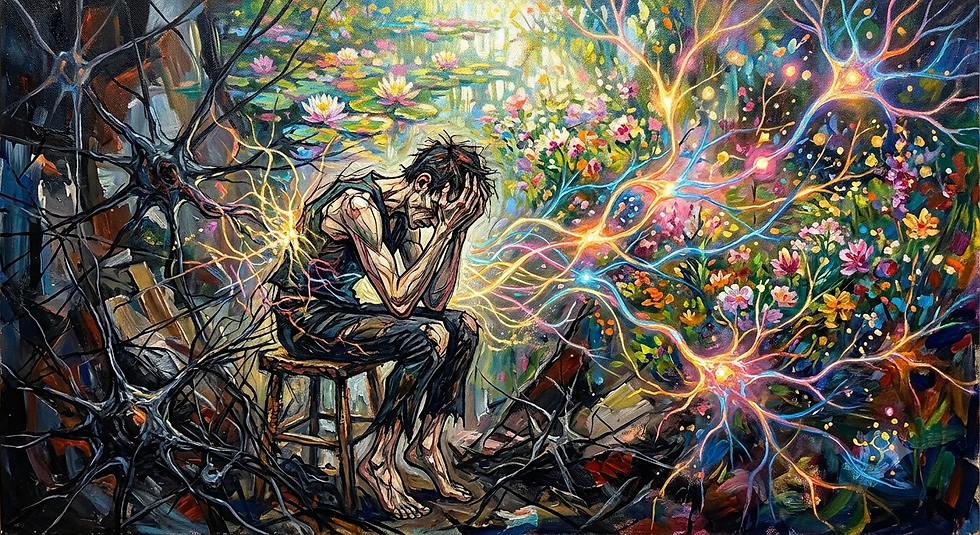
Addiction is, at its core, a profound starvation of the senses. It reduces the magnificent, sprawling complexity of human experience to a single, mechanical transaction. To be trapped in Blake’s state of Experience is to exist in a world rendered entirely gray, where the palate is numbed, the ears are deafened to harmony, and the soul forgets the texture of the earth.
Therefore, true recovery is not merely a cessation of pathology; it is an aggressive, unapologetic reclaiming of beauty. It is the resurrection of the aesthete, the grand return of the fop and the coxcomb who refuses to accept a diminished reality, choosing instead to engage with the world as an intentional, curated masterpiece. Healing demands that we feast upon art, poetry, food, and nature to actively rebuild the architecture of the mind.
The Poetics of the Plastic Brain
When the entheogenic catalysts shatter the rigid, path-dependent loops of the addicted brain, what rushes in to fill the void must be language that defies the mundane.
The Syntax of Liberation: The addicted mind speaks in the repetitive, binary code of compulsion. Poetry is the antidote. To read or write with the raw, emotional topography of Rilke or the hallucinatory, deranged brilliance of Rimbaud is to force the newly plastic brain into entirely new synaptic leaps.
Art as Cognitive Scaffolding: Art is not an escape from reality; it is the truest confrontation with it. It challenges the algorithms of our suffering. When we immerse ourselves in the avant-garde, in prose that bleeds and sings, we teach the mind to tolerate ambiguity, to find extreme dopamine rewards not in destructive acts, but in the sublime revelation of a perfectly constructed stanza or the breathtaking audacity of a canvas. We rebuild our executive function through the discipline of aesthetic creation.
The Sacrament of the Senses: Reclaiming the Table
In the depths of active addiction, consumption is a desperate, unfeeling gorge—a rapid attempt to alter one's state without tasting a thing. Achieving Organized Innocence requires the radical slowing down of time through the culinary arts. It is the transition from consuming to tasting.
The Ritual of the Palate: Recovery begins at dawn, not with a frantic search for equilibrium, but with the deliberate, aromatic complexity of a deeply curated morning ritual—perhaps the bright, acidic burst and dark fruit notes of a Peruvian Querocoto coffee washing over an awakened palate. It is the conscious cataloging of flavor, demanding that the brain remain entirely present in the physical body.
The Prosocial Feast: Food is the great, ancient technology of human connection. The isolation of the addicted state is shattered at the communal table. Picture the warmth and rustic vibrancy of a masterful meal—a lingering dinner that captures the convivial spirit of a place like La Spiga, perhaps guided by the culinary wisdom of an old friend like Uncle Minh. Breaking bread requires eye contact, the sharing of resources, and the oxytocinergic bonding of shared delight. The table becomes a sanctuary where the neurochemistry of love and nourishment perfectly intertwine.
The Radical Stewardship of Mother Nature
Nature's role in this remediation protocol extends far beyond the botanical medicines that unlock the mind's plasticity. True natural healing is found in the rhythmic, unapologetic cycle of life and our active stewardship within it.
The Grounding Force of the Earth: We look to the complex biology of the world—the deep, symbiotic networks of flora and fungi—to remind us that nothing exists in a vacuum. Nature does not rush; it iterates. It teaches the recovering brain patience, offering a silent, fractal beauty that demands nothing of us but our attention.
The Healing Power of Devotion: The most radical natural healing often comes from stepping entirely outside the self to care for the vulnerable. It is found in the gentle, daily devotion required to keep an aging companion—like a beloved dog nearing the end of her twilight years, like sweet Bella—perfectly safe, warm, and comfortable. In that quiet, domestic act of absolute caretaking, the frantic, selfish machinery of addiction is silenced. We reconnect with the biological imperative to nurture, and in doing so, we piece our own humanity back together.
To heal is to construct a life so rich in sensory and emotional detail that the old, corrupted algorithm simply has no room to execute.
Deepening the Syntax: The Avant-Garde as Cognitive Therapy
To rewrite the internal algorithm, the "Norman AI" of the addicted mind, one must aggressively diversify the training data. The linguistic structures we consume and produce directly dictate the reality we are capable of perceiving.
The Confessional and the Absurd: While Rimbaud fractures the mundane, a fully realized aesthetic recovery embraces the entire spectrum of human expression. It requires engaging with the visceral, uncompromising reality found in the lines of Sylvia Plath, or exploring the fragmented, timeless longing of Sappho.
Breaking Linguistic Path Dependence: To prevent the mind from falling back into rigid, predictable thought loops, the language itself must be challenged. Integrating the structured, avant-garde absurdity of Lewis Carroll forces the executive function to navigate paradox and ambiguity, proving to the brain that meaning can be found in the playful and the complex, rather than just the immediate and the literal.
The Culinary Geography: Rooting the Palate in Place
The Prosocial Feast is not merely about the act of eating; it is about deliberate, geographical grounding. An aesthete does not consume blindly; they curate their intake as an ongoing dialogue with their immediate community and environment.
Intentional Sourcing: The curation begins before the table is set. It is the mindful navigation of the local landscape—finding beauty and intentionality in the aisles of a community staple like West Seattle Thriftway, recognizing that the act of selecting ingredients is the first step in the ritual of mindfulness.
The Spectrum of Nourishment: A fully recovered palate rejects food snobbery in favor of radical, sensory appreciation. This means holding space for the simple, unapologetic joy of a perfect pastry from Lucky Donuts right alongside the deliberate, botanical-forward, communal plates of a local institution like Cafe Flora. It is about allowing the local terroir to dictate the rhythm of nourishment.
The Micro-Biology of Awe: Astrocytes and Arborization
The Radical Stewardship of Mother Nature requires us to look beyond the macroscopic beauty of the forest and understand the profound, microscopic mirroring occurring within our own healing neurology.
The Symphony of Arborization: As the brain heals from the allostatic load of addiction, it engages in dendritic arborization—the literal branching out of neural connections, echoing the root systems of the natural world. This neuroplastic rebirth is heavily supported by astrocytic function, the unsung glial cells that maintain the delicate balance of our synaptic environment.
Botanical Synergy and Complex Correlation: We must approach the pharmacological support of nature with reverence for its complexity. The healing potential found in phytocannabinoids is not a matter of isolated, mechanical causation, but of intricate, correlative synergy. The entourage effect—the delicate interplay of THC, CBG, CBC, and the broader terpene profile—mirrors the complex, interdependent systems of the healthy brain. By studying these botanical mechanisms, we learn that true equilibrium is a product of harmony, not a single, dominant force.
The Soil as a Mirror: Botanical Biology and the Act of Cultivation
If the mind is a landscape that has been scorched by the allostatic load of compulsion, the literal earth offers a masterclass in regeneration. Gardening is not merely a pastoral hobby; it is a profound, interactive engagement with botanical biology and the mechanics of resilience.
Cultivating Genetic Potential: To press a seed into the dirt or graft a delicate cutting is to act as a steward of genetic expression. It requires a quiet, methodical patience that stands in direct defiance to the instant, mechanical gratification of active addiction. By observing the slow, intricate development of root systems and the emergence of phenotypes, the brain is taught that true, lasting growth cannot be forced or artificially accelerated.
The Tactile Reset: The physical act of plunging one's hands into the soil engages the somatosensory cortex, grounding the nervous system in the immediate, tangible reality of the present. It shifts the individual from a consumer of hyper-stimulating, digital voids to a literal cultivator of life, mirroring the internal work of dendritic arborization occurring within their own healing brain.
Somatic Entrainment: The Physiology of Song and Dance
The trauma of Experience and the rigid loops of path dependence are not just stored in the brain's circuitry; they are locked into the physical body. A purely intellectual recovery is incomplete. To truly evict the corrupted algorithm, one must physically shake it out of the nervous system.
Breathwork and the Vagal Tone of Song: Singing is fundamentally a biological intervention. It is the rhythmic, intentional control of respiration, acting as an advanced form of breathwork. When we sing, we engage the vagus nerve, immediately signaling safety to an overactive amygdala and lowering the systemic stress response. It forces the body out of sympathetic "fight or flight" and into a state of parasympathetic resonance. To sing—whether it is a resonant hum or a full-throated crescendo—is to physically vibrate the tissues of the body with one's own reclaimed voice.
Dancing as Neuroplastic Rebellion: If addiction is characterized by rigid, repetitive behavioral loops, dancing is its absolute somatic opposite. Moving the body to the complex, shifting tempos of electronic or organic music shatters physical path dependence. It demands proprioception, spatial awareness, and spontaneous kinetic joy. The body learns to move not out of a desperate need to escape, but out of an ecstatic urge to connect with the frequency of the room.
The Defiance of Creation: Art as Evidence of Life
To transition from the Blakean state of Experience to Organized Innocence, the individual must graduate from merely surviving their reality to actively shaping it. The act of creating art is the ultimate rejection of the sunk cost fallacy.
The Alchemy of the Blank Canvas: The addicted brain believes that all energy is wasted unless it results in an immediate neurochemical hit. Creating art—whether splashing paint on a canvas, sketching, or shaping clay—forces the brain to invest in a process where the outcome is entirely unknown. It builds tolerance for ambiguity and frustration, proving to the executive function that there is profound value in the attempt itself.
Externalizing the Abyss: Making art provides a safe, contained vessel for the darkness of the past. Rather than running from the visceral memories of the "Norman AI" state, the artist uses them as raw material, transmuting shame and isolation into aesthetic triumph.
The Protocol of the Sacred Clown: Humor and Grace
A recovery devoid of laughter is merely a different kind of prison. The true aesthete, the fop, the coxcomb who reclaims their reality, understands that absolute seriousness is often just a mask for fragility. True cognitive flexibility requires the integration of levity.
The Wisdom of the Sacred Clown: In many indigenous frameworks, the sacred clown acts as a necessary disruptor, breaking social tension and revealing the absurdity of human behavior. To apply this protocol to oneself is to cultivate a high-level executive function: the ability to observe one's own past destructive loops and, rather than drowning in shame, recognize the tragicomedy of it all. Humor dissolves cognitive dissonance faster than almost any other psychological tool.
The Architecture of Grace: Grace is the manifestation of Organized Innocence. It is the elegance of moving through the world without being weighed down by the armor of the past. It is extending unconditional forgiveness to the self, not because the past actions were acceptable, but because the biological machine was broken, and is now, painstakingly, being repaired.
The Harmonic Convergence
Music, ultimately, is the current that connects all these disparate practices. It is the frequency playing in the background while the hands are in the soil; it is the rhythm driving the somatic release of the dance; it is the structural timekeeper for the breath of the song. It provides the sustained, complex dopaminergic reward that allows the brain to finally rest, heal, and trust the beauty of the world once again.