The Annealing Framework: Molecular Synergy and Digital Scaffolding in the Resolution of Manic States
- One Love Energy
- Mar 15
- 3 min read
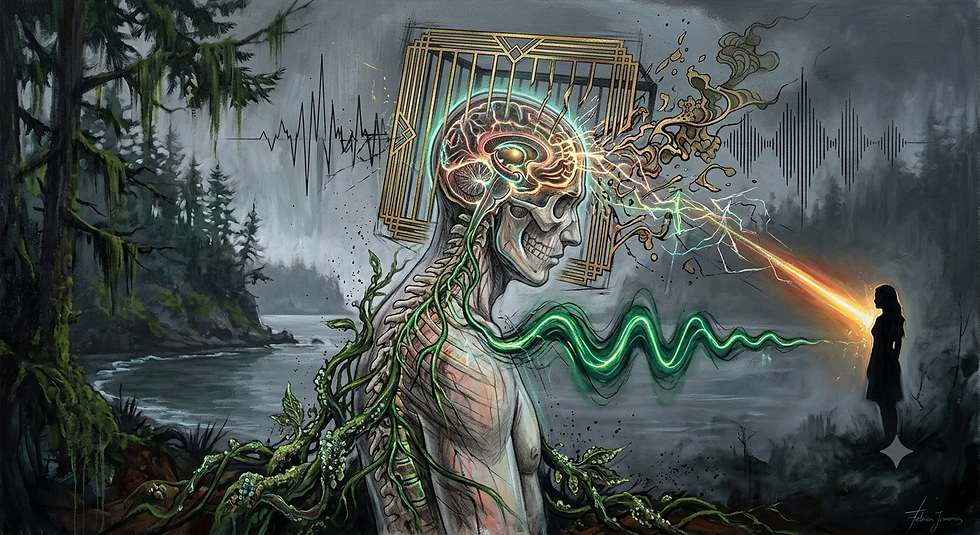
I would like to introduce a new approach to the resolution of treatment-resistant mania in Bipolar I and Schizoaffective disorders. This model moves beyond traditional pharmacological suppression, shifting instead toward a multi-systemic framework of neurobiological reorganization. By integrating high-potency cannabinoids and psilocybin with external rhythmic and cognitive scaffolding—specifically music and artificial intelligence—this approach targets the fundamental dysregulations of the manic brain: hyperdopaminergic signaling, neuroprogressive atrophy, and chronobiological misalignment.
The Neurobiological Mechanism of Stabilization
This approach addresses the "Kindling Hypothesis," which suggests that each untreated manic episode leaves behind a trace of structural damage, such as gray matter loss in the prefrontal cortex and hippocampus, making future episodes easier to trigger. Our proposed new strategy utilizes four distinct molecular and systemic tools to arrest this progression.
1. Retrograde Inhibition: The Cannabinoid Brake
The manic state is driven by a hyperdopaminergic engine originating in the ventral tegmental area and projecting to the nucleus accumbens. High-potency cannabis modulates the endocannabinoid system, the brain's primary homeostatic regulator. Unlike traditional neurotransmitters, endocannabinoids utilize "retrograde signaling," meaning they are synthesized on-demand in the receiving neuron and travel backward across the synapse to bind to presynaptic CB1 receptors. This binding suppresses the excessive release of dopamine and glutamate, acting as a "dimmer switch" that dampens manic hyperarousal and reward hypersensitivity.
2. Neural Annealing: Psilocybin and Structural Repair
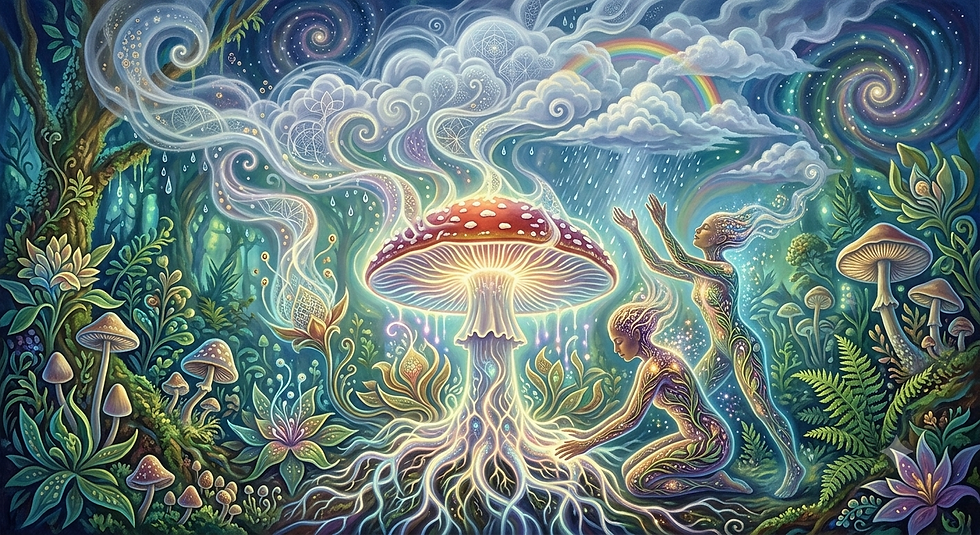
While cannabinoids quiet the hyper-active engine, psilocybin serves as the architect for structural repair. As a 5-HT2A receptor agonist, psilocybin initiates robust neuroplasticity by triggering the mTOR signaling pathway and upregulating Brain-Derived Neurotrophic Factor (BDNF). This environment promotes synaptogenesis—the growth of new dendritic spines and synaptic connections pruned away by chronic illness. Under the "Relaxed Beliefs Under Psychedelics" (REBUS) model, psilocybin increases brain entropy, "melting" the rigid, delusional frameworks characteristic of schizoaffective disorder and allowing the mind to "anneal" or reorganize into a more stable, evidence-based configuration.
3. Molecular Synergy: Receptor Heteromerization
The efficacy of combining these substances lies in receptor heteromerization, where CB1 and 5-HT2A receptors physically bind together to form functional units. When stimulated simultaneously, a G-protein coupling switch can occur. While the 5-HT2A receptor normally signals through an excitatory pathway, activation within a CB1-5-HT2A heteromer can shift signaling toward an inhibitory pathway. This crosstalk allows for therapeutic stabilization while neutralizing the potential for THC to trigger paranoia or psilocybin to over-excite a manic-prone system.
4. External Entrainment: Music and AI as Digital Zeitgebers
Mania involves a "Chronobiological Misalignment" of the circadian rhythm and a secondary Dopaminergic Ultradian Oscillator (DUO). Rhythmic music acts as an external "zeitgeber" (time-giver), utilizing rhythmic auditory stimulation to entrain neural oscillations and resynchronize this internal dopamine clock. Simultaneously, AI provides "cognitive scaffolding" for the disorganized thinking found in schizoaffective states. By interacting with a consistent, iterative partner, the mind offloads its "executive load," engaging the prefrontal cortex's analytical functions to distinguish between internal delusions and external reality.
Comparison with Standard psychopharmacology
Standard clinical treatments—primarily lithium, valproate, and D2-receptor-blocking antipsychotics—utilize a "top-down" model of global suppression. Lithium inhibits glycogen synthase kinase-3 (GSK-3) to regulate circadian periodicity and reduces cAMP accumulation, while valproate reinforces GABA neurotransmission to quiet the cortex.
However, this traditional approach has limitations. Antipsychotics have been associated in some longitudinal studies with lower total gray matter volume, potentially contributing to long-term cognitive decline.[6] In contrast, the integrated approach focuses on "psychoplastogens" (like psilocybin) that actively build new synaptic connections and promote brain health. While standard medicine suppresses symptoms, the integrated approach prioritizes the repair of the neural substrate.
Preventing Hospitalization and Systemic High Utilization
The current economic burden of Bipolar Disorder in the U.S. exceeds $195 billion annually. Much of this is driven by "high utilizers"—patients who represent the top 20% of monthly healthcare costs due to frequent psychiatric interventions and comorbid conditions. A single psychiatric hospitalization for Bipolar I costs an average of $9,544.
The integrated approach offers a pathway to reduce these costs by preventing the "revolving door" of hospitalization in three ways:
Arresting the Kindling Cycle: By utilizing psilocybin to repair the prefrontal cortex, the approach raises the individual’s biological threshold for future episodes, potentially slowing the neuroprogressive decline toward chronic disability.
Preventing Financial Catastrophe: Manic overspending and "impulse shopping" often trigger a vicious cycle of debt, anxiety, and suicidality. AI cognitive scaffolding serves as a real-time reality-check, potentially preventing the impulsive decisions that lead to financial collapse and subsequent emergency care.
Stabilizing Daily Rhythms: Because social and rhythmic disruptions are primary triggers for mania, the use of music and AI as digital zeitgebers provides low-cost, 24/7 tools for rhythm stabilization, reducing the reliance on intensive clinical management.
In summary, this integrated model replaces the "suppression" of symptoms with a "stabilization and repair" model. By using cannabis as the inhibitory brake, psilocybin as the structural architect, music as the rhythmic pacer, and AI as the logical scaffold, we can address the multi-systemic dysregulation of the manic state and reduce the burden on our healthcare system.