The Anthropology of Psilocybin: Evolutionary Catalysts, Ritual Systems, and the Global Renaissance
- One Love Energy
- Feb 19
- 12 min read
The relationship between the genus Psilocybe and the hominin lineage represents one of the most complex interspecies intersections in evolutionary biology and cultural anthropology. This association, spanning millions of years, transcends simple dietary chance, suggesting a profound co-evolutionary trajectory that has influenced human cognition, social structures, and spiritual cosmologies.
Psilocybin, a prodrug that the human body metabolizes into the psychoactive compound psilocin, acts primarily on the serotonin 5-HT2A receptors, triggering a cascade of neuroplastic changes and altered states of consciousness. To understand the anthropology of psilocybin is to explore the transition from the Pliocene forest floor to the sophisticated ritual hierarchies of Mesoamerica, and ultimately to the contemporary clinical "renaissance" that seeks to medicalize ancient sacraments.
This report examines the multi-layered history of these fungi, weaving together evolutionary theory, archaeological evidence, ethnographic accounts of indigenous resilience, and the modern ethical challenges of medicalization.
Evolutionary Foundations and the Neurobiological Scaffolding of Consciousness
The hypothesis that psilocybin-containing mushrooms played a role in the evolution of the human mind is no longer relegated solely to the periphery of psychedelic culture. While early theories such as the "Stoned Ape Hypothesis" proposed by Terence McKenna in 1992 were criticized for being overly speculative and lacking a mechanism for genetic inheritance, modern revisions provide a more nuanced framework grounded in neurobiology and niche-construction theory. The core of this evolutionary perspective lies in the interaction between psilocybin and the 5-HT2A receptor, a site characterized by its role in mediating neural plasticity and an "active coping strategy".
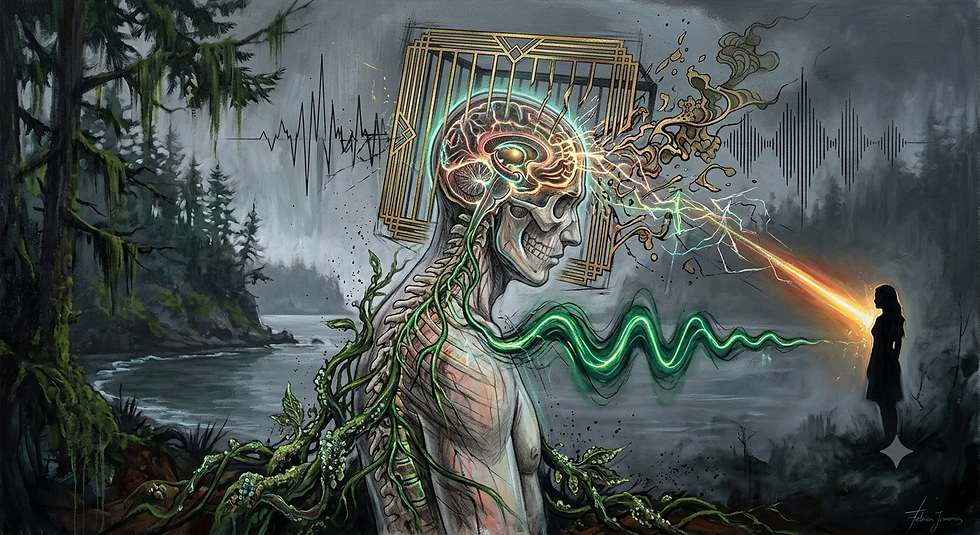
Hominin ancestors likely encountered psilocybin-containing fungi as early as the Pliocene (approximately 5.3 million years ago) as they intensified their exploitation of forest floor foods and followed the migrations of ungulates, whose dung provides a primary substrate for many Psilocybe species. This incidental ingestion may have provided selective advantages in a rapidly changing environmental landscape. By stimulating cortical plasticity and inducing synaptogenesis, psilocybin acts as a "psychoplastogen," potentially favoring the selection of the exaggerated neural plasticity that defines the human brain.
Neurochemical Mechanisms and Cognitive Flexibility
The metabolic conversion of psilocybin into psilocin via alkaline phosphatase in the bloodstream allows the compound to cross the blood-brain barrier and bind to serotonin receptors. This binding alters normal patterns of neural activity, particularly within the Default Mode Network (DMN), which is associated with self-referential thought and the maintenance of a stable ego. The initial step in the psilocybin biosynthesis pathway involves the enzyme PsiD, which catalyzes the conversion of tryptophan to tryptamine by removing the carboxyl group, a critical modification that sets the stage for the psychoactive potency of the molecule.
The increase in cortical entropy and environmental sensitivity caused by psilocybin may have facilitated a "flexible and associative mode of cognition". This flexibility is theorized to have aided hominins in overcoming the rigid predictive models of reality that can become maladaptive during environmental shifts. The "New Stoned Ape Theory" suggests that while these changes may not be directly heritable in a Lamarckian sense, the worldview shifts and prosocial behaviors they fostered could have "gone viral" within a community, creating a cultural "ratcheting" effect that altered the selective environment. Critics, however, maintain that such cognitive shifts are difficult to reconcile with the modern synthesis of evolution, noting that acquired traits are not passed down through DNA, although proponents point to the Baldwin effect and epigenetic modifications as potential workarounds.
The Socio-Cognitive Niche and Prosociality
A significant anthropological insight involves the role of psilocybin in reinforcing the "socio-cognitive niche"—a lifeway based on cooperative communication, social learning, and interdependent social bonds. The prosocial effects of the compound, including enhanced empathy, suggestibility, and emotional processing, may have mediated the expansion of social bonding mechanisms such as laughter, music, and collective ritual. This "instrumentalization" of psychedelics allowed early humans to manage psychological distress, facilitate group decision-making, and resolve interpersonal conflicts, thereby increasing the overall fitness of the group.
The transition from Homo erectus to Homo sapiens, often termed the "Great Leap Forward" occurring between 100,000 and 40,000 years ago, involved the sudden appearance of complex tools and symbolic art. Some scholars argue that psilocybin acted as an "evolutionary catalyst" for this leap, promoting "transcendent awareness" and a nuanced approach to environmental synergy. While mainstream biology often views these claims as speculative, the cross-cultural near-universality of psychedelic ritual suggests a deep evolutionary heritage that depends on higher levels of consciousness for survival.
Prehistoric Iconography and the Origins of Mycolatry
Archaeological records provide glimpses into the ancient veneration of mushrooms, a practice often referred to as "mycolatry." While the interpretation of rock art remains a subject of intense scholarly debate, several key sites across the globe suggest that the ritual use of fungi is a prehistoric phenomenon of significant antiquity, potentially dating back to the Neolithic period and beyond.
Tassili n'Ajjer: The Saharan Canvas and Shamanic Paradoxes
The Tassili n'Ajjer plateau in Algeria, a UNESCO World Heritage site covering 72,000 square kilometers, contains some of the world's most famous prehistoric cave art, dating back to approximately 10,000 BCE. Among the 15,000 engravings and paintings are the controversial "mushroom figures." The most notable of these is the anthropomorphic figure often called the "bee-faced mushroom shaman," first documented by Henri Lhote in the 1950s and later popularized by Terence McKenna in his 1992 work Food of the Gods.
The figure is depicted with elaborate headgear and body paint, common indicators of a ritualistic role, with what appear to be mushrooms of the Psilocybe genus sprouting from its limbs and head. Researchers like Giorgio Samorini and Gastón Guzmán suggest the paintings resemble species such as P. mairei or P. natalensis. However, modern scholarship cautions that the popular "mushroom shaman" image is actually a later artistic interpretation by Kat Harrison, who never saw the original art and filled in damaged areas based on her own perceptions. Alternative interpretations by ethnographers and archaeologists suggest the figures could represent sheep-men, arrowheads, oars, or flowers.
The transition from hunter-gatherer societies to pastoralism depicted in Tassili art is particularly relevant to the ethnomycological narrative. McKenna hypothesized that the domestication of cattle led to an inevitable relationship with coprophilic (dung-loving) mushrooms, influencing the growing complexity of religious beliefs as pastoralist groups encountered these fungi in their herds' waste.
Selva Pascuala: The European Connection and Ecological Synergy
In Europe, the Selva Pascuala mural in Cuenca, Spain, provides what some researchers claim is the first direct evidence of ritual Psilocybe use on the continent, dating to roughly 6000 BCE. The mural features a striking association between a bull and 13 vertically oriented fungoid pictographs. These figures possess sinuous stipes and subconical caps, closely matching the morphology of Psilocybe hispanica, a neurotropic species that grows in the region on bovine manure.
The identification remains tentative, as skeptics like Andy Letcher point out that the figures could be culturally agreed symbols for non-psychoactive mushrooms or abstract "doodles". Nevertheless, the "mythic link" between the bull and the mushroom suggested by the mural is significant, as it mirrors patterns found in later Mediterranean religious traditions. The presence of both Levantine naturalism and Schematic abstraction in the same shelter suggests a culture undergoing a long-term process of change, where the mushrooms may have served as agents of cognitive or social transformation.
Mesoamerican Sacred Systems: The Flesh of the Gods
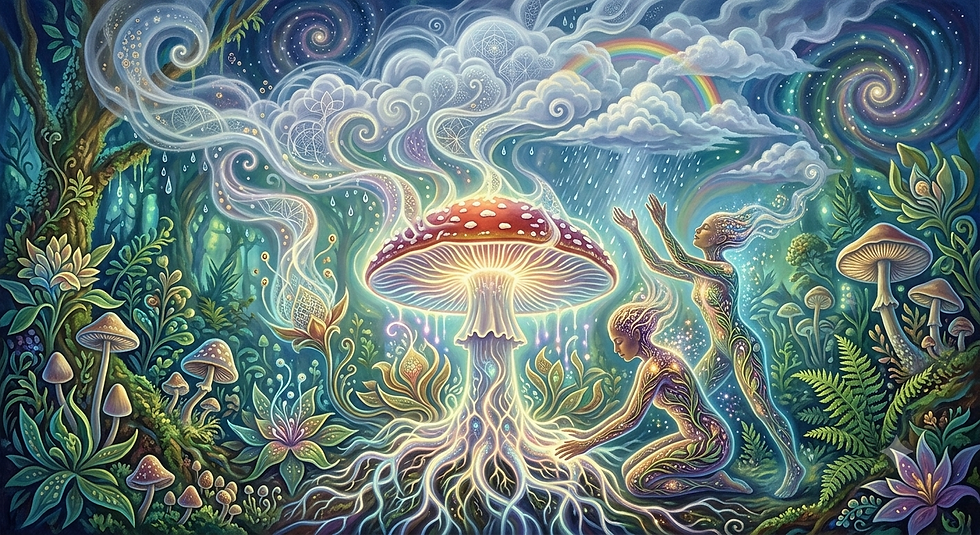
Nowhere is the anthropology of psilocybin more vivid or better documented than in Mesoamerica. Civilizations such as the Maya, Mixtec, and Aztec integrated sacred mushrooms into the very fabric of their religious, political, and medical systems. The Aztec term teonanácatl, translated as "flesh of the gods" or "astonishing gift of the gods," reflects the supreme status of these fungi as entheogens—substances that "generate the god within".
Maya Mushroom Stones and the "Mushroom Code"
Archaeological excavations in the Maya ruins of Kaminaljuyu in Guatemala and sites across El Salvador and Mexico have uncovered hundreds of "mushroom stones". These artifacts, dating as early as 1000 BC, often feature a mushroom cap emerging from a base adorned with human or animal effigies—frequently jaguars, toads, or birds. Anthropologist Dr. Stephan F. de Borhegyi proposed the "Mushroom Code," suggesting these stones were icons used in a sophisticated mushroom cult.
The presence of miniature grinding stones (metates) and hand stones (manos) near these sculptures suggests they were used to crush mushrooms into a liquid beverage for ceremonial consumption. Borhegyi further associated the number nine—found in caches of nine miniature stones—with the "nine lords of the night" in Maya mythology. The Maya believed these rituals were tied to warfare, the Mesoamerican ballgame, and a "trophy head cult," where the mushrooms provided the spiritual fortitude required for sacrifice and state-sanctioned violence.
The Aztec State: Ritual Hierarchy and Xochipilli
For the Aztecs (Mexica), the use of mushrooms was deeply institutionalized and stratified. Historical records, including the Florentine Codex and the Magliabechiano Codex, describe how mushrooms were consumed during the coronation of Moctezuma II and other high-state festivals. The mushrooms were often eaten with honey or chocolate after a period of fasting, and the ensuing ceremonies involved dancing, weeping, and the sharing of visions.
The statue of Xochipilli, the "Prince of Flowers," discovered on the slopes of the Popocatépetl volcano, serves as a primary artifact of this tradition. The deity is depicted in a state of "ecstatic mushroom trance," his body covered in glyphs representing Psilocybe caps and other psychoactive plants. This iconography reinforces the belief that the mushrooms were not just tools for individual escape but were the source of artistic, poetic, and spiritual inspiration for the elite "pipiltin" (nobility) and the "tlamatinime" (philosophers).
Colonial Suppression and the Hidden Centuries
The arrival of Spanish colonizers and the subsequent imposition of the Catholic Church initiated a centuries-long period of brutal suppression. The Spanish Inquisition viewed the indigenous veneration of mushrooms as a diabolical practice, a form of "witchcraft" or "idolatry" that threatened the Christian order and the exclusivity of the Eucharist.
The Destruction of Knowledge and the Trial of Mixcóatl
In the mid-16th century, Spanish clergy, including friars such as Diego Durán and Bernardino de Sahagún, documented the use of teonanácatl even as they sought to eradicate it. Sahagún's Historia General de las Cosas de la Nueva España describes the "intoxicating" mushrooms that caused "strange visions," noting that the Indians ate them with honey to "see the future". However, the systematic burning of indigenous codices—extensive records of history, medicine, and spirituality—effectively erased much of the written context for these practices
Last known Inquisition reference before the tradition went fully "silent". The Inquisition was remarkably successful in its erasure. For nearly 400 years, the Western world believed the reports of teonanácatl were myths or that the term actually referred to peyote, which contains mescaline rather than psilocybin. The suppression was so complete that by the early 20th century, some scholars doubted the mushrooms had ever existed as a ritual focus.
Indigenous Resilience and the Highland Diaspora
Despite the persecution, the use of sacred mushrooms survived in the remote mountain regions of Oaxaca among the Mazatec, Mixtec, Chinantec, and Zapotec peoples. These communities were forced into a state of "clandestine continuity," adapting their rituals to include Catholic terminology while maintaining the core indigenous cosmology. The mushrooms became known as "Niños Santos" (Holy Children) or "Ndi Xijtho" among the Mazatecs, a term reflecting their personification as diminutive, powerful spiritual guides.
The Ethnographic Revival: Maria Sabina and the 20th Century
The re-emergence of psilocybin into the Western consciousness was facilitated by the work of ethnobotanist Richard Evans Schultes and amateur mycologist R. Gordon Wasson. This period marked the transition from "hidden indigenous tradition" to "global psychedelic phenomenon," a shift that brought both scientific enlightenment and cultural destruction to the Mazatec highlands.
Rediscovery and the Life Magazine Catalyst
In 1938, Richard Evans Schultes and physician Blas Pablo Reko traveled to Huautla de Jiménez and collected the first voucher specimens, identifying the mushrooms as members of the Paneolus and Psilocybe genera. However, it was R. Gordon Wasson's 1955 visit that truly opened the floodgates. Guided by the curandera Maria Sabina, Wasson became the first known Westerner to participate in a velada and document the experience for the general public.
Wasson's 1957 article in Life magazine, "Seeking the Magic Mushroom," introduced the world to the "mushrooms that cause strange visions". This publication had a devastating impact on the Mazatec community. The ensuing "hippie trail" of tourists and celebrities (including John Lennon and Bob Dylan) seeking "trips" disrupted the sacred nature of the ceremonies. Maria Sabina was eventually harassed by the police and ostracized by her community, who blamed her for the monetization and desacralization of their most sacred medicine.
Diverse Indigenous Practices: A Comparative View
Ethnographic research has since revealed that indigenous mushroom practices are not monolithic. Different groups maintain distinct conceptualizations of the fungi and their role in social health.
Linked to ancient codices and cosmogenic creation myths. Among the Chinantecs, the mushrooms are described as "matter-of-fact" and secular compared to the highly religious Mazatec ceremonies. The "children" seen in visions are believed to reinforce societal norms by offering moral injunctions to live harmoniously. These variations underscore a central anthropological truth: while the molecule remains the same, the meaning of the experience is entirely constructed by the cultural "set and setting".
The Modern Renaissance: Clinical Efficacy and Neurobiology
The current "psychedelic renaissance" represents a shift from the ethnographic and counter-cultural interests of the mid-20th century toward a rigorous biomedical framework. Psilocybin is now being studied as a breakthrough treatment for mental health conditions that have proven resistant to standard pharmacology.
Therapeutic Applications and Data Clusters
Contemporary clinical trials have demonstrated that psilocybin-assisted psychotherapy (PAP) can produce significant and enduring reductions in symptoms of depression, anxiety, and PTSD. Unlike traditional antidepressants, which require daily dosing and have high nonresponse rates, psilocybin often produce benefits after just a single session of 25 mg.
The efficacy of psilocybin is often correlated with the intensity of the "mystical experience" reported by the participant, assessed via scales measuring sense of unity, sacredness, and transcendence of time and space. Research suggests that these subjective effects are necessary for the long-term restructuring of neural circuits, serving as "narrative inflection points" that allow individuals to change their identification with maladaptive patterns of thought.
Neuroplasticity and the Default Mode Network
At the neurological level, psilocybin promotes "synaptogenesis" and increased expression of brain-derived neurotrophic factor (BDNF). The compound disrupts the Default Mode Network (DMN), a group of brain regions that are overactive in individuals with depression. This disruption leads to an "entropy-rich" brain state where distant networks communicate more freely, providing the "neural flexibility" required for a more sophisticated perspective to replace older, rigid cognitive models.
The Political Anthropology of the Pacific Northwest
The legal status of psilocybin is undergoing a rapid transformation, particularly in the Pacific Northwest of the United States. This region has become a "pivotal moment" for drug policy reform, reflecting a shift in public sentiment toward therapeutic potential and equitable justice.
Washington State: The Regulatory Balance
In Washington, psilocybin is currently a Schedule I substance, but several cities, including Seattle and Olympia, have passed resolutions to make its enforcement the lowest law enforcement priority. The state legislature has introduced bills such as SB 5921, which targets a "medical pathway" for treatment-resistant conditions, and 2SSB 5263, which focuses on broader access and regulatory frameworks.
The Washington "Social Opportunity Program" is a notable attempt to remedy the targeted enforcement of drug laws on overburdened communities, ensuring that the new psilocybin industry does not replicate the exclusionary patterns of the past. However, the path to legalization faces challenges from law enforcement concerns and the need to reconcile state laws with federal prohibitions under the Controlled Substances Act.
Oregon and the Fall of Measure 110
Oregon's Measure 109 legalized supervised therapeutic use, while Measure 110 decriminalized personal possession. However, the rise of the fentanyl epidemic in the region has led to a "sense of desperation" and a partial retreat from complete decriminalization, illustrating the "dynamic period" in Pacific Northwest drug and crime policy. This instability highlights the difficulty of integrating ancient medicines into a modern legal system that is simultaneously grappling with a synthetic opioid crisis.
Ethics, Biopiracy, and the Future of Human Niche Construction
As psilocybin transitions from indigenous sacrament to a projected $10 billion pharmaceutical industry, the anthropological conversation has shifted toward "colonial extractivism" and biopiracy. The indigenous communities that stewarded these medicines for millennia are often excluded from the profits and patents generated by North American and European businesses.
The Disparity of Reciprocity
Western facilitators can earn over $10,000 per service event, while indigenous practitioners in their communities of origin may earn as little as $2 to $150. Furthermore, companies like COMPASS Pathways have achieved billion-dollar valuations based on the "breakthrough therapy" designation, yet there are currently no formal plans for reciprocity with groups like the Mazatec. Indigenous nations have raised concerns that the patenting of traditional knowledge will impede their free exercise of religion and lead to the destruction of habitats through unauthorized bioprospecting.
Future Adaptations and the "Ultrasocial" Brain
Looking forward, Michael Winkelman suggests that psychedelics may play a role in the future evolution of humanity by enhancing our adaptations for more harmonious futures. Through the process of "neural reuse" and the stimulation of the 5-HT2A active stress response, psilocybin instrumentalization could facilitate human self-transformations through:
* Augmentation: Enhancing cognitive and social communication skills.
* Symiosis: Fostering deeper connections with the environment and cross-cultural integration.
* Transcendence: Overcoming the "social differences" and barriers created by modern cultural niches.
This long-term view posits that the "socio-cognitive niche" was not just a historical stage in our evolution but is an ongoing process of construction. If psilocybin provided the initial sparks for language, religion, and social bonding, its re-integration into modern society may represent a "metamodern" shift toward a global, systems-thinking awareness that aligns human interests while preserving cultural diversity.
Conclusion: A Synthesis of Evolution and Sacred Tradition
The anthropology of psilocybin reveals a compound that is inseparable from the trajectory of the human species. From the Pliocene forest floor to the high-state rituals of the Aztecs and the clinical cleanrooms of the 21st century, these fungi have served as "instruments of enhancement" for cognition, sociality, and spiritual resilience. The survival of these traditions through centuries of Inquisition and colonial suppression is a testament to the profound value placed on the "inner world" revealed by the "Holy Children."
As the Western world moves toward the medicalization and decriminalization of psilocybin, the primary anthropological challenge remains one of ethics and equity. The "renaissance" cannot be complete if it remains a story of extraction. Instead, the future of psilocybin research and use must be oriented toward a model of reciprocity that respects the indigenous roots of this knowledge.
By integrating the neurobiological insights of the modern age with the ritual wisdom of the past, humanity may once again utilize this ancient catalyst to navigate the complexities of our ever-changing socio-cognitive niche. The trajectory from the Tassili "mushroom shaman" to the modern clinical researcher suggests a continuous, deeply human quest for transcendence and connection—a quest that has been facilitated by the "flesh of the gods" for millions of years.