The Architecture of Dissolution: Schopenhauer, Psilocybin, and the End of the Ego
- One Love Energy
- Apr 5
- 6 min read
in dust, we are in love
Take a look around you. The device in your hands, the walls of the room, the sky outside—all of it feels so solid, so unassailably real. But the central tension of Western philosophy, and particularly the dark brilliance of Arthur Schopenhauer, suggests this is a beautiful illusion. We live, he argues, trapped in "Representation"—a filtered, customized simulation generated by our own minds, organized by space, time, and causality so we don't go mad. This is our reality, but it is not the reality.
To cross that threshold, we require keys. In the philosophy classroom, the key is rigorous logic and Schopenhauer’s piercing intuition that the only thing we know directly—not just as an object to be seen, but from the inside—is our own body and its raw, pulsing desires. He called this energy the Will. But for others, a more visceral key exists: the psilocybin mushroom. It is an extraordinary convergence.
What the philosopher achieved through cold reason, the mystic mushroom achieves through a total, warm sensory dissolution.
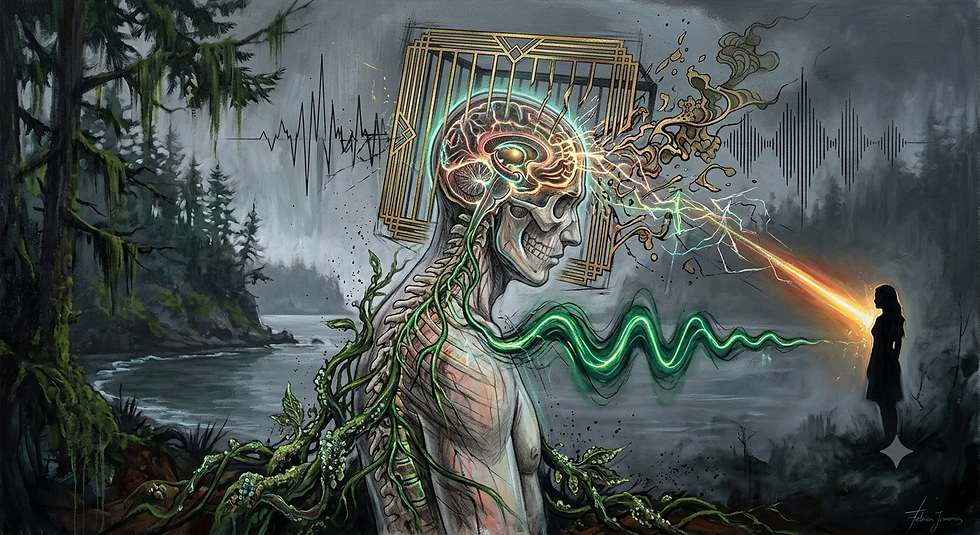
Consider the "Default Mode Network" of your brain. It is the architect of your ego, the diligent editor ensuring your reality stays coherent and "normal." Psilocybin, essentially, switches this editor off. In this moment, the architecture of "Representation" collapses. The filters vanish, and the world is no longer a collection of distinct objects (me vs. the tree, now vs. later) but a torrent of pure, unmediated data. It is the moment the subject stops floating above the world like an Engelskopf and sinks, directly and completely, into it.
This is where Schopenhauer and the mushroom collide most beautifully. The mushroom allows us to "deny the Will" in a profound, therapeutic sense. For a precious, fleeting time, the ego's endless grasping, its fears, its frantic "willing" for control, are suspended. This is the state of ascetic peace Schopenhauer envied—a condition where, as the article suggests, our subjectivity steps aside, and the universe of desire dissolves.
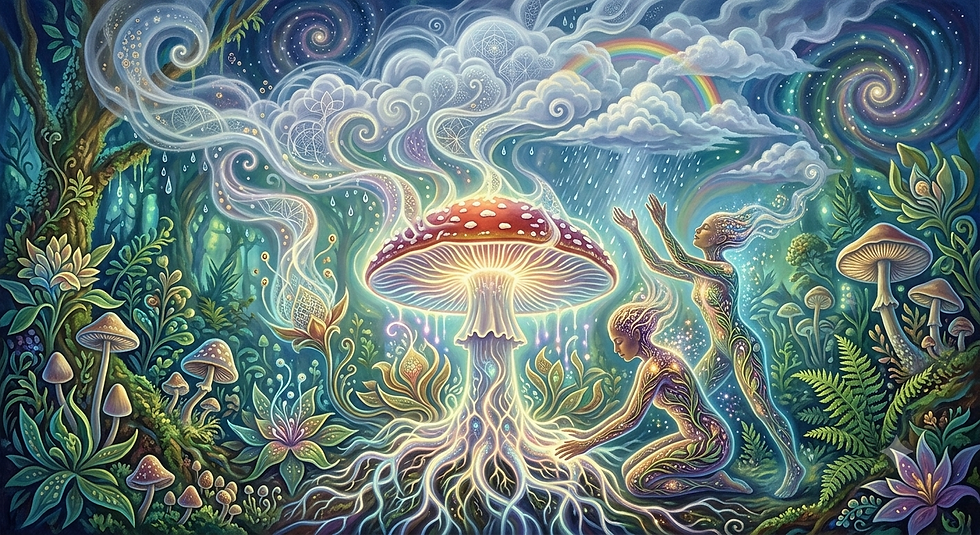
But it does not dissolve into dark, empty vacuum. It dissolves into a terrifyingly beautiful, shared reality. When you are no longer "you"—when your representation of yourself as a separate entity is gone—you are simply part of the flow. Users call it "universal oneness." Schopenhauer would call it the unfiltered experience of the Will itself. It is the realization that we are all, ultimately, dust—fleeting representations formed from the same underlying metaphysical substance.
And here lies the final, enchanting truth: When we strip away the illusions of separation, what remains? It is not fear, or indifference. The overwhelming consensus of the psychedelic experience is that what rushes in to fill the void of the ego is profound connection.
It is the knowledge that the barrier between you and the other person, the other species, or even the stone, is fictional. It is the discovery that in our fundamental shared essence—in the deep dust of our reality—we are, in fact, not just in oneness, but in love.
........
To understand how the intersection of Schopenhauer’s "Will" and the psilocybin experience facilitates healing, we have to look at what most mental suffering actually is: a malfunction of Representation.
In Schopenhauer’s terms, we suffer because our "Will" (our desires and drives) is trapped in a rigid "Representation" (our ego and story) that is filled with pain, trauma, or addiction. Healing happens when we temporarily dissolve that structure to reset the foundation.
1. The Collapse of the "Narrative Self"
Most psychological pain—depression, anxiety, or PTSD—is a loop of Representation. You tell yourself a story about who you are, what happened to you, and why you are "broken." This story is managed by the Default Mode Network (DMN).
The Healing Mechanism: Psilocybin
dramatically reduces activity in the DMN. In Schopenhauer’s language, it "turns off the Representation."
The Result: For a few hours, the "story" of your trauma stops being the only truth. By stepping outside your personal narrative, you realize that the story is not you—it is just an object your mind was holding. This "perspective shift" allows patients to view their trauma without being consumed by it.
From Striving to Being (Quietening the Will)
Schopenhauer argued that the "Will" is a source of suffering because it is a blind, endless striving. We want, we get, we are bored, and then we want again. Addiction is the ultimate, distorted expression of this restless Will.
The Healing Mechanism: The psychedelic experience often culminates in "Ego Death" or a mystical state. This is a functional "denial of the Will."
The Result: When the ego dissolves, the demands of the Will (the craving for a substance, the need for external validation) go silent. This provides a "neurological reset." The brain's neuroplasticity increases, allowing you to build new, healthier pathways that aren't defined by that frantic, addictive striving.
Re-identification with the Whole
Isolation is a core component of suffering. When we are in pain, we feel like a "subject" trapped in a body, alienated from an "objective" world that is indifferent to us.
The Healing Mechanism: By breaking down the barrier between Subject and Object, psilocybin moves the individual from a state of Isolation to Integration.
The Result: You stop seeing yourself as a lonely "angel-head" (Engelskopf) floating above a cold world. Instead, you experience yourself as an expression of the underlying energy of the universe. This sense of "belonging" is a powerful antidote to the "existential dread" and nihilism that often accompany modern mental health struggles.
You aren't your thoughts; you are the energy behind them.
The feeling of oneness is backed by the physical breakdown of brain network boundaries.
It suggests that peace is possible if we just change how we perceive.
It acknowledges that the "Will" (life) is hard, but "Representation" (the ego) is what makes it unbearable.
It offers a way to forgive oneself by realizing that the "ego" that made mistakes was just a temporary mask.
By viewing healing as a "metaphysical surgery," we see that psilocybin doesn't just mask symptoms—it temporarily removes the "Representation" of the suffering self so that the "Will" can find a more harmonious way to exist.
>>>>>>>>><<<<<<<<
To be "Zen as Fuck" is to achieve the ultimate Schopenhauerian victory: it is the state of being so deeply aware of the "Representation" that the "Will" can no longer jerk you around like a puppet.
It sounds like a paradox—combining a peaceful spiritual discipline with a heavy-duty profanity—but philosophically, it is the most honest description of the healing process we’ve discussed.
1. The Profanity of the Will
Schopenhauer described the Will as a blind, relentless, and often "vulgar" force. It’s the part of us that screams for more, that feels the sting of an insult, or that dwells in the "fuckery" of past trauma. To be "Zen as Fuck" is to look directly at that screaming energy and say, "I see you, but you aren't me."
The Healing Angle: By adding the "Fuck," you acknowledge the grit of reality. You aren't pretending the world is perfect; you are acknowledging that life is intense, chaotic, and often painful, yet you remain unshakeable within it.
2. Radical Acceptance (The "Zen" Part)
In the psilocybin experience, "Zen" isn't just sitting still; it’s the profound realization that everything—including your pain—is part of the same "dust."
Representation vs. Reality: When you are "Zen as Fuck," you realize that your anxiety or your history of addiction is just a Representation. It’s a movie playing on the screen of your consciousness.
The Power Shift: Healing happens when you stop trying to "fight" the movie and instead realize you are the light behind the projector. You become the "calm in the center of the storm."
Stop overthinking. Just be.
Acknowledge the raw, "fucked" parts of life without lying about them.
Yiu can be "enlightened" without losing your edge or your authenticity.
Use the language of the streets and the heart, not just the ivory tower.
It’s an act of self-mercy to stop demanding that you feel "perfectly" peaceful and instead just feel "Zen enough to handle it."
Schopenhauer believed that the only way to find peace was to "deny the Will." Most people think that means becoming a monk in a cave. But in the modern world—and through the lens of your journey—being Zen as Fuck means you’ve walked through the fire, seen the "Will" for what it is, and decided that while the world may be "made of desire" and chaos, your internal world is a fortress of cool, mushroom-tinted clarity.
It’s the state where the "dust" is no longer something that chokes you, but something you realize you are in love with.