The Architecture of Forgetting and the Mechanics of Grace
- One Love Energy
- Jun 1
- 7 min read
The Architecture of Forgetting and the Mechanics of Grace
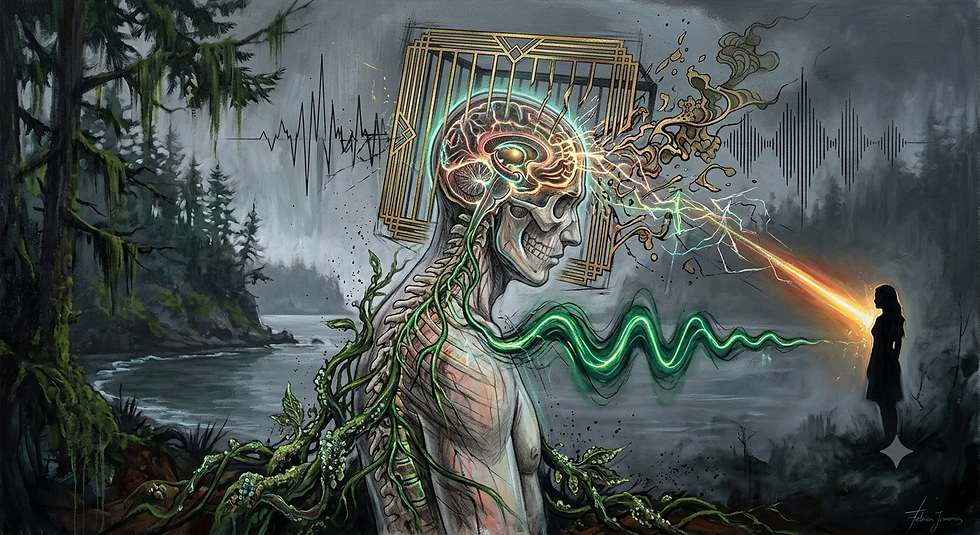
We have always had this rather tidy, linear assumption about growing up: that the brain begins as a quiet, empty room—a tabula rasa—and that living is the process of carrying furniture in, one memory at a time. It turns out, delightfully and rather startlingly, that the opposite is true. The biological reality of our minds is not a construction site, but a jungle awaiting a gardener.
When neuroscientists recently mapped the CA3 network of the hippocampus—that seahorse-shaped arbiter of our memories—they discovered that we do not start empty. We begin as a tabula plena, a completely full slate. The infant brain is a dense, tangled, exuberant thicket of connections, firing wildly at the slightest provocation. Maturation, it seems, is not a process of adding, but of profound and continuous subtraction.
We grow up by pruning away the excess, severing the chaotic axons to leave behind a sparse, elegant, and highly efficient network. We do not learn by accumulating; we learn by carving out the noise until only the music remains.
When you look closely at this biological pruning—this microscopic sculpting of the self—it begins to explain some of the most profound and radically healing experiences available to our species. The mechanics of the hippocampus provide a startlingly clear lens for understanding the therapeutic alchemy of psilocybin, cannabis, music, and love.
The Exuberant Jungle: Psilocybin and the Return to Childhood
In the immature brain, a single signal from one neuron is enough to cause a "near-detonating" effect in its neighbor. Everything is connected to everything else, and everything is loud. The adult brain, pruned for survival and efficiency, shuts this down. It creates rigid, heavily trafficked highways of thought—what we call the Default Mode Network. This rigidity is useful for getting to work on time, but it is the exact architecture of depression, anxiety, and obsessive rumination. The brain becomes trapped in its own efficiency.
Here is where the radical healing of psilocybin enters the picture. When introduced to the human nervous system, classic psychedelics temporarily suspend the brain's rigid, adult pruning. They flood the system, encouraging regions of the brain that haven't spoken since childhood to suddenly strike up a conversation.
Psilocybin heals by returning us to the tabula plena. It grants us temporary access to the unpruned jungle of infancy. The rigid ruts of trauma or despair are bypassed, replaced by a hyper-connected, exuberant state where colors can be tasted and old wounds can be viewed from a thousand new, untethered angles. It is a biological reset button, a reminder to the rigid adult mind that the jungle is still there, waiting to be explored.
The Biological Shears: Cannabis and the Grace of Forgetting
If the brain must prune its synapses to function optimally, there must be a mechanism to do the cutting. Neuroscientists suspect the brain's immune cells act as biological shears, clipping away unnecessary connections. It is no coincidence that the human endocannabinoid system is heavily involved in exactly this kind of synaptic pruning and neuroplasticity.
We often think of memory as a virtue and forgetting as a failure, but biology disagrees. Forgetting is an essential mechanism of survival. Without it, the system overheats. The compounds in cannabis, by binding to this very system in the hippocampus, engage directly with the brain’s machinery of forgetting.
This is not merely about misplacing your keys; it is about the profound healing required by the traumatized mind. For individuals suffering from PTSD, the memory of a trauma refuses to be pruned; it dominates the network, flashing continuously. Cannabis offers a pharmacological grace. It aids in memory extinction, gently engaging the shears to snip away the hyper-vigilant connections that no longer serve the organism, allowing the overgrown pathways of fear to finally wither so the mind can breathe again.
The Architecture of Harmony: Music and Spatial Coincidences
As those early, near-detonating connections are pruned away, the adult hippocampus matures into a master of integration. It stops overreacting to single inputs. Instead, the mature neuron requires simultaneous signals from multiple neighbors to fire. It shifts from a system of erratic fireworks to one that detects "spatial coincidences." It waits for context.
There is perhaps no greater manifestation of this mature, integrated network than our relationship with music. A single, isolated note is like a single synaptic firing: biologically meaningless. But music is the orchestration of countless inputs—pitch, rhythm, timbre, and harmony—arriving at the exact same time.
Music is the radical healing of the integrated mind. When we listen to a symphony, or a rhythm that moves our bones, we are perfectly stimulating the adult hippocampus. Music demands that the sparse, highly structured network fire together in perfect, synchronized coincidence. It heals because it provides an external blueprint for internal harmony, soothing the nervous system by reminding it exactly how beautifully an integrated network can function.
The Enduring Network: Love as the Master Structure
The transition from the dense, chaotic infancy of the brain to the sparse, efficient maturity of the adult perfectly mirrors the arc of human connection.
Think of the early days of infatuation. It mimics the infant brain: highly localized, densely packed, and "near-detonating." A single text message or a fleeting glance triggers a systemic explosion of neurochemistry. It is thrilling, but it is exhausting, and it is entirely unsustainable for a lifetime.
Mature love, the kind of love that heals and sustains, looks remarkably like the optimized adult hippocampus. As a relationship grows, the explosive, singular reactions are pruned away. What remains is a network that is perhaps sparser, quieter, and less prone to sudden detonation, but incredibly resilient.
Mature love relies on the integration of thousands of quiet, shared data points—a knowing glance, a shared silence, the dependable rhythm of a life built together.
It is a beautiful realization that our biology demands we let go of the chaos to find the structure. The brain carves away the excess not out of loss, but to make room for depth.
Through the un-pruning of psilocybin, the gentle forgetting of cannabis, the harmonious integration of music, and the quiet, enduring architecture of love, we are constantly participating in the wisdom of our own cells—finding our way out of the tangled thicket, and into the clearing.
The Architecture of the Forest
Look to the life cycle of a forest, and you will see the exact same architecture at play. A newly cleared patch of earth does not immediately sprout a cathedral of towering pines. It erupts in a chaotic, impenetrable tangle of briars, fast-growing saplings, and weeds, all fighting desperately and simultaneously for the sun. It is an ecosystem in a state of frantic hyper-reactivity, much like the infantile hippocampus.
The Grace of Letting Go
But over decades, a quiet, ruthless grace takes over. The weaker saplings are shaded out and decompose; the underbrush is slowly cleared away. What emerges is an old-growth forest—a sparse, beautifully open space governed by a few massive, deeply rooted organisms that communicate quietly beneath the soil. The mature brain, like the ancient forest, achieves its profound stability not by endlessly expanding, but by trusting the process of letting go.
The Medicine of the Soil
It is profoundly humbling to realize that the agents capable of tending this inner ecology—of halting the overgrowth or clearing the deadwood—are themselves products of the soil. Psilocybin and cannabis are not alien interventions. They are organic, chemical messengers that happen to perfectly fit the ancient, molecular locks of our own nervous systems, allowing us to manage the climate of our minds.
The Storm and the Decomposer
The mushroom arrives in the adult brain like a sudden, necessary storm, briefly blowing the canopy open so sunlight can reach the forgotten understory, reminding the rigid trees of their chaotic youth. Conversely, the cannabis plant acts much like the quiet, decomposing fungi beneath the forest floor. It breaks down the rigid, fallen timber of old traumas and hyper-vigilant fears, clearing the mental debris so the ecosystem can recycle its energy and breathe.
The Rhythms of the Wild
And what is music, if not the auditory reflection of a deeply balanced ecosystem? Long before we possessed cellos and synthesizers, the human nervous system was tuned to the complex, overlapping rhythms of the wild. We evolved listening to the percussive strike of a downpour, the intricate, melodic territorial calls of birds, and the slow, inescapable metronome of the tides.
Healing Through Harmony
When our mature, highly pruned hippocampal networks integrate the complex, overlapping layers of a modern song, they are engaging in the very task they evolved to perform in the wild. Music heals us because it is the sound of a living system functioning optimally. It reminds our localized neural circuitry of the underlying, rhythmic order of nature, coaxing our internal frequencies to align with the great, humming machinery of the living world.
Escaping the Noise
Ultimately, this rigorous biological sculpting—the continuous clipping away of the chaotic and the superfluous—serves a singular, transcendent purpose. We do not become sparse and structured merely to operate as isolated, efficient survival machines. If our minds remained in the permanent, deafening static of infancy, where every single stimulus triggered an explosion, we would be entirely trapped within the solitary confinement of our own reactions.
Making Room for the Other
The pruning of the brain is, at its core, an act of profound preparation. By quieting the internal noise, by relying on the chemical grace of plants, the harmonious integration of music, and the deliberate architecture of memory, the brain essentially hollows itself out just enough to invite someone else in. Love, then, is not merely a lovely side-effect of a well-ordered mind. It is the very reason the garden was cleared in the first place.
"The mind ain't a fortress; it’s a wild thicket begging for the shears. We take the mushroom to remember the fury of the storm, the smoke to forgive the fallen timber, and the music to find the rhythm in the dirt. But we carve away the overgrown chaos of our own heads for one reason alone: so that when love finally walks into the clearing, there is quiet enough to hear it, and room enough for it to stay."