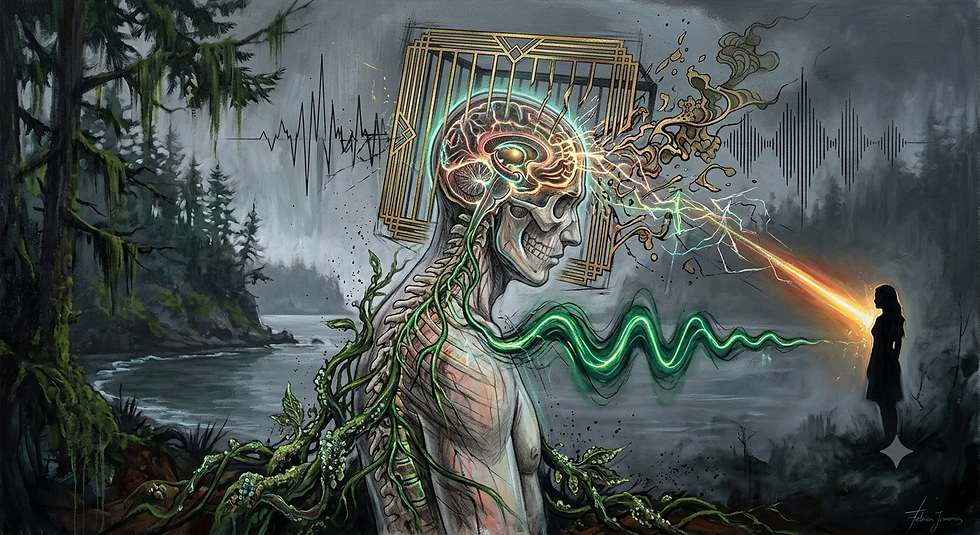
The Architecture of the Unmanaged Human: Escaping the Velvet Prison
- One Love Energy
- May 26
- 7 min read
The Architecture of the Unmanaged Human: Escaping the Velvet Prison
Who is your master?
It is the oldest, most uncomfortable question in the history of human civilization. We gather today to discuss a word that has been so diluted, so co-opted by political marketers and bureaucratic managers, that it has almost lost its structural weight: Liberty.
In 1831, a young French aristocrat named Alexis de Tocqueville traveled across the United States. He was looking for the secret of the American democratic experiment. But what he found terrified him as much as it inspired him. He observed a profound and dangerous truth about the human psyche: People love equality far more than they love liberty. Equality is comfortable. Equality ensures no one rises too high and no one falls too low. But liberty? Liberty is a rugged, unmanaged, and highly dangerous architecture.
To understand the global concept of liberty today, we cannot look at it as a poetic ideal. We have to deconstruct it as a multi-dimensional structure—an architecture built of geography, theology, economics, and the literary imagination. We must look at it through the unforgiving empirical lens of human trade-offs, the spatial geometry of political power, and the pragmatic reality of human nature.
The Illusion of "Positive" Liberty and the Velvet Prison
Let us start with the foundation. In 1958, Isaiah Berlin mapped the battleground of the modern political spectrum by distinguishing between negative and positive liberty.
Negative liberty is the classical definition. It asks: "How much am I interfered with?" It is the absence of external constraints. It is the fiercely protected private sphere where you, the individual, are left alone to build, speak, and trade without the arbitrary intervention of a monarch, a mob, or a bureaucrat. It is the bedrock of classical liberalism.
Positive liberty, however, is a very different animal. It defines freedom as the capacity to act. It argues that to be truly free, you must be provided with the structural conditions—education, healthcare, economic security—that allow you to realize your potential. While negative liberty asks what you are free from, positive liberty asks: "What am I free to become?"
But here is the trap, and it is precisely the trap Tocqueville warned us about almost two centuries ago. To guarantee positive liberty, you must empower a centralized authority to forcibly distribute those conditions. You cannot have a provider state without a managerial state. You must grant the government the power to manage the lives, property, and choices of others.
Tocqueville called this the threat of "soft despotism." He envisioned a modern state that does not break men's wills, but softens, bends, and guides them. An immense and tutelary power that takes total responsibility for our happiness—provided it gets to be the sole agent and judge of it. It creates a society of permanent dependents. The pursuit of positive liberty often becomes the velvet prison that justifies the destruction of our negative liberty. We willingly vote for our own wardens because they promise us security in exchange for our agency.
The Topography of Freedom: Harbors, Frontiers, and the Logic of Space
But liberty does not just happen because philosophers debate it in Parisian salons. It happens because geography forces it. Liberty has a topography.
The history of liberty is an uneven narrative of emergence and suppression. It began not with grand declarations of human rights, but with the pragmatic establishment of written law.
The Code of Hammurabi in ancient Mesopotamia was a foundational step toward freedom simply because it shifted power from the capricious will of a monarch to a predictable, public legal framework. In the Classical era, the Greek polis and the reforms of Solon gave us citizenship, while the Roman Republic gave us the Twelve Tables. In the Medieval period, the Magna Carta established that even a king is subject to the law.
Yet, the most powerful predictors of human freedom are geographic: access to the sea and the presence of a frontier.
Look at the spatial distribution of power. Port cities and natural harbors facilitate the massive, unpredictable mobility of people, goods, and ideas. They create independent wealth, and an independent bourgeoisie is the only reliable counterweight to an absolute, land-based empire. Flat, landlocked regions historically default to massive, centralized autocracies because they lack the topographical friction required to stop a marching army.
And then, there is the frontier. According to the Turner Thesis, the process of settling an advancing frontier created a perennial rebirth of democratic institutions. When colonists faced the American wilderness, the environment forced them to shed the aristocratic traditions of Europe. It bred a fierce individualism that was inherently anti-social and deeply resistant to the tax-gatherer.
The frontier created the unmanaged human.
Even the control of geographic information is a battleground for liberty. The "Surveyor's Eye," once used to map the visible landscape for the British Empire, was turned by revolutionaries against the crown to defend independence. Geography dictates logistics, and logistics dictate who remains free.
The Political Economy of Humanomics: Markets and Property
Let us look at the engine that sustains this spatial architecture: the political economy.
There is an inherent, often unspoken tension between Liberty and Democracy. They are not synonyms. Liberty asks: "What are the absolute limits of government power?" Democracy merely asks: "Who gets to wield that power?"
The economic benefits of liberty are empirically unassailable. We must recognize the reality of what drives the great enrichment of the human species. Wealth is not a static pie to be managed and divided by enlightened bureaucrats; it is a dynamic phenomenon created by human ingenuity.
Data shows that free economies grow significantly faster than heavily intervened ones. Property rights, limited regulation, and the rule of law explain more than 80 percent of the international variation in wealth. The spontaneous order of voluntary exchange does more to cure infant mortality, raise literacy, and provide safe water than any centralized decree in history.
But Tocqueville warned of the "tyranny of the majority." In a democratic age, what stops a voting majority from using their political power to legally plunder the property of the minority? What stops them from voting away the free market in the name of the "common good"?
When a society believes that justice equates to forced redistribution rather than equal protection under the law, it begins to devour its own foundation. The ascendancy of democracy can, paradoxically, threaten the survival of the free-market economy that feeds it.
The Inner Republic: Theology, Aesthetics, and Self-Mastery
This brings us to the most critical dimension of all. The inner republic.
If external political checks are removed, what governs the human animal? Theology and literature have long told us that true liberty is inseparable from self-mastery. It is a limbic drive, a visionary impulse that requires intense internal regulation.
In the Christian tradition, we grapple with the tension between free will and divine grace.
Islam addresses this through the concepts of Qada' and Qadar, where God's decree meets human accountability.
Judaism emphasizes that while all is foreseen, freedom is still granted to the human soul.
In the Dharmic religions, liberty is moksha—liberation from the cycle of suffering through the mastery of karma and intentional action.
Look at the literary imagination, the aesthetics of rebellion. Milton’s Satan in Paradise Lost is the ultimate rebel, violently overthrowing authority, but his rebellion is driven by megalomania, and it traps him in a hell of his own making. Contrast that with Shelley’s Prometheus Unbound. Prometheus opposes an omnipotent tyrant not with raw power, but with moral fortitude, truth, and love. He achieves a liberation of both body and spirit that transforms society.
Tocqueville observed that religion and morality were the first of the American political institutions, not because they dictated federal laws, but because they restricted the inner will. If a man is free from a king, he must be bound by his own conscience. The struggle against tyranny is fundamentally internal. A society of individuals who expect the state to resolve their spiritual and economic anxieties is a society begging for a master.
The State of the World: A 2026 Reckoning
Where does this multi-dimensional architecture stand today, in 2026?
The global ledger is flashing red. We are drowning in a third wave of autocratization. The data from the V-Dem Institute and Freedom House is chilling: for the first time in over twenty years, there are more autocracies (91) on this planet than democracies (88). Almost 40% of the world's population—3.1 billion people—are living in nations where the architecture of liberty is being systematically dismantled.
The weapons of modern autocrats are structural. They use media censorship. They subvert elections. They weaponize the legal system, disqualifying opposition leaders like Maria Corina Machado in Venezuela or arresting dissidents like Liu Xiaobo in China. Violence has become a normal feature of national voting. Even in established, liberal democracies, we are seeing a terrifying trend of democratic slippage—a consolidation of executive power that threatens to override the institutional checks designed to protect us from ourselves.
Yet, even in the dark, the architecture holds. We see bright spots in places like Bhutan and Senegal, which have moved to "Free" status. We see the enduring legacy of Gene Sharp’s theories of non-violent resistance, proving that a state's power derives entirely from the obedience of its subjects. We remember figures like Mandela, Gandhi, Wangari Maathai, and Jody Williams. They understood that justice does not equate to revenge; it equates to the transformation of the opponent through understanding, immense courage, and non-violent action. When the subjects withdraw their consent, the velvet prison shatters.
Conclusion: The Parallel Polis
Liberty is not a gift bestowed upon you by the state. It is a topography of the soul.
It is the negative space where arbitrary authority ends, and the positive capacity where self-mastery begins. Whether it is found in a deep-water harbor, a rugged frontier township, or the quiet, uncompromising will of a political prisoner in a silent cell, freedom is the high-resolution architecture of the unmanaged human.
We must remember the core warning: do not trade the turbulent, difficult reality of liberty for the quiet, managed servitude of equality. We do not need to ask for a seat at the table of the old, failing, centralized order. We are building the Parallel Polis, where their table is redundant, where local institutions and free exchange thrive, and where the code is One Love.
Who is your master?
Make sure the answer is looking back at you in the mirror.