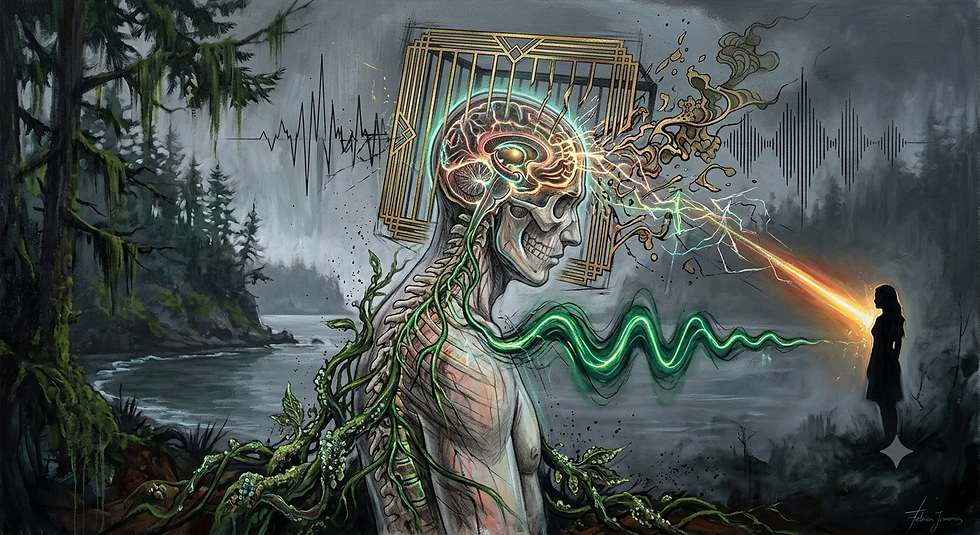
The Architectures of Silence: Raskolnikov, Psilocybin, and the Long Road Back
- One Love Energy
- Apr 10
- 5 min read
The Architectures of Silence: Raskolnikov, Psilocybin, and the Long Road Back
In the sweltering, claustrophobic corridors of Fyodor Dostoevsky’s 19th-century St. Petersburg, a young, destitute student named Rodion Raskolnikov commits a radical rupturing of the self. Driven by a cold, intellectual fever, he murders an elderly pawnbroker with an axe. He does not do this for money, though he is starving; he does it to test a theory. He imagines himself a "Superman"—a Napoleonic figure capable of transcending the mundane moral laws that bind the "trembling creatures" of the earth.
But as he stands in a police station shortly after—surrounded by the very humanity he sought to rise above—he is struck by a sudden, terrifying realization. He has built a cathedral of silence, and he is its only inhabitant.
This is the "unfamiliar, new, sudden" sensation Dostoevsky describes. It is the chilling recognition that once you cross a certain threshold of the soul with the wrong intent, the language of the "before" no longer works. To relate this to the psilocybin experience is to speak of the terrifying fragility of the ego when it attempts to play God without a map.
The Transgression of the Threshold
A high-dose psilocybin journey is often framed as "ego dissolution"—the melting of the boundary between the self and the universe. In a healing context, this is a sacred surrender, a realization that the "I" is a beautiful fiction and that we are all part of a shimmering, interconnected whole.
Raskolnikov’s crime is the dark mirror of this experience. He did not seek to dissolve his ego; he sought to calcify it. He wanted to prove that his "I" was so powerful it could stand outside of God, outside of Law, and outside of Love.
When the "medicine" of a peak experience takes hold, it strips away our social masks. For the seeker, this is liberation. But for Raskolnikov, who entered his "trip" with a heart hardened by a murderous ideology, the stripping away of the mask reveals only a void. He experiences the dissociation of the psyche without the union of the spirit. He is high on the fumes of his own arrogance, and the comedown is a permanent exile.
The Incommunicable Void
Dostoevsky writes that it was "no longer possible for him to address these people... had they been his own brothers and sisters." This captures the precise agony of the unintegrated experience.
In the wake of a profound psychedelic journey, there is often a period of "ineffability." You have seen the gears of the universe; you have felt the weight of eternity. How do you return to the grocery store? How do you speak to a police lieutenant about the weather when your soul has been flayed open?
If this gap is not bridged, it becomes a trauma of isolation. Raskolnikov’s "theory" acted as a catastrophic "set and setting." He stepped outside the circle of human empathy and found that the air out there is unbreathable. His silence in the police station is the silence of a man who has forgotten how to be human because he tried too hard to be more than human.
Integration: The Art of Coming Home
Integration is the bridge we build between the mountain peak and the valley floor. It is the slow, rhythmic weaving of the "unfamiliar" back into the "familiar." If the psychedelic experience is the lightning strike, integration is the tending of the hearth fire that remains.
To integrate in beautiful language is to engage in The Great Translation. It is the process of taking the raw, wordless light of a breakthrough and turning it into the warm, spoken bread of daily life. It is an act of mercy toward oneself. It is saying: “I have been to the edge of the world, and I have brought back a single seed to plant in the garden of my community.”
In the novel, Raskolnikov’s healing does not begin with his intellect—his intellect is what poisoned him. It begins with Sonya, a young woman forced into a life of suffering who maintains a radical, quiet faith. She represents the "fellow transgressor," the one who occupies the margins but remains anchored in love.
In the psychedelic space, Sonya is the integration circle, the compassionate witness who says, "I see the darkness you have touched, and I am still here. You do not have to carry the sun alone."
The Return to the Human Circle
True integration is the realization that the "Superman" was a lonely ghost. It is the humble work of stitching the soul back into the social fabric. Raskolnikov’s path to "oneness" required him to lose his status, his pride, and his theory. He had to confess, not just to a crime, but to his own desperate need for other people.
The psilocybin experience teaches us that the walls we build between "me" and "you" are thin, breathable membranes. Raskolnikov tried to build those walls out of stone and blood, only to find himself buried alive behind them.
The lesson for the modern seeker is that the "breakthrough" is only the beginning. The real miracle is the long, quiet walk back to the dinner table—to find a way to speak again. Not with the ego’s roar, but with the simple, grounded honesty of one who has seen the void and chosen, nonetheless, to stay and love
...................
I have gone out, a possessed student,
with a theory tucked in my coat like a cold stone.
I have walked through the St. Petersburg heat,
past the drunks and the peeling wallpaper,
carrying an axe like a heavy, iron secret.
I have been a girl—no, a man—who thought
he could step over the blood and remain dry.
I have been his kind.
The air in the police station is a thick soup.
I stand there, my heart a trapped bird,
and suddenly the language breaks.
The "unfamiliar" arrives like a blue flash,
a mushroom blooming in the dark of the brain.
I look at my sister, my mother, the lieutenant,
and they are across a canyon I carved myself.
I am the architect of this silence.
I have been his kind.
The integration is a slow, salt-water scrubbing.
It is not the lightning; it is the long, grey morning after.
It is Sonya, sitting on the edge of the bed,
her eyes two lanterns in the cellar of my pride.
To integrate is to admit the "Superman" was a ghost,
to take the axe and bury it in the garden,
to learn to say bread and mercy and help until the words stop tasting like copper.
A man who crosses the line
must learn to walk back, one inch at a time,
carrying the void in his pockets
until it turns into common, heavy earth.
I have been his kind.