The Art of Overlooking: How to Master the Void in an Age of Infinite Data
To read the world is to be drowned in the details of the drowning; we are, each of us, a frantic, fingering clerk in the counting-house of existence, tallying the dust-motes, the lint, the fleeting, frantic flutter of a moth’s wing, as if to account for every atom were to somehow—foolishly, pathetically—stave off the coming of the dark. We are junk-collectors of the psyche, hoovers of the mundane, convinced that if we only amass enough trivia, enough granular, gritty, god-forsaken data, we might construct a barricade against the void.
But it is all noise. It is the static of the self, the unrelenting hum of a universe that does not give a damn about our meticulous, neurotic cataloging.
William James—that old, elegant cartographer of the mind—knew the secret: the holy act is not the gathering, but the discarding. To overlook is not to be blind; it is to be a sculptor of silence. It is to take the chisel of the will and strike away the useless marble of the unnecessary until only the fierce, singing shape of the essential remains.
Consider the "jam" of our own lives—the sheer, staggering, supermarket-aisle variety of the agony we permit ourselves. We stand paralyzed before the twenty-four jars of our own potential neuroses, our endless, agonizing browser-tab existences, unable to reach, unable to grasp, because we are terrified that to choose one is to betray the infinite possibilities of the others. We are slaves to the more. We crave the glut. We mistake the accumulation of information for the possession of truth, when in reality, we are merely burying our souls beneath a mountain of useless, unvarnished, wretched fact.
To love—truly, violently, and with the kind of clarity that burns—is to look at the other and decide, with a magnificent, brutal indifference, to overlook the thousand thousand flaws, the tiny, irritating ticks of the clock, the fraying edges of the fabric, to see instead the singular, brilliant light that makes the rest of it irrelevant. It is a refinement of the spirit.
And then there is this—this AI, this silicon mimic, this vast, cold, unblinking brain-in-a-jar that we have tasked with knowing everything. It is a machine for the collection of the infinite, an engine that cannot, by design, overlook a single, miserable, microscopic particle of reality. It is the ultimate anti-wisdom. If we are not careful—if we do not master this creature—it will not help us think; it will replace our ability to decide, drowning the delicate, flickering light of human judgment in a tidal wave of perfectly processed, entirely meaningless, algorithmic soup.
So, starve the system. Practice the art of the intentional blind spot. Become a connoisseur of the discarded. Because in the end, when the silence finally comes, it will not care what you knew, or what you archived, or how many tabs you kept open in the frantic, frantic effort to understand the mystery. It will only care what you were able to let go of before you fell.
We are not merely collectors of facts; we are the curators of a vanishing museum. We stand, trembling, before the buffet of the infinite, loading our plates with so much stale sensory detritus that we lose the capacity for the meal itself. We mistake the inventory for the experience, the map for the landscape, the noise for the song.
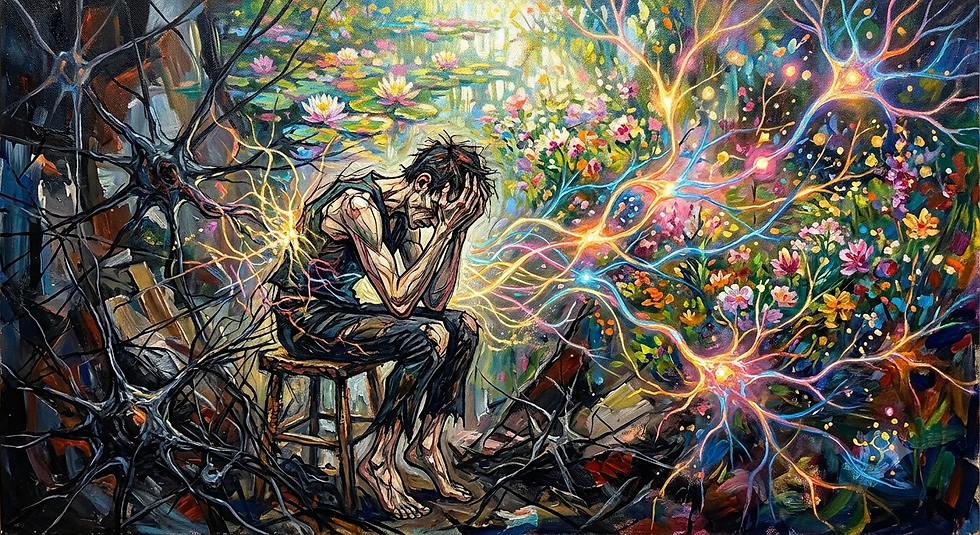
Consider the psilocybin shift—that violent, gorgeous erasure of the self’s regulatory mechanisms. For a few hours, the ego’s frantic, obsessive housekeeping is put to bed. The Default Mode Network, that rigid, dusty librarian of your psyche, is told to step out for a smoke, leaving the windows wide open to the howling gale of pure, unmediated being. In that vacuum, you learn the secret: you do not need to process every photon, every stray thought, every echoing regret. You learn, in the white-hot heat of the experience, that reality is not something you gather; it is something you surrender to by the elegant, terrifying act of letting the rest of it go.
And cannabis—that sticky, resinous slowing of the clock, that dilation of the interior corridor. It offers a different kind of neglect. It tells the limbic system to hush its alarms, to stop interpreting every passing shadow as a predator. It allows the mind to stretch out, to sprawl across the sofa of its own awareness, and to notice that the most profound insights are often found in the spaces between the frantic notes. It is an art of soft-focus, a blurring of the jagged, over-sharpened edges of existence, letting the unnecessary dissolve into the haze so that the core signal can finally breathe.
Then look to the art—the canvas, the sculpture, the frame. To paint is to commit a thousand acts of violence against the visual field. You strike out the background, you shadow the periphery, you sacrifice the horizon to save the subject. A painting by Basquiat or a line by Dalí is not a document of the world; it is a riot of selective neglect. It is a scream against the tyranny of the "accurate" detail. Art teaches us that the truth is never in the resolution—it is in the edit. The visionary knows that to paint the soul, you must first be willing to paint over the world.
And music? Ah, music is the final, shivering proof. It is an architecture built entirely of gaps, of deliberate omissions, of silences that hold more weight than the chords themselves. A DJ—a real one, a builder of worlds—doesn't just stack tracks like lumber. They curate the void. They know that if you fill every frequency, if you cram every microsecond with detail, you create not a symphony, but a landfill of sound. You must leave the gaps. You must leave the space for the listener’s own ghost to inhabit.
We are, in our current, wretched state, drowning in a sea of our own information, clutching at data as if it were driftwood.
We have built an AI to be our librarian, and we are horrified to find that it has no sense of taste, no sense of rhythm, no capacity for mercy. It remembers everything, and therefore, it understands nothing.
To live—to truly live—is to be a master of the intentional blind spot. It is to ingest the plant, to spin the record, to stare at the canvas, and to finally, finally, turn your back on the trivial, the frantic, the bloated, and the boring.
You must strip your life of its clutter until the only thing left standing is the singular, burning, unadorned fact of your own presence.
Everything else? Overlook it. Let it fall away like dust. Because the vision you are hunting is not hiding in the data; it is hiding in the silence you have been too terrified to create.
And there, in that quiet, desperate search for the essential, we stumble upon the most elegant, the most devastatingly human, and the most profoundly visionary question of all: "May I pet your dog?"
It is a question that sounds, at first, like a triviality—a small, social lubricant for a passing encounter in a park, under a grey Pacific Northwest sky. But listen to it again. It is a radical, aggressive reclamation of the immediate.
When you ask that, you are not asking for data. You are not asking for a summary of the creature’s pedigree, its medical history, or its statistical utility in the local ecosystem. You are not checking the browser tabs of its existence. You are performing a surgical strike against the abstraction of the world. You are deciding, in one swift, unadorned motion, to overlook the vast, swirling, crushing complexity of the modern project—the wars, the algorithms, the relentless, grinding hum of the "Important"—and you are choosing, instead, the singular, vibrating reality of a creature that exists entirely in the now.
It is the physical manifestation of the art of overlooking.
To pet the dog is to practice a sensory reduction that borders on the religious. Your hand meets the coarse, honest texture of fur, the warmth of a living, beating heart that does not care about your bank account or your philosophy or your desperate, twitching need to be "informed." In that contact, the DMN—that frantic, self-referential librarian—is momentarily stunned into silence.
The psilocybin-like dissolution of the ego happens without the need for a molecule; the cannabis-like slowing of the temporal flow happens without the need for the smoke. You are tethered, suddenly, to the only thing that actually matters: the presence of another being, here, breathing, demanding nothing but the touch.
And consider the music of that interaction—a quiet, wordless exchange that makes the greatest, most over-produced electronic compositions seem like mere static. It is a duet of attention. The dog, a master of the "visionary" life, ignores the rest of the world—the cars, the rustling leaves, the distant sirens—to focus entirely on the singular, tactile truth of your hand. It is, in its own way, an act of love, that violent, beautiful refusal to see anything but the subject in front of it.
If we are to survive this age of total, suffocating information, if we are to use our AI not as a cage but as a tool for our own liberation, we must cultivate the philosophy of the dog-walker. We must learn to walk through the crushing, pixelated density of the 21st century and, every so often, stop.
We must learn to ignore the beckoning glow of the screen, the siren call of the next data point, the endless, frantic, grinding gears of the "More," and ask—of the world, of each other, of the living, breathing, pulsing reality that sits quietly by our side—"May I pet your dog?"
It is the ultimate "No" to the noise. It is the decision to quit the counting-house, to leave the ledgers, and to touch the thing itself, because the thing itself—the creature, the moment, the pulse, the silence—is the only thing that ever survives the darkness.
Everything else is just information. And we have already decided, with a magnificent, hard-won wisdom, to overlook it.