The Borderland of Brilliance: Bridging the Gap Between Wild Dreams and Hard Logic
- One Love Energy
- May 2
- 6 min read
The Architecture of the In-Between: A Map of the Creative Soul
We have long been told that creativity is a lightning bolt—a sudden, violent strike of inspiration from the heavens. We’ve been told it lives in the "right brain," a colorful, chaotic attic of the mind, forever at war with the "left brain’s" cold, grey laboratory. But the truth, it turns out, is far more elegant.
Creativity is not a strike of lightning. It is a bridge.
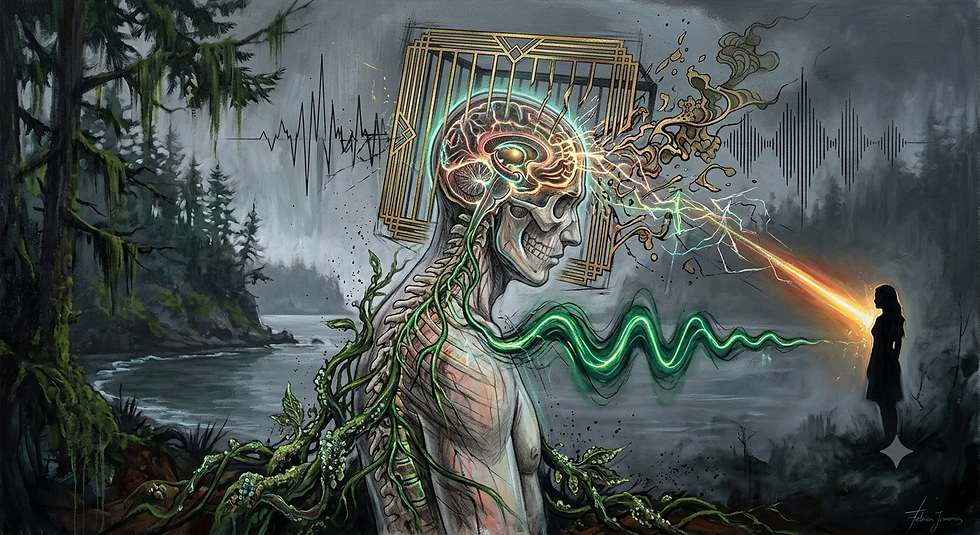
Recent neuroscience has begun to map the cartography of our inner worlds, and the findings are a revelation for anyone who has ever felt the pull of a song, the weight of a metaphor, or the spark of a new idea. To understand how we create, we must look at the "Rostral Bridge" and the two vast, contrasting continents it connects.
The Two Continents: The Jungle and the City
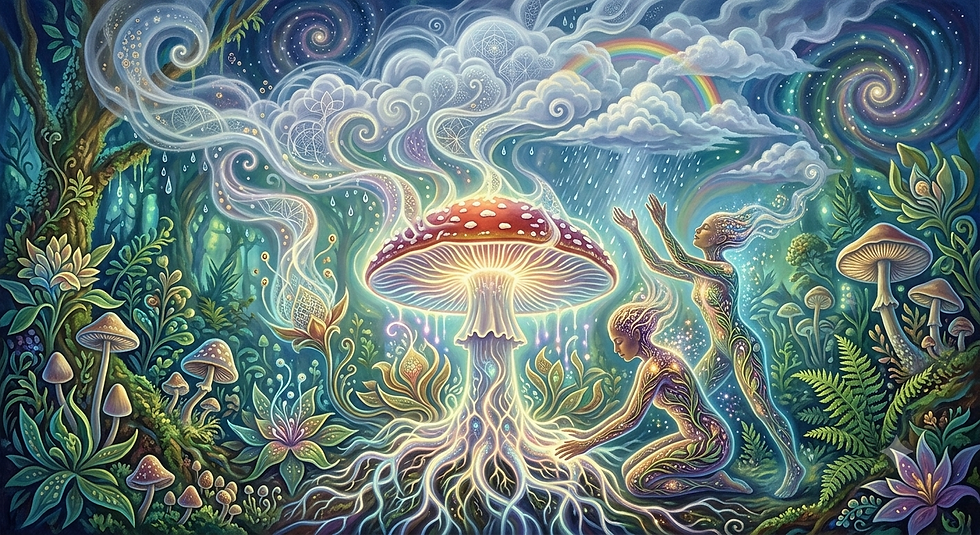
At one end of our consciousness lies the Default Mode Network (DMN)—the Wild Interior. This is the land of the daydream, the memory, and the "what if." It is a lush, untamed jungle where thoughts don't move in straight lines. They tangle. Here, the smell of rain can trigger a memory of a lost love, which in turn sparks a melody. It is the realm of spontaneous association.
When we explore the depths of psilocybin or the fluid drift of cannabis, we are trekking deep into this jungle, where the boundaries of "self" and "other" begin to blur.
At the opposite pole sits the Executive Control Network (ECN)—the Gridded City. This is the realm of the engineer and the editor. It is built on logic, focus, and goal-oriented survival. It is the part of us that keeps time to a beat, corrects a line of code, and ensures that a good idea actually works in the real world.
This is the AI of our biology: precise, efficient, and ruthlessly relevant.
The Paradox of Distance
The most startling discovery of this new cartography is that creativity does not happen when these two worlds merge. In fact, when they get too close—when the city is built inside the jungle—the mind becomes compressed. We lose the ability to distinguish between a dream and a plan, a symptom often seen in the tragic erosion of frontotemporal dementia.
Instead, the Creative Amplitude depends on distance.
The more distinct the jungle and the more organized the city, the greater the creative potential. The magic lies in the gap. Creativity is the tension maintained between the dreamy spontaneity of the DMN and the logical rigor of the ECN. To be truly original, you need a jungle wild enough to house monsters and a city strong enough to build cages for them.
The Rostral Bridge: The Gateway of "And"
Connecting these two worlds is the rostral prefrontal cortex. It is our most modern piece of biological hardware—the ultimate Functional Bridge.
This bridge is where Intentional Association occurs. It is the site where we take the raw, chaotic material of our dreams and march it across the water into the city to be refined.
This is where music happens: the spontaneous emotion of the jungle met with the mathematical timing of the city.
This is where Love lives: the wild, irrational pull of the heart coordinated by the intentional, everyday labor of partnership.
Tending the Map
To live a creative life is to be a master of this geography. It requires us to "get sticky with it"—to use the S.T.I.C.K. mnemonic to ensure our ideas have the Simplicity, Trustworthiness, Intensity, Concreteness, and Kinship to cross the bridge successfully.
We must feed the jungle with art, silence, and perhaps the occasional chemical tide of psilocybin or cannabis to keep the vines growing. But we must also pave the streets of the city through discipline and craft.
The next time you find yourself stuck, do not look for the lightning bolt. Instead, look to your bridge. Check the distance. Are you too far into the city, drowning in logic? Or too deep in the jungle, lost in a fog of association?
The original idea is waiting in the middle of the bridge, right at the intersection of who we are and who we are becoming. It is the functional distance between our wildest dreams and our most disciplined work that defines the height of our humanity.
The relationship between cannabis, psilocybin, love, and music is a sophisticated dance of chemical signaling and structural bridge-building. To understand this through the lens of endocrinology and the "Rostral Bridge," we must view the brain not just as a series of electrical circuits, but as a fluid ecosystem.
Hormones and neurotransmitters act as the environmental conditions—the humidity, the temperature, the tides—that determine how easily information travels between our spontaneous "internal jungle" (the Default Mode Network) and our executive "city" (the Executive Control Network).
Psilocybin acts as a powerful disruptor of the traditional brain hierarchy, temporarily dissolving the gating mechanisms of the rostral prefrontal cortex. By inhibiting the stability of the Default Mode Network, it allows for a flood of cross-talk between regions that rarely communicate, effectively submerging the Executive City in the Spontaneous Jungle. From an endocrinological perspective, this surge in serotonergic activity can trigger downstream effects on the hypothalamic-pituitary-adrenal (HPA) axis, shifting the body from a state of rigid stress-response to one of neuroplastic openness.
Cannabis, by contrast, acts as a subtle tuner of the Functional Connectivity Gradient. By engaging the endocannabinoid system—the body's primary tool for maintaining homeostatic balance—it can relax the rigid borders of the executive network without fully dissolving them. This creates a stretched state where the distance between raw associations and logical processing is widened. This allows for a more expansive amplitude of thought, enabling the thinker to reach for distant metaphors while maintaining the endocrinological calm necessary to observe them without the interference of the fight or flight response.
Music serves as the ultimate rhythmic exercise for this rostral bridge, synchronizing the DMN and ECN through a process of entrainment. While the spontaneous network processes the emotional resonance and memory-recall of a melody, the executive network tracks the mathematical precision of the beat. This synchronization triggers the release of dopamine and oxytocin, the social hormones, which reinforce the structural integrity of the bridge. Music essentially creates a predictable endocrinological environment where the brain feels safe enough to allow the spontaneous and the executive to collaborate in high-definition.
Love is the most profound biological manifestation of this intentional association, acting as a permanent architect of the prefrontal cortex. The endocrinology of love—driven by a potent cocktail of oxytocin, vasopressin, and dopamine—serves to grease the gears of the rostral bridge. It provides the motivation for the executive network to engage with the spontaneous, unpredictable world of another person’s mind. Love ensures that the distance between two people (or two brain networks) is bridged by a functional, resilient connection, turning raw survival instincts into complex, creative social navigation.
When we synthesize these four elements, we see a cartography of human transcendence. Psilocybin and cannabis provide the tides that refresh the landscape; music provides the vibration that keeps the structure resonant; and love provides the foundation upon which the bridge is built. Together, they illustrate that creativity and consciousness are not just mental states, but physical legacies of how our hormones and neurobiology work in concert to translate the chaos of the wild interior into the beautiful structure of a life well-lived.
Creativity is not merely an artistic trait; it is a fundamental tool for autonomy and resilience. When the bridge is compromised—as seen in neurodegenerative conditions—the brain loses the ability to differentiate between spontaneous thought and intentional action. True creative health requires maintaining the tension of distance: nurturing a wild internal interior while fortifying a disciplined executive structure.
The genius of the human machine isn't found in the chaos of the jungle or the cold math of the city, but in the strength of the bridge that holds them apart. To be a master of the craft, you must keep your dreams wild and your logic sharp, for true original thought is simply the tension held between the two—the ability to reach deep into the dark of the interior and bring back a flame that the city can actually use to stay warm.