The Broken Glass of Being: Psilocybin and the Art of the Uncomfortable
- One Love Energy
- Mar 22
- 3 min read
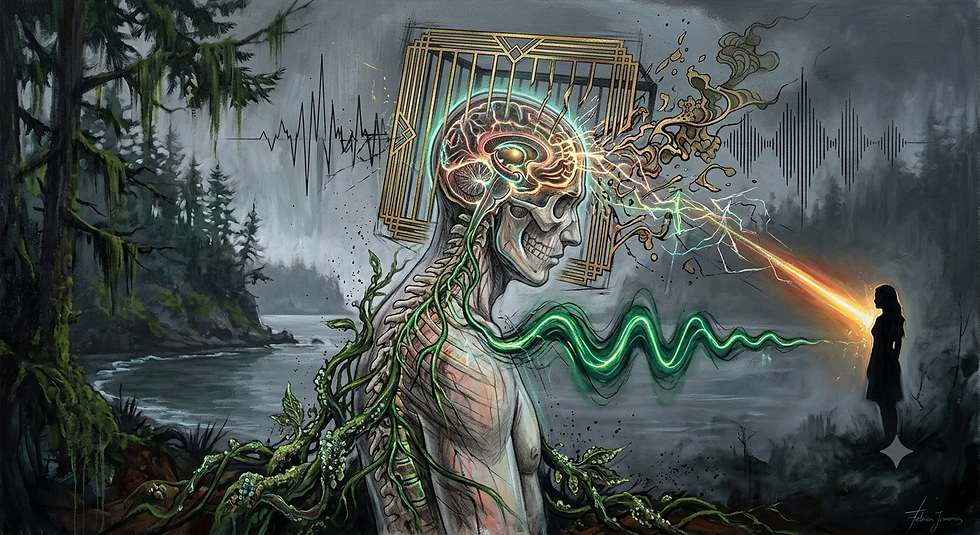
The fungal modulation of the human psyche is not merely a chemical transaction; it is a profound biological coup, a deliberate dismantling of the mirrors we use to navigate the waking world. When we introduce psilocybin into the delicate architecture of the brain, we are inviting a master deconstructor to take up residence. This is the art of the "uncomfortable" made manifest in the very marrow of our consciousness. To understand this process is to understand how the ancient, subterranean intelligence of the mycelial web reaches upward to entangle itself with the lightning-fast, often rigid impulses of the modern mind.
The Architect of Dissolution
At the heart of this modulation lies a paradox: to find a more authentic self, one must first endure the discomfort of watching the "known" self dissolve. In the natural world, fungi are the great recyclers. They exist in the spaces between life and death, turning the fallen and the forgotten into the fertile. When psilocybin—or more accurately, its active form, psilocin—enters the bloodstream, it performs a strikingly similar ritual within the skull.
It targets the serotonin receptors, specifically the 5-HT2A variety, which act as the gatekeepers of our sensory and narrative reality. By binding to these receptors, the fungal messenger modulates the Default Mode Network, that interconnected web of brain regions responsible for the "ego." This network is the mirror of society we carry within us; it is the source of our "I am," our ruminations on the past, and our anxieties about the future. It keeps our reality predictable, safe, and—all too often—stagnant.
When the fungus modulates this network downward, the mirror doesn't just crack; it melts. The rigid boundaries that separate "the self" from "the other" or "the thinker" from "the thought" begin to fray. This is where the allure of the experience meets its inherent disturbance. There is a primal fear in losing the "I," yet it is only through this loss that the brain can achieve a state of high entropy—a beautiful, chaotic fluidity where regions of the mind that haven't spoken in years suddenly begin a vibrant, cross-disciplinary dialogue.
The Mycelial Mind: A Symbiotic Symphony
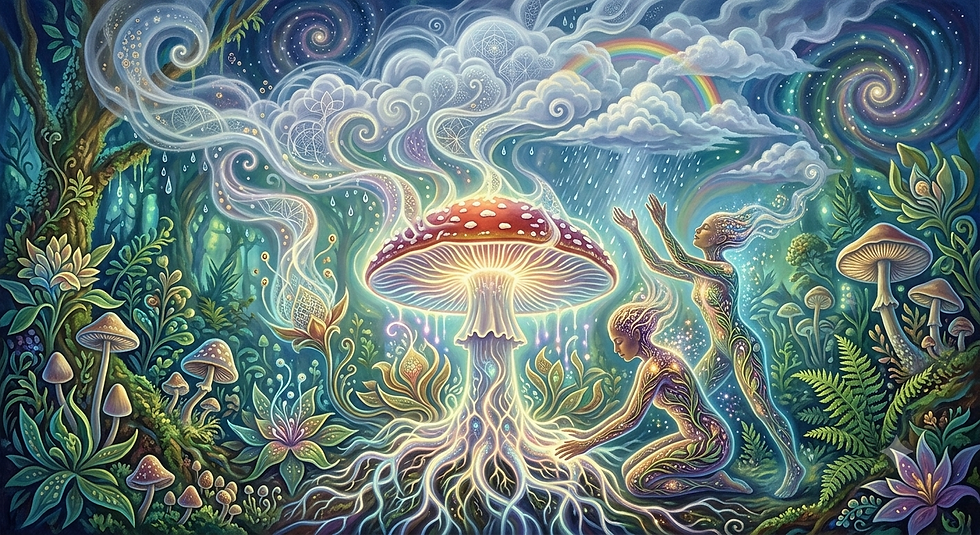
We often speak of the "Wood Wide Web," the vast underground networks where fungi facilitate the exchange of nutrients and information between trees. In the state of fungal modulation, the human brain becomes a mirror of this forest floor. This is not just a metaphor; it is a functional shift in connectivity.
The fungus introduces a "global connectivity" that bypasses the standard, efficient highways of thought. It forces the brain to find new paths, to forge new synaptic bridges. This is the biological definition of perspicacity—the ability to see through the surface level of things to the underlying connections. In this state, a scientific concept might suddenly hum with the resonance of a musical chord, or a painful memory might be reframed through the lens of evolutionary biology. The fungus doesn't just change what we see; it changes the very apparatus of seeing.
This modulation is inherently "alluring" because it offers a glimpse into a reality that is older and more expansive than human language. It is a return to a symbiotic state where we are no longer masters of our environment, but participants in a much larger, darker, and more luminous ecology.
Breaking the Social Mirror
Society requires us to be "static." We are expected to have consistent personalities, predictable desires, and a firm grasp on the "consensus reality." Fungal modulation is the ultimate act of rebellion against this stasis. It is the "Sacred Clown" of the biological world, mocking our self-importance and showing us the absurdity of our social constructs.
By disturbing our internal equilibrium, psilocybin forces a confrontation with the "grotesque" truths we usually ignore: our mortality, our animal nature, and the sheer fragility of the stories we tell ourselves. Much like the transgressive art of Goya or Bacon, the fungal experience uses discomfort as a tool for de-escalation. It de-escalates the ego’s frantic defenses, allowing us to stand naked before the mirror of existence—only to realize that the mirror was an illusion all along.
The resulting clarity is cogent and cohesive, even if it feels alien at first. It is the clarity of the forest after a fire, where the old growth has been cleared away to make room for something wilder and more resilient. We are left with a brain that is more plastic, more "sticky" with new ideas, and more deeply attuned to the interconnected hum of the living world.
To modulate the fungal is to accept the invitation to be broken down and built back up. It is an admission that our societal mirrors are too small to hold the vastness of what we actually are. In the discomfort of the fungal embrace, we find the only truth that matters: that we are not separate from the web; we are the web, momentarily dreaming it is a person.