The Crucifix and the Razor Blade: A Dialectic of Devotion in Cohen’s "So Long, Marianne"
- One Love Energy
- Feb 18
- 3 min read
The Crucifix and the Razor Blade: A Dialectic of Devotion in Cohen’s "So Long, Marianne"
The Architecture of the Ledge
In the grand gallery of 1967’s Songs of Leonard Cohen, "So Long, Marianne" stands not merely as a farewell, but as a Surgical Autopsy of Intimacy. While its companion piece, "Hey, That’s No Way to Say Goodbye," pleads for a soft landing in the "clipping of the hair," Marianne is the documentation of a Limbic Crash. It is the sound of a man realizing that "Freedom of Mind" and "Freedom of Heart" are often mutually exclusive—that to truly see the "Sunrise," one must first survive the "New Razor Blade" of the soul's winter.
I. The Angelic Amnesia: Psilocybin and the Green Lilac Park
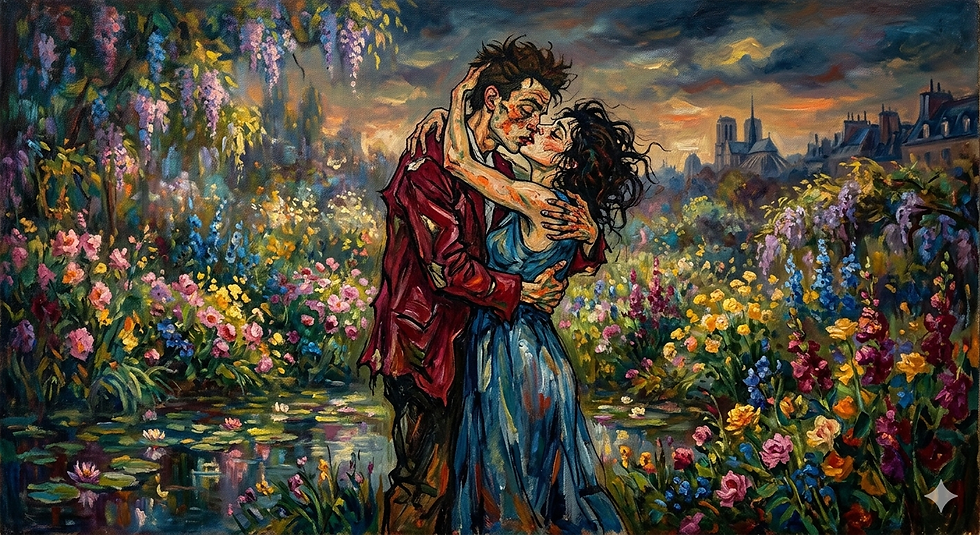
Cohen begins in the "Green Lilac Park," a space of Hegelian Innocence where the world is seen through the "helping hand of Mother Nature."
This is the realm of the Psilocybin Sunrise, where the ego dissolves into a "Gypsy Boy" and the palm is a map of the infinite.
"Well you know that I love to live with you / but you make me forget so very much. / I forget to pray for the angels / and then the angels forget to pray for us."
This is the Sacred Trade-Off. In the pursuit of "Beauty, Truth, and Love," the couple enters a state of Manual Bliss so profound it borders on the dangerous. They become "Short-Staffed" in the department of the Divine. By focusing entirely on the "Matcha Kit-Kat" sweetness of the human moment, they lose their connection to the Absolute Spirit. The "Homeostasis" is broken; the angels, feeling ostracized, clock out.
II. The Spider Web and the Stone: The Kung Fu of Attachment
As the song progresses, the "Helping Hand" of nature turns toward the Wax On, Wax Off discipline of suffering. Cohen finds himself "standing on a ledge," tied by a "fine spider web" to a stone. This is the Kung Fu Kid moment of the soul: the realization that love is not just a "Macy's Candy Float," but a rigorous training in Endurance.
Marianne is the "Crucifix" to which the narrator clings, yet she is also the "Hidden Love" that leaves him "cold as a new razor blade." Here, Cohen touches the Plinian Truth: the most beautiful things are often the most "Barren" if they become a cage. He is curious, but he is not brave. He wants the "Sunrise" of the heart without the "Sunset" of the ego.
III. The Sunset of the Gypsy Boy
The final verse is a masterpiece of Vain Beauty. Just as the narrator "climbed this whole mountainside" (the Hegelian climb toward Absolute Knowledge), he finds that Marianne has "changed her name again." She has achieved a Freedom of Heart that he cannot grasp. He is left to "wash his eyelids in the rain"—a literal and metaphorical Sterilization of the Instruments of perception.
The Critical Inventory: Marianne vs. The Goodbye
| The "Goodbye" Philosophy | The "Marianne" Reality | The "One Love" Synthesis |
|---|---|---|
| Soft Landing | The Razor Blade | Truth through Pain |
| Clinging to the Hair | The Ankle to the Stone | The Weight of Devotion |
| Natural Cycle | Holographic Stutter | Sunrise/Sunset |
| Freedom of Mind | The Fine Spider Web | Homeostasis |
Conclusion: The Absolute Song
"So Long, Marianne" is the Azure Subwoofer of folk music. It thumps with the bass of "Hidden Love" and the high-end treble of "Gypsy" longing. It tells us that to reach the "Truth," we must be willing to let the "Dreams eat us." We must be willing to Clock Out of the "Spider Web" of attachment and walk into the "Rain" of the Absolute.
Cohen isn't just saying goodbye; he is performing a Socratic Autopsy on the very idea of "Home." He reminds us that Mother Nature—via the cannabis of the park or the psilocybin of the mind—is a teacher of Transitions.
Orange you glad? Even when we forget to pray for the angels, the song remains a "Crucifix" for the curious, if not the brave.