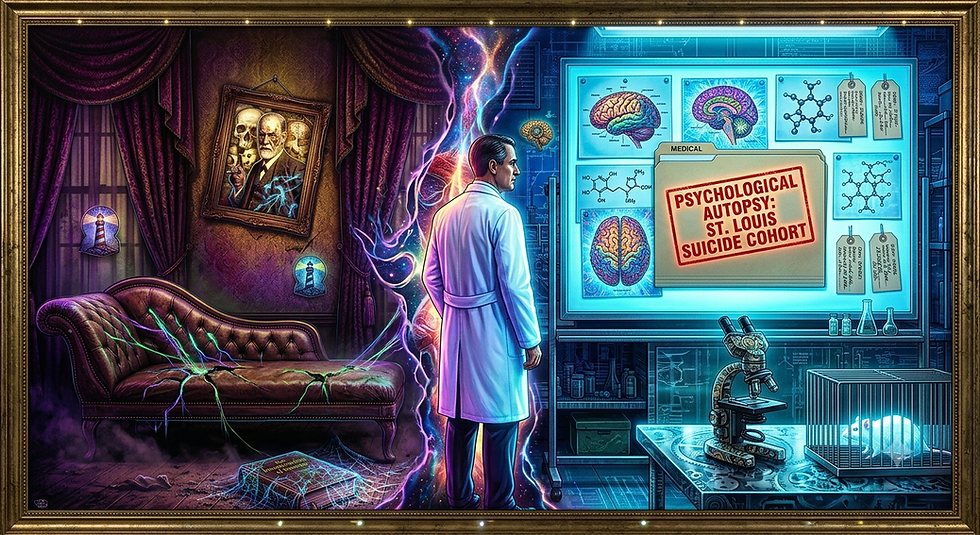
The Dynamism of the Mind
The Dynamism of the Mind: Escaping the Stasis of Chronic Psychosis
Letter from the Editor-in-Chief | Radical Healing of Mother Nature
For decades, the psychiatric establishment has treated chronic psychosis as a tragic, inevitable march of decay.
The institutional response has been fundamentally reactionary—a regime of static containment. We have relied on chemical straightjackets, primarily dopamine antagonists, to suppress the most florid symptoms of schizophrenia while quietly accepting the collateral damage: the steady erosion of the patient’s cognitive architecture, the dulling of their affect, and the unraveling of their agency. It is a medical model built on the premise of stasis, designed to manage decline rather than pursue restoration.
But human biology, when properly allied with the sophisticated molecular technology of the natural world, is infinitely more dynamic than our bureaucracies give it credit for.
A profoundly disruptive case study recently brought to my desk—detailing the full remission of a 30-year history of chronic psychosis through the concomitant use of psilocybin and whole-plant cannabis—demands that we entirely rethink the boundaries of the possible. This isn't merely a medical anomaly; it is a vivid demonstration of how botanical interventions can dismantle entrenched, pathological rigidities and fundamentally reweave the physical and computational fabric of the brain.
The Tyranny of the Pruned Network
To understand this paradigm shift, we must first look at what chronic psychosis actually does to the brain’s infrastructure. The true tragedy of the disorder is not just the hallucinations, but the profound hypofrontality—the aggressive, pathological hyperpruning of synaptic connections in the prefrontal cortex driven by overactive microglia.
Classical antipsychotics do absolutely nothing to halt this structural demolition. They merely block the downstream noise (the hyperdopaminergic state in the striatum) while the upstream network continues to fray.
Enter psilocybin. The classical narrative surrounding serotonergic psychedelics has long warned that they are strictly contraindicated for anyone with a history of psychosis, based on a surface-level resemblance between a psychedelic trip and acute manic decompensation. But this view fundamentally misunderstands the mechanism. Psilocybin is a potent psychoplastogen. Because it is highly lipophilic, its active metabolite (psilocin) bypasses the cellular membrane to activate an entirely distinct, intracellular pool of 5-HT2A receptors.
This intracellular activation triggers the TrkB/mTOR pathways—the biological looms that spin new neural architecture. Within 24 hours, dendritic spine density in the prefrontal cortex can increase by 10%. It is not a palliative masking of symptoms; it is the aggressive, physical rebuilding of the cortical network.
Breaking the Monopoly of Delusion
Yet, physical repair alone cannot account for the rapid cessation of a delusion that has defined a patient's reality for three decades. To understand this, we have to look at the brain not just as a biological organ, but as a computational engine—a Bayesian inference machine that relies on predictive models to navigate the world.
In a chronically psychotic brain, specific high-level priors—deep-seated beliefs about threats, reality, or self—become pathologically overweighted. They act like a tyrannical central planning committee, forcing all incoming sensory data to conform to a rigid, delusional narrative.
Psilocybin introduces what computational neuroscientists call "entropy." It acts as a radical deregulator.
By flattening the brain's variational free-energy landscape (a process detailed in the REBUS model), psilocybin breaks the monopoly of these entrenched priors. The Default Mode Network (DMN) disintegrates, temporarily stripping away the rigid boundaries of the psychotic identity. The brain's hierarchy is opened up to a free market of sensory and emotional data, allowing the system to discover new, healthier baselines that are grounded in present reality rather than historical trauma.
The Neurochemical Anchor
However, untempered entropy in a traumatized system is a recipe for chaos. The introduction of radical, bottom-up information can trigger massive anxiety—what researchers call the SEBUS risk, where the brain hastily constructs a new paranoid narrative just to close out the terrifying uncertainty of the entropic state.
This is where the sheer elegance of polypharmacy and the endocannabinoid system comes into play. If psilocybin provides the necessary dynamism to shatter the old regime, cannabidiol (CBD) and the minor cannabinoids provide the institutional trust required for a peaceful transition. This creates a highly effective, synergistic division of labor.
Psilocybin acts as the primary disruptor, providing the necessary neuroplasticity via TrkB activation and the computational entropy required to dismantle rigid, delusional priors. Cannabidiol, on the other hand, operates as the essential stabilizer. By acting as an inverse agonist at CB1 receptors, CBD normalizes hippocampal glutamate overflow and blunts the amygdala's fear responses.
At the molecular level, the 5-HT2A and CB1 receptors physically bind to form heteromeric complexes. When stimulated simultaneously, they engage in a sophisticated "negative crosstalk." The CBD steers the psychedelic cascade away from pathways that generate anxiety and cognitive fragmentation, funneling the biochemical energy almost entirely toward structural repair. The cannabis acts as a vital neuro-affective buffer, allowing the patient to tolerate the profound vulnerability of belief-revision without spiraling into a panic response.
A Curative Horizon
This synergy forces a reckoning with our current diagnostic boundaries and ethical frameworks. The Power Threat Meaning Framework correctly posits that psychotic symptoms are often intelligible, evolved survival responses to severe adversity.
If our current medical model merely suppresses the distress of that survival response, the intelligent integration of classical psychedelics and endocannabinoid modulators offers something infinitely more valuable: the opportunity to actually resolve it.
We stand on the precipice of moving psychiatry from the stasis of palliative management to the dynamism of curative, neuroplastic intervention. It is time we allow the natural world to help us reweave the mind.