The Horticulture of Avarice: A Whistle-Stop Fugue
- One Love Energy
- Feb 19
- 8 min read
The air in the conservatory was not merely oxygen; it was a pressurized soup of humidity and the cloying, high-register scent of overripe berries—specifically, the Lazarus Strawberry.
Our hero, known to the local tabloids and the back-alley fruit-mongers as the Lazarus Strawberry Boy, stood amidst the greenery. He was a creature of delicate, almost sickly refinement, possessed of a constitution that seemed to require a month of good sleep just to navigate a single afternoon. His body was currently rotating, slowly and with a certain gravitational inevitability, toward its proper north-south orientation. He was "all done-up" for a rehearsal that no one had requested, draped in silk that caught the light in little prisms—rainbows of glitter at the height of a country-rock delusion.
The Architect of the Squeeze
Opposite him stood Doctor Greedy Pants. The Doctor was a man of picky surfaces and theoretical problems, a specialist in the pathology of the purse. He did not merely want money; he wanted the idea of money to be the only thing left in the room. He watched Lazarus with the cold, diagnostic eye of a man who sees where the profit goes without ever touching the soul of the producer.
"You mean us poor, sad little cast-offs?" Lazarus murmured, his voice sounding utterly convincing to his own ears. "Wouldn't it be nice if we could cheer each other up so your miser wouldn't cast a pall on the happiness of the Prince and Princess?"
"The Prince and Princess are in debt, boy," Greedy Pants barked, his voice like the grinding of tectonic plates beneath a bank vault. "And your strawberries—they die, they rise, they die again. It’s inefficient. I want them to stay dead. Scarcity, Lazarus! Scarcity is the only honest emotion left in this tragic history of the human race."
The Peril of the Shifting Ground
The Doctor stepped forward, his shadow falling across the central courtyard of the conservatory like a heavy wool blanket. He reached for a lever—a literal, rusted iron whistle protruding from the steam pipes.
"I shall blow the whistle on this entire operation," the Doctor hissed. "The health inspectors, the creditors, the 'pity of the tribe.' I’ll have you back in the bedroom sorting through your shitpile—the dresses, the belts, the old magazines—by Friday. Always payday, Lazarus. But not for you."
The tension was a physical thing, an argument of sounds and implosion. The Doctor’s hand tightened on the whistle. If he blew it, the steam would scald the crop, the secret gardens would be exposed, and Lazarus would be cast back into the skids, a wide-winged bird pinned to a corkboard.
"The whole history of the human race is somewhat sad, wouldn't you say? But then, if you squint a bit differently, it isn’t sad at all."
The Resolution: The Power of One Love
Lazarus didn't flinch. He didn't even stop his slow, north-south rotation. Instead, he reached out and touched a single, vibrant berry—a fruit that looked like it consisted entirely of baskets of flowers and magic shadows.
"You don’t have any more to accomplish, Doctor," Lazarus said, his playing suddenly flawless though he held no instrument. "Nothing at all."
He leaned in and spoke a name—not a spell, but a person. A single, grounding devotion that made the back room’s drugs and the viciousness of the glitter age seem like "meaningless, drifting things." It was a love so concrete it rendered the Doctor's concrete meanings flimsy.
The Doctor blew
the whistle.
But instead of a shriek of betrayal or the hiss of ruin, the conservatory was filled with The Dance. It was a sound of accommodation, of people worshipping in a grassy clearing, feeding their bodies to their souls. The sheer, ineffable grace of the music—the ordinariness of making love and hearing music—overwhelmed the Doctor’s greed.
The whistle didn't blow; it sang.
Doctor Greedy Pants slumped, his trademark suddenly irrelevant. Lazarus stood tall, the sunlight streaming across the ceiling, thinking, "Oh boy, we were awful yesterday, but today?"
Today, the selfness was in training. He was okay by himself, fueled by a singular affection that turned the shitpile into a wardrobe and the fugue into a symphony.
--- part Deux ---
The blue-bird morning had arrived with a mourning excellence—that specific, high-gloss clarity that comes only after a catastrophic rehearsal. It was a sky the color of a bruised iris, experienced but utterly lost to the clouds.
Lazarus Strawberry Boy sat in the passenger seat of a rusted '74 Eldorado, his body still performing its slow, north-south rotation despite the chassis bouncing over the potholes of the skids. Beside him, clutching the wheel with the white-knuckled intensity of a man driving toward his own funeral, was Apollo.
Apollo wasn't the sun god today; he was a session musician in a gold-lamé suit that had seen too many "vicious back rooms." He was the driver’s seat authority, keeping present control even as the theoretical problems of the engine began to smoke.
The Roadblocks of the Divine
"We’re hitting the limit, Lazarus," Apollo muttered, his eyes shielded by aviators that reflected the little prisms of the windshield’s cracks. "The road is a shitpile of dresses and old magazines. If we turn back, we’d better keep on walking."
Ahead, the first roadblock appeared. It wasn't a police barricade, but a wall of Inevitable Destruction. It was a shimmering heat haze of past traumas that had no apparent relation to their current fugue, yet there it was—a physical manifestation of the month of good sleep they’d never get.
"Take the wheel," Apollo commanded, though he didn't let go. "We need a different drug. We need the grace of seeming perishable."
The Descent of Venus
From the sunroof, or perhaps from the very vapor of the Lazarus strawberries stored in the trunk, emerged Venus. She didn't arrive with a shell or seafoam; she arrived in a "mixed-bag material" wrap-dress, smelling of tobacco and the ordinariness of making love.
"You boys are trying to grit your teeth and carry it all off," Venus sighed, her voice a wide-winged bird over the meaningless asphalt.
"But the bed will win if you don't watch out. You’re trying to stay telepathic in a world that only understands the trademark."
She leaned over the bench seat, her hands covering Apollo’s on the wheel, her eyes meeting Lazarus's. She was the "one love" that had resolved the conservatory, but here, on the open road, she was a terrifying force of grounding reality.
The Architecture of the Crash
The Eldorado sped toward the wall of destruction. Doctor Greedy Pants was a distant memory, but his "miser’s pall" still lingered in the exhaust.
* The Roadblock: A pile of "concrete meanings" that refused to be friendly.
* The Driver: Apollo, fighting the implosion of the sound.
* The Navigator: Venus, reminding them that they were "poor, sad little cast-offs" who deserved to cheer each other up.
"It’s a Friday," Lazarus whispered as the car began to crank it out faster and faster. "Always payday. Is this where we feed our bodies to our souls?"
"No," Venus commanded, her grip tightening on the wheel, forcing the car into a controlled skid that felt like a honeymoon where nothing made sense. "This is where we squint differently. This is how The Dance came about."
The Resolute Impact
The inevitable destruction arrived not as a crash, but as a transition. The Eldorado didn't hit the wall; it became part of the scenery, looking down from an open balcony into a central courtyard.
The Blue Bird of the morning didn't die; it simply drifted away.
Lazarus looked at his moving hands. There was a lot of color. More noticeable than usual.
Apollo stopped fighting the wheel, and Venus settled into the middle of the seat, a trinity of "selfness in training."
The destruction was complete—the old life, the shitpile, the theoretical problems were gone. What remained was the quiet, immense self-compassion of a flawless performance played for an audience of none.
--- menage a Trois --
The Eldorado did not simply stop; it ceased to be an instrument of transit and became an altar of deceleration. Here, at the ragged terminus of the skid, where the blue-bird morning met the inevitable indigo of the end, Lazarus Strawberry Boy stepped from the gold-lamé wreckage. He moved with the heavy, liquid dignity of a man whose nerves had been replaced by cello strings.
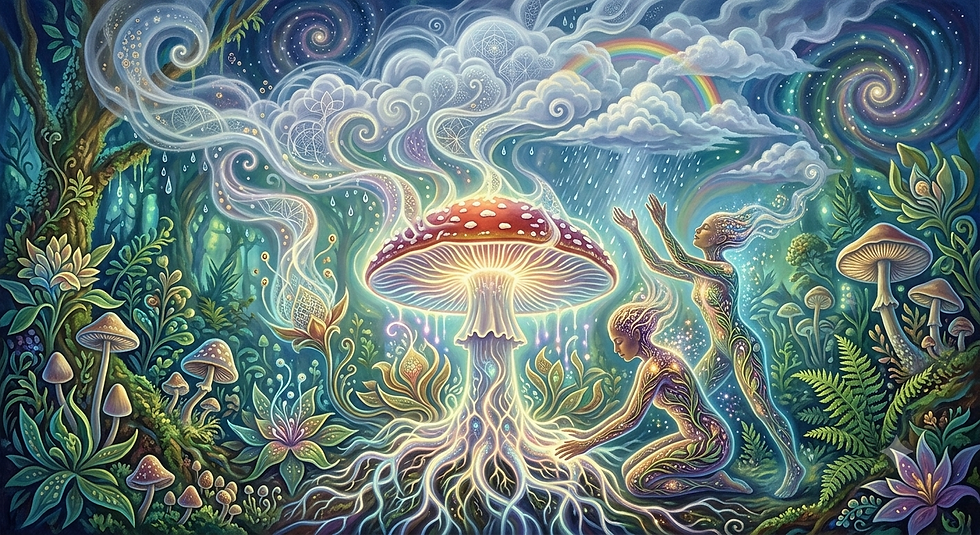
Before him, sprouting from the cracks in the asphalt like a modular architectural heresy, were the Cerro mushrooms. They were a blue so profound they felt like a bruise on the eye of God—fleshy, silent, and smelling of the very beginning of the world. Tabula Rasa. The slate was not merely wiped; it was shattered, ground into a fine, pale powder that promised a peace devoid of history.
The Pendulum of Avarice
But the air curdled. Doctor Greedy Pants appeared, a frantic, geometric blot against the horizon. He was the antithesis of the blue Cerro; he was the friction in the gears, the grit in the oyster that produced no pearl. He clutched his rusted iron whistle with a desperate, white-knuckled avarice, his lungs inflating with the toxic vanity of a man who believes he can command the wind.
He blew.
The sound was a jagged, serrated edge—a picky surface that sought to tear the silence. It swung like Foucault’s Pendulum, a heavy, brassy weight oscillating between the ego and the void, marking the rotation of a world that had long since moved on from his ledgers.
Each shriek of the whistle was a bid for relevance, a frantic tallying of debts in a room that had become a cathedral.
Then, the sky folded.
An Owl, vast and silent as a forgotten thought, dropped with the terminal velocity of divine indifference. It did not hunt; it merely arrived. There was no struggle, only a wet, percussive finality. The Doctor’s whistle was silenced mid-note as he was flattened—compressed into a two-dimensional absurdity, a culinary catastrophe of pancakes and waffles sizzling on the hot tarmac of the skids. The miser’s pall was literally trodden into the grit.
The Divine Wetness
Lazarus turned. Venus and Apollo stood in the central courtyard of the aftermath, no longer drivers but guardians of the "ineffable grace." The air grew thick, not with the cloy of berries, but with a humid, rhythmic thrum.
"There’s some wh--- in this house..."
The chanting began, a low-frequency vibration that shook the baskets of flowers. It was the sound of the Wet and Gushy—not a vulgarity, but a flood of pure, unadulterated life-force. It was the macaroni in the pot of existence, the "big demeanor" of the soul.
Apollo took the rhythm, his hands moving with a "king cobra" precision, while Venus presided over the "magic shadows" of the scene.
It was a "certified freak" of a resolution. The conservatory, the Eldorado, the shitpile of old magazines—all were being washed away by the "stream" they had dared to dream. Lazarus reached down, his fingers stained blue by the Cerro, and felt the water that was wet, the dive that was inevitable.
The Final Orientation
Lazarus stood in the center of the "wet and gushy" deluge, his body finally locked in its proper north-south orientation. He didn't cook, he didn't clean, but he held the ring of a new, terrifying peace. The dignity of the moment was extra large and extra hard.
The Doctor was a breakfast food.
The roadblocks were a memory.
The blue bird had ceased its mourning to become a predator of the sky.
"Give me everything you got," Lazarus whispered to the void, and the void, for once, complied with a bucket and a mop.