The Infinite Resonance: Psilocybin and the Cognitive Ecology of the Social Brain
- One Love Energy
- Mar 11
- 3 min read
The Infinite Resonance: Psilocybin and the Cognitive Ecology of the Social Brain
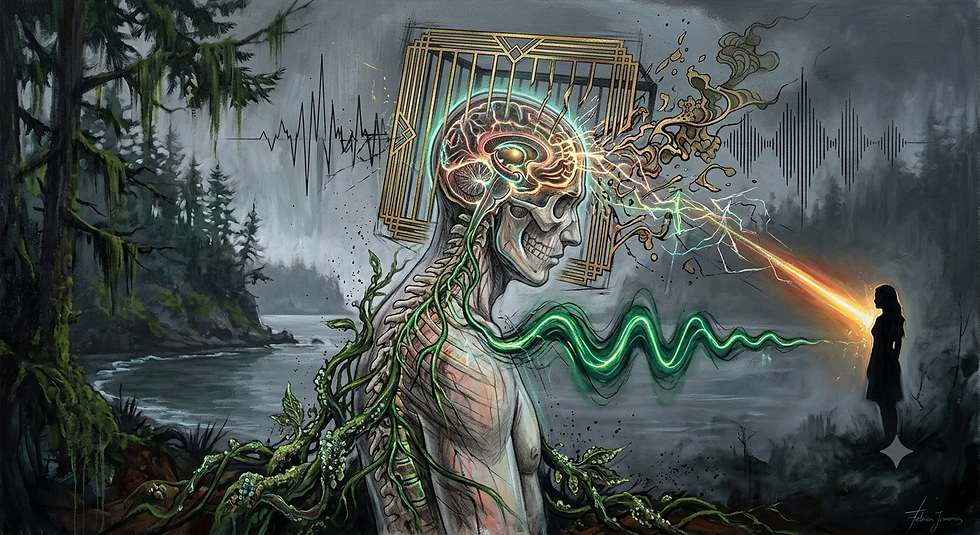
The human condition is a relentless, iterative game of "Othering." As established by the landmark research of Buergi et al. (2026), our survival is tethered to adaptive mentalization—a sophisticated neuro-computational process where the Right Temporoparietal Junction (rTPJ) and Anterior Insula (AI) serve as the high-stakes hubs for updating our internal models of the world. Yet, in the modern landscape of depression, social anxiety, and trauma, these hubs often become calcified. We find ourselves trapped in a stagnant cognitive ecology, playing a rigid, defensive game against a world we no longer trust.
Psilocybin therapy emerges not merely as a pharmacological intervention, but as a radical "Bayesian reset" that restores the fluid, prosocial resonance of the human spirit.
The Rigid Game: Stagnation and the Zero-Sum Self
Before healing can occur, we must recognize the pathology of the "Closed Game." In a state of social disconnectedness, the brain’s CHASE model parameters are locked into a survivalist crouch.
* The Neurobiology of Isolation: The rTPJ, rather than being a hub for dynamic belief updating, becomes a fortress. Coupling with the Anterior Insula is redirected toward monitoring Loss Sensitivity (\lambda). Every interaction is filtered through the amygdala's threat-detection, prioritizing ego-preservation over connection.
* The Strategic Failure: Under this regime, we default to low-level recursive reasoning (k=1). We assume the "Other" is a static competitor. This is the Zero-Sum Ecology: a lonely, competitive landscape where we stop learning, stop updating, and ultimately, stop belonging.
The Psilocybin Catalyst: Expanding the Cognitive Horizon
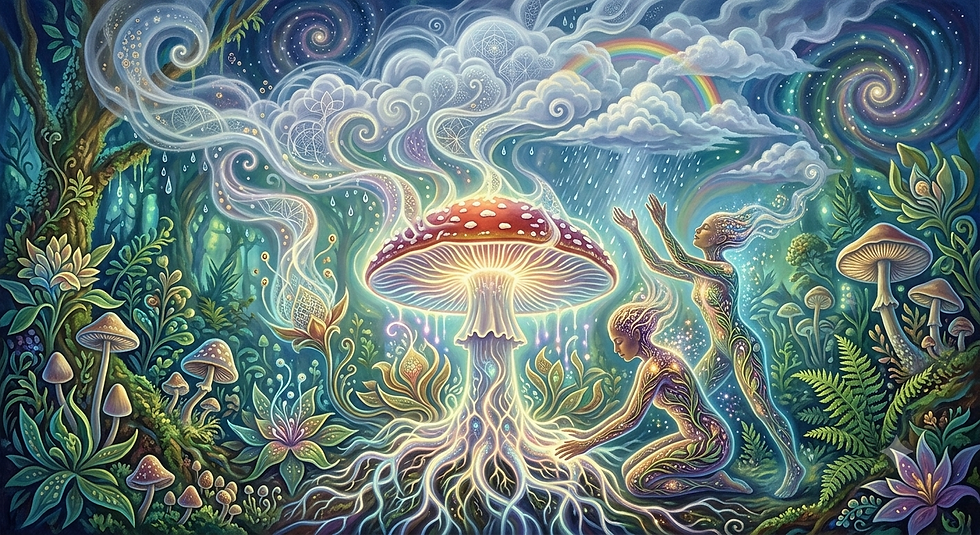
Psilocybin shatters this defensive posture by targeting the 5-HT2A receptor, the brain's primary gateway for neuroplasticity and transformation.
* Inference Expansion: By temporarily disrupting the Default Mode Network (DMN)—the seat of our rigid narrative self—psilocybin lowers the "priors" that keep us trapped. The Belief Update (BU) signal identified by Buergi is suddenly liberated.
* Hyper-Connectivity: As the DMN’s grip dissolves, the brain enters a state of high entropy. However, this is not chaos; it is a profound expansion of \kappa (sophistication). We move from the tactical "Me vs. You" to a holistic "We," where the rTPJ begins to track shared agency rather than individual exploitation.
Salient Recalibration: The Prosocial Pivot
The healing power of psilocybin is found in the transition from Game Theory to Game Resonance. The therapeutic experience recalibrates the social brain through three vital shifts:
* Dissolving the Boundary: While the rTPJ and AI connectivity "scrambles" during the trip, this inhibition actually facilitates Ego Dissolution. By blurring the neural line between self and other, the motivation to "outsmart" an opponent is eclipsed by the drive to harmonize with a partner.
* Reducing Social Pain: By dampening the Anterior Insula’s reaction to social "loss," psilocybin makes the world safe to play in again. We re-engage with the Social Novelty of others, no longer paralyzed by the fear of rejection.
* Neural Entrainment: Instead of trying to stay "one step ahead" (k+1), the adaptive mentalization signature shifts toward Synchrony. We stop playing a game of dominance and start playing a game of resonance.
Conclusion: The Infinite Game of Healing
Healing is the act of re-entering the Infinite Game. Unlike finite games that aim for a conclusion and a winner, the Infinite Game is played for the purpose of continuing the play. Psilocybin’s true power lies in its ability to return us to this Cognitive Ecology of Connection.
Through the lens of neuroscience, we see the rTPJ move from a cold, strategic calculator to a warm, empathetic hub. Through game theory, we see the zero-sum ego expand into a non-zero-sum collective. Through the experience of the mystic, we find that the "Other" is not a target for exploitation, but a mirror for transformation.
We heal when our internal models finally catch up to the truth: that we are not isolated players in a hostile game, but intrinsic participants in a vibrant, evolving resonance. Psilocybin does not just change our minds; it restores our capacity to be sticky with life, to track the beauty in others, and to play the most important game of all—the one where everyone wins because the game never ends.
The goal of the Infinite Game is not to outsmart the 'Other,' but to expand the 'Self' until the 'Other' is no longer an opponent, but a partner in the play.
Buergi, N., Aydogan, G., Konovalov, A. et al. A neural signature of adaptive mentalization. Nat Neurosci (2026).