The Living Cartography of Indigenous Resilience
- One Love Energy
- Mar 19
- 3 min read
The resonance of an ancient identity does not simply fade into the atmosphere; it settles into the very marrow and molecules of those who carry it forward. To understand the modern Indigenous journey is to recognize a profound continuity where the spiritual and the biological are not separate territories, but a single, integrated landscape. This is a story of resilience written in a genetic script, a narrative where the quality of the soul is mirrored in the unique challenges of the physical form.
The Biological Archive of Survival
The internal map of many Indigenous populations contains a sophisticated record of ancestral endurance. For mille
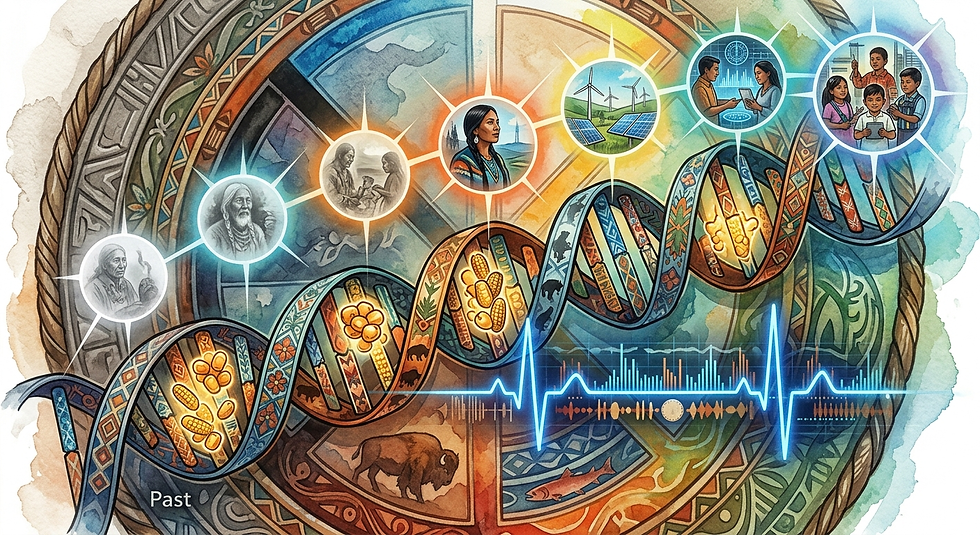
nnia, various groups developed a metabolic architecture designed for extreme efficiency. This adaptation, often discussed through the lens of a survival-oriented genetic profile, allowed for the rapid storage of energy during periods of abundance to safeguard against times of scarcity.
In a modern context, this evolutionary masterpiece encounters a profound environmental mismatch. The same ABCA1 and KCNQ1 gene variants that once ensured survival now navigate a landscape saturated with processed inputs and sedentary rhythms. This results in a heightened susceptibility to metabolic conditions such as Type 2 Diabetes (T2D).
However, seeing this strictly as a "disease" misses the deeper truth of the body’s memory. It is a biological testament to a history of triumph over harsh conditions. The challenge today is not to "fix" the genetics, but to restore a world where that unique biological brilliance can once again function in harmony with its surroundings.
The Epigenetic Pulse and the Care of the Soul
Beyond the static sequences of DNA lies the fluid realm of gene expression. Science now suggests that the profound stresses of the past—the forced silences, the displacements, and the historical disruptions of community—have left chemical markers on the genome. This intergenerational echo means that the nervous system of a descendant may carry a heightened sensitivity to the world, a physiological reflection of a "dark night" experienced by those who came before.
This is where the concept of dignity becomes a medical necessity. When a culture prioritizes the care of the soul and the restoration of traditional rhythms, it is engaging in a form of biological healing. By returning to the principles of long-term stewardship, where every action is weighed against its impact seven generations into the future, the community begins to re-tune its collective biology. This spiritual practice acts as a dampener on the epigenetic noise of past trauma, allowing for a new state of health to emerge.
The Cartography of Sacred Presence
The relationship between the individual and the environment in this experience is defined by an inherent sense of sacredness. The ground is not merely a resource; it is viewed as being enriched by the life cycles of countless predecessors. This perspective transforms the very act of walking into a dialogue with the past.
There is a persistent understanding that the world is never truly empty of its original inhabitants. Even when the physical presence of a people seems to ebb like a receding tide, the spiritual and biological imprint remains. This creates a unique form of dignity—one that does not rely on external recognition or legal "tables of stone," but on an internal realization of the quality and depth of one’s connection to the cosmos.
Sovereignty as a Biological Intervention
The path toward opportunity and recognition is increasingly paved through the reclamation of traditional food systems and economic models. This movement, sometimes referred to as the pursuit of total sovereignty, recognizes that the health of the body cannot be separated from the autonomy of the culture.
Nutritional Restoration: By returning to ancestral diets—farming heirloom crops and prioritizing traditional proteins—communities are speaking to their genes in a language they recognize. This is more than a cultural revival; it is a precision-guided intervention against T2D.
Economic Integrity: True opportunity arises when development aligns with communal values. This involves creating systems that favor long-term stability and spiritual health over short-term extraction.
A Multi-Perspectival View: Seeing the world through a multitude of "eyes" allows for a sophisticated navigation of the modern world. It involves respecting the hard data of the laboratory while honoring the deep, intuitive truths held in the collective memory.
The Transition of Worlds
The narrative of the Native American experience is moving toward a horizon of renewed greatness. It is a transition from a period of being overshadowed by external forces to a period of internal illumination. The unique biological challenges of the present are being reframed as catalysts for innovation and self-determination.
The realization that there is no true ending, but only a shift in how life is expressed, provides a powerful foundation for the future. The biological "dust" of the ancestors is not a burden of the past, but the building material for a sovereign tomorrow. It is a map where every heartbeat is a bridge between the ancient world and the world yet to be born.


