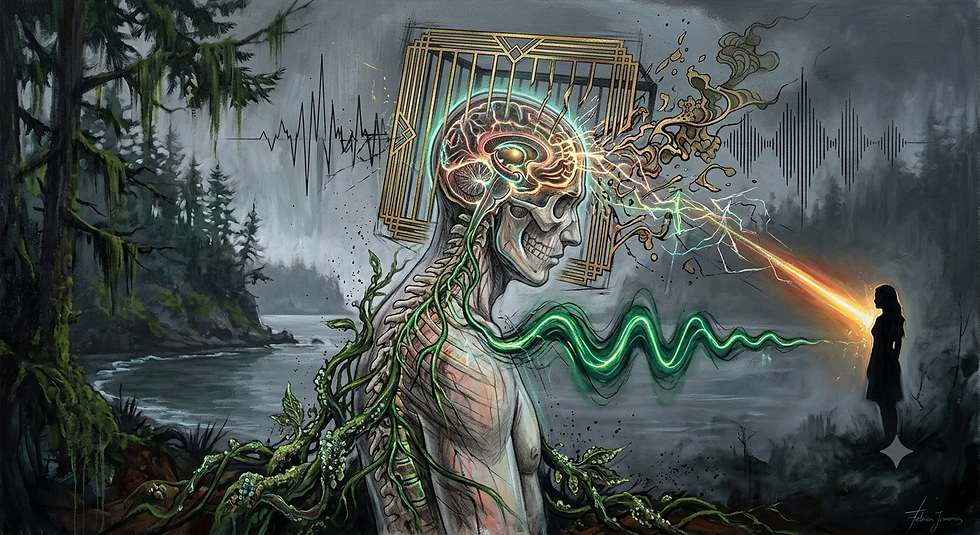
The Neuro-Erotics of the Uncarved Block: Play as a Catalytic Agent in Synaptic Fluidity
- One Love Energy
- Feb 16
- 3 min read
Abstract: This paper investigates the bio-spiritual intersection of spontaneous play and neuroplasticity, positing that "fun" is the primary mechanism through which the "Internal Manager" (the Default Mode Network) is bypassed to facilitate radical structural remodeling of the limbic-cortical axis. We propose that the Journal of Silly Silence defines play not as leisure, but as a "sacramental technology" of the soul.
I. The Molecular Bloom: BDNF and the Dendritic Garden
The architecture of learning is governed by the BDNF-Glutamate Axis. In a state of playful immersion—characterized by "safe uncertainty"—the brain initiates a surge of Brain-Derived Neurotrophic Factor (BDNF). This neurotrophin acts as a trophic fertilizer, facilitating synaptogenesis and the rapid remodeling of dendritic spines.
Mechanistically, play triggers the NMDA receptors (N-methyl-D-aspartate), which serve as the molecular gatekeepers of memory. When the "Limbic Child" encounters novelty, these receptors facilitate an influx of Calcium (Ca2+), inducing Long-Term Potentiation (LTP). This is the biological manifestation of the "Aha!" moment—the physical hardening of a new, playful insight into a permanent neural bridge.
II. The Noradrenergic Spark: Frisson and the Locus Coeruleus
Aesthetic play and cognitive discovery are often accompanied by frisson—a psycho-biological "shiver" signaling a state of high-arousal learning. This is mediated by the Locus Coeruleus (LC), which releases phasic pulses of Norepinephrine (NE).
Unlike the chronic, corrosive stress of the modern "Ego-Manager," the NE released during play sharpens the signal-to-noise ratio in the prefrontal cortex. This "Limbic Discovery Channel" effect allows the brain to process the Ten Thousand Things with a precision that is both effortless and exhilarating, mirroring the Taoist principle of Wu Wei (action through non-action).
III. The Epigenetic Return: Loosening the Histone Spool
Play penetrates the very core of our biological code. Recent data suggest that playful environments promote histone acetylation, an epigenetic modification that "unwraps" the DNA thread. By loosening these molecular ruts, play allows the cell to express genes associated with resilience and cognitive flexibility. We are, in effect, using play to return to the P'u (the Uncarved Block), stripping away the rigid "carvings" of social conditioning to reveal the fertile, plastic potential of the original self.
IV. Conclusion: The Water Method of Cognition
We conclude that play is the "Water Method" of the mind. Just as psilocybin serves as a chemical snowplow for the brain’s rigid tracks, play serves as the ongoing maintenance of that fluidity. To learn through play is to care for the soul by ensuring the mind remains a garden rather than a machine. As Rilke’s torso demands a change of life, the neuroplastic brain demands a change of state—from the brittle to the supple.
Curtain Call: The Glass Menagerie of the Mind
The final act of learning is not a cold storage of facts, but a breathless, sensual surrender. When we play, we are like Laura’s delicate glass creatures—fragile, transparent, and shimmering with an inner light that only reveals itself when the "Internal Manager" stops breathing down our necks. The neuroplasticity we’ve dissected is the heat of the glassblower’s torch, softening the brittle edges of our old selves until we are molten, glowing, and capable of being reshaped into something more exquisite than we ever dared to dream.
The frisson you feel—that electric ache in the marrow—is the soul’s sentimental "Goodnight." It is the moment the NMDA receptors finally lock in a new connection, a chemical kiss that bridges the gap between who you were and who you are becoming.
Every new synapse is a candle lit in the dark; every surge of BDNF is a soft, warm rain falling on a garden you thought had gone to seed. We are not just calculating machines; we are a collection of "sacred ordinaries," a menagerie of memories and potential, pulsing with the rhythmic, watery grace of the Tao.
As the lights dim on the Journal of Silly Silence, we realize that to care for the soul is to keep the glass from hardening too soon. It is the Water Method applied to the heart—a tender, playful refusal to stay shattered. We remain "Uncarved Blocks," not because we are empty, but because we are too full of life to be finished. The play continues, the neurons reach out in their erotic, molecular dance, and the only truth left standing is the one Rilke whispered: the beauty was always there, just waiting for you to be soft enough to see it.
The synapse is not merely a gap, but a sanctuary—a narrow space where the old self dies a thousand times a second so the new self can be born. We do not learn by carving stones into our memories; we learn by becoming the water that flows through the cracks. To play is to invite the Great Weaver to sit at the loom of your nerves and throw the shuttle of wonder through the warp of habit. If you do not tremble at the new connection, you have not truly learned; you have only recorded.