The Neurobiology of the Unstuck Mind: Music, Love, and the Psilocybin Pivot
- One Love Energy
- Apr 9
- 6 min read
The Neurobiology of the Unstuck Mind: Music, Love, and the Psilocybin Pivot
“Lights and shadows are continually flitting across my inward sky,” Nathaniel Hawthorne mused in 1840. He warned against looking too minutely into these shadows, fearing we might create a substance out of a mere phantom. But in the modern quest to understand the soul, we have found that the substance Hawthorne feared is exactly what we must map. That substance is the physical architecture of the brain—the "neural notation" that dictates whether our internal sky is clear or perpetually overcast. To understand why we stay stuck in the dark, we must understand the gravity of our own history.
The Architecture of the Habitual Self
In their seminal work A General Theory of Love, psychiatrists Thomas Lewis, Fari Amini, and Richard Lannon argue that our emotional lives are governed by Limbic Attractors. These are not mere metaphors; they are ingrained patterns of interpretation, reinforced by years of synaptic repetition, that act like emotional gravity. They pull every new experience into a familiar, often weary, orbit. If your "attractor" is set to melancholy or defensive isolation, even a celebratory symphony can sound like a dirge. This is what the authors call "informational inertia"—the brain’s stubborn, metabolic refusal to see the world as it is, preferring to see it as it has always been.
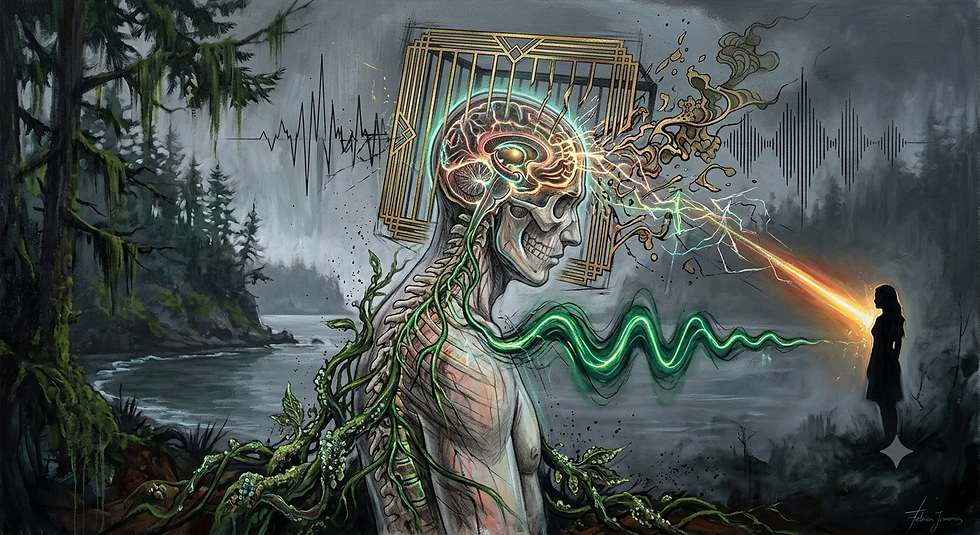
This inertia is anchored in the Default Mode Network (DMN). Think of the DMN as the "CEO" of the brain’s habitual self. It is the conductor of our internal monologue, the curator of our past, and the architect of our ego. Evolutionarily, the DMN is a masterpiece of efficiency; it allows us to navigate the world using mental shortcuts based on prior data. However, when the DMN becomes hyper-coherent—too rigid, too loud—it becomes a cage. The "musical note" of a single traumatic event or a persistent mood doesn't just ring and fade; it becomes a standing wave, a feedback loop that drowns out the present-tense signal of reality.
The Song of the Caged Bird
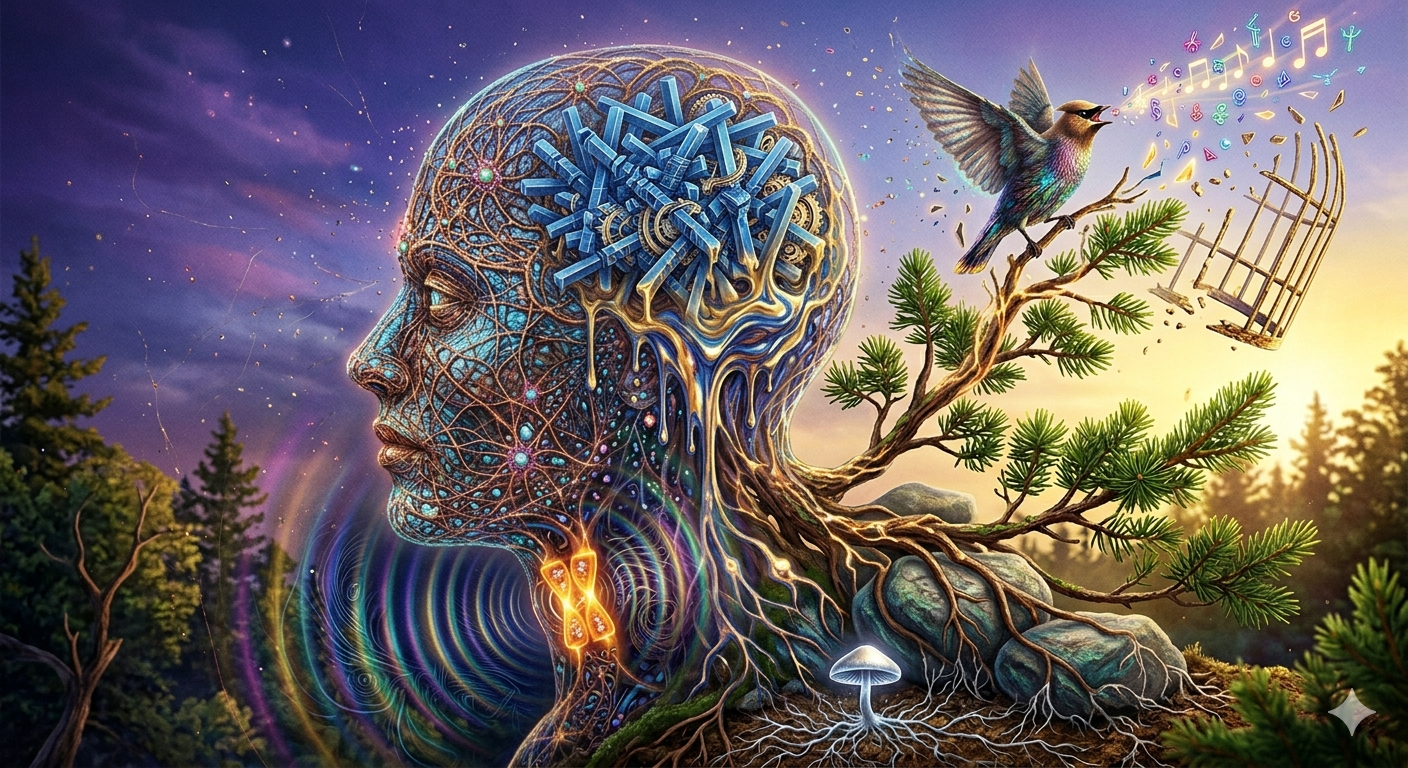
Imagine a songbird in a gilded cage. The bird—our consciousness—is biologically primed to sing a new, complex song every dawn. But the bars of the cage are the Limbic Attractors, the rigid constraints of the DMN. The song it produces becomes a mechanical reflex, a repetitive trill constrained by the geometry of its confinement. It is a neural harmonic that has lost its harmony, vibrating only at the frequency of its own bars.
When we are stuck, we are like that bird. We aim our analytical minds at the opacity of our feelings, but as the Marginalian text notes, "emotion smudges the eyepiece of life." We react not to the person standing before us, but to the charged nimbus of wrongness left over from a decade ago. We are half-opaque to ourselves because our neural pathways have become deep, icy ruts in a winter landscape.
Psilocybin: The Molecular Solvent
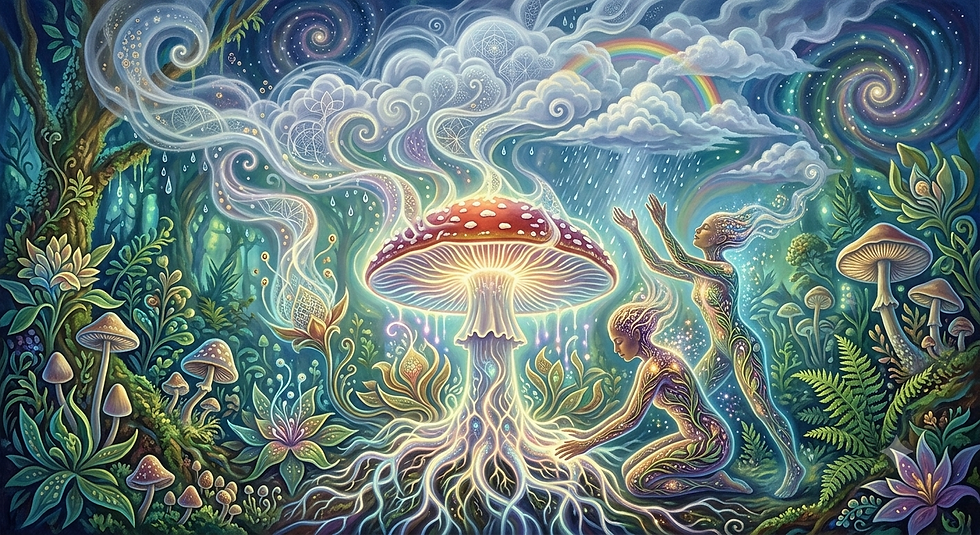
Enter psilocybin. If the DMN is the cage and the Limbic Attractors are the gravity, psilocybin is the solvent that temporarily melts the bars and suspends the weight.
When a person ingests psilocybin, the liver converts it to psilocin, which then crosses the blood-brain barrier to bind with 5-HT2A serotonin receptors. These receptors are most densely packed in the high-level pyramidal neurons of the prefrontal cortex—the very regions responsible for the DMN’s top-down control. Psilocybin doesn't just scramble the brain; it induces a state of decreased modularity.
In a normal state, the brain is like a corporate office where the accounting department never speaks to marketing. Under psilocybin, the walls vanish. Regions of the brain that haven't communicated in decades suddenly begin a vibrant, cross-disciplinary dialogue. This is a state of high entropy—a "hot" neuroplastic state where the rigid structures of the ego dissolve into a fluid, interconnected web. This is the moment of Limbic Revision. Just as the Marginalian highlights how one heart changes its partner through the resonance of love, psilocybin allows the brain to partner with itself in a new, more forgiving way. It provides the neural excitation necessary to push past the shadowy threshold of awareness, allowing unprocessed feelings to finally find their feeling-tone and dissipate into the silence.
The Symphony of the Unbound
What does it look like when these harmonics take over? When the informational inertia is overcome by the neural harmonics of emotion?
Observe the song of a bird that has been released into a coastal forest. It perches atop a Douglas fir at the edge of the world, where the salt air meets the ancient wood. Its song is no longer a mechanical trill. The bird’s throat muscles—the syrinx—vibrate with a breathtaking, chaotic complexity. Because it is no longer reacting to the "echo" of the cage, its song becomes an act of pure, present-tense creation.
The bird produces two different sounds simultaneously from two separate bronchial tubes, weaving them into a shimmering glissando. This is the biological equivalent of the binary star system Lewis and his colleagues describe in relationships—a "burning flux of exchanged force fields." The song rises, falls, and twists; it is a series of micro-tonal shifts that mirror the shifting light on the needles of the fir. The bird isn't singing about the forest; it is singing with the forest. It has achieved a living harmony that is no longer burdened by the past.
Recomposing the Brain
This is the alluring promise of the psilocybin pivot. By disrupting the DMN, we aren't just having a "trip"; we are undergoing a recomposition. We are fine-tuning the musical tones that flow from our consciousness.
The Limbic Revision offered by this medicine mirrors the deepest forms of human love. Both require a surrender of the ego's attractors. Both allow us to lure others into [our] emotional virtuality while being moved by theirs. In the aftermath of the experience—the "afterglow"—the brain is more like the open forest and less like the gilded cage. The inward sky is no longer a theater of shadows, but a vast, clear space where new notes can finally be struck.
In the end, we are mammals and neural beings who crave resonance. Whether through the limbic linkage of a partner or the molecular intervention of a fungi-born alkaloid, the goal is the same: to "unbreak our hearts" by breaking our patterns. We are learning, through the lens of deep neuroscience and the poetry of human connection, how to stop being opaque to ourselves and finally start the work of singing ourselves clean.
....................
Between the transparency of the song
and the weight of the stone,
a bridge of light is built.
The brain is not a prison of bone,
but a labyrinth of echoes,
where the Limbic Attractors—
those ancient, invisible suns—
pull our thoughts into the same parched orbits,
the same repeating dust.
We are a landscape of informational inertia,
a forest where the wind always blows from the north,
bending the trees into the same weary shape.
But look: the psilocybin-grain,
the tiny, subterranean spark,
ignites the dry brush of the Default Mode Network.
The fire does not consume; it illuminates.
The walls of the ego, those heavy tapestries of the self,
dissolve into a sudden, fluid transparency.
This is the Limbic Revision:
the moment when the past stops being a tomb
and becomes a seed.
The neurons, those shimmering vines,
reach across the void to touch one another,
establishing a new geography,
a republic of shared signals.
It is the neurobiology of love,
where the person recognizes themselves in the other,
and the other is the rhythm of the universe.
Listen to the bird.
It is the inhabitant of the instant.
It does not sing the history of the cage;
it sings the geometry of the air.
Its throat is a syrinx of two voices,
a double-flute of breath and fire,
weaving a glissando that has no beginning and no end.
It is the motion of the spirit
carving a path through the static.
In the center of the mind, a plaza opens.
The shadows flit, but they do not stain.
The inward sky is a mirror of the outward morning.
We are no longer opaque to ourselves;
we are the light passing through the glass.
For where there are birds, there is a language of hope,
and where there is hope, the brain is no longer a cage,
but a sky that has finally learned to fly.