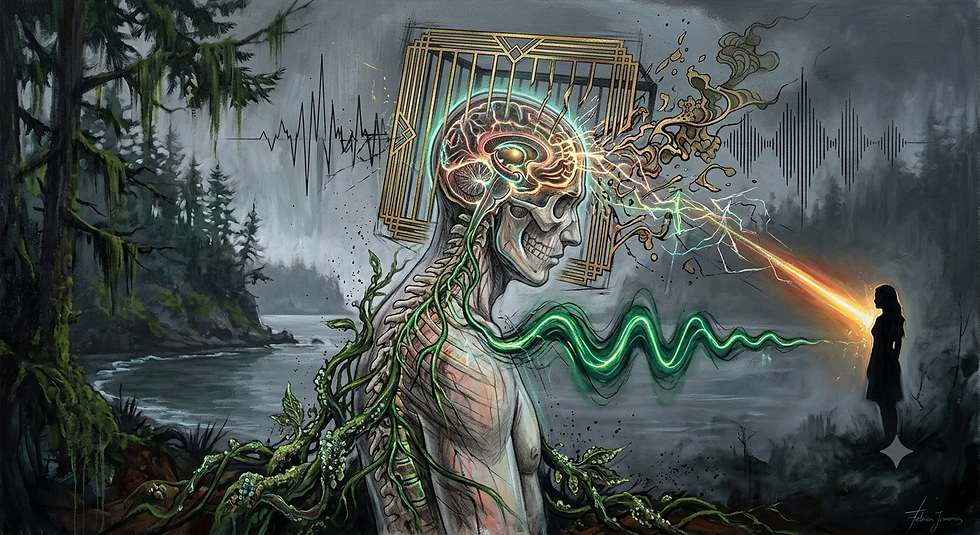
The Neurological Architecture of the Psychedelic State: A Comprehensive Synthesis of Network Reorganization and Therapeutic Viability
- One Love Energy
- Apr 9
- 6 min read
The Neurological Architecture of the Psychedelic State: A Comprehensive Synthesis of Network Reorganization and Therapeutic Viability
In April 2026, a massive study published in Nature Medicine completely changed the game for psychedelic science. Led by neuroscientist Manesh Girn and published on April 6, this international mega-analysis pooled brain imaging data from labs across five countries, creating the largest study of its kind to date. By combining brain scans from hundreds of people, scientists finally mapped out exactly what happens in the human brain during a psychedelic experience.
For decades, small and expensive studies gave us fragmented and sometimes contradictory ideas. Some researchers thought psychedelics simply "turned off" the brain's default mode network. However, this new mega-analysis proves things are much more complex.
It turns out that whether someone takes lab-made LSD or a traditional botanical brew like ayahuasca, their brain activity shifts in a remarkably similar, unified way.
This research reveals a brain state defined by the breaking down of mental boundaries, the scrambling of normal communication pathways, and a massive surge in global neural connectivity. Crucially, this biological validation arrives at a time when the field of psychedelic medicine is facing intense regulatory and ethical pushback.
Breaking Down the Walls: The Collapse of Brain Hierarchy
Normally, our brains are strictly organized into a hierarchy. At the bottom, you have sensory networks that process raw, incoming data from the outside world—things like sight, sound, and touch. At the top, you have higher-order networks that handle abstract thinking, memory, and our sense of self.
Usually, these systems are kept highly separate. This strict division is what allows us to navigate the physical world efficiently while maintaining a clear, distinct sense of who we are as individuals.
Psychedelics temporarily tear down these neurological walls. They force regions of the brain that usually operate in isolation to talk to each other freely. This breakdown explains why people on psychedelics often can't tell the difference between their internal thoughts and the outside world.
It also explains the phenomenon of synesthesia, where people report "seeing" sounds or "tasting" colors. By flattening the brain's hierarchy, the strict boundary between perception and cognition dissolves.
Certain networks are particularly impacted. The salience network, which normally helps us figure out what to pay attention to, gets totally scrambled. Even a small sheet of gray matter called the claustrum—which is believed to be responsible for setting attention and switching tasks—gets turned down, a change that closely mirrors patient reports of feeling connected to everything.
This floods the conscious mind with raw, unfiltered data. It even profoundly distorts the perception of time. Because psychedelics suppress the default mode network and alter the function of the basal ganglia and cerebellum (which usually manage interval timing), the brain loses its standard spatiotemporal orientation, causing minutes to feel like hours or linear time to evaporate entirely.
The Hyper-Connected Brain
Past studies argued over whether psychedelics disconnect the brain or over-connect it. This 2026 mega-analysis finally settles the debate: psychedelics trigger a state of dynamic "hyper-connectivity."
They do this in a very specific two-step process. First, they weaken the tight, internal connections within specific, specialized networks. Then, they cause a massive surge in communication between different networks that usually ignore each other.
Deep brain structures—like the thalamus and the basal ganglia, which normally act as bouncers filtering out junk sensory data—suddenly start sending unfiltered information straight to the higher-thinking parts of the cortex.
While all classic psychedelics share this general blueprint, the study did pinpoint some specific quirks for different drugs. LSD and psilocybin act very similarly, serving as the most consistent drivers of this brain-wide cross-talk. DMT, on the other hand, packs the biggest punch, showing the most dramatic and intense increases in overall brain connections.
Mescaline follows a similar but slightly milder pattern. Ayahuasca is the outlier; because it is a complex botanical brew, its effects are more idiosyncratic, often decreasing connections in the brain's emotional and memory centers.
These sweeping connectivity changes are directly tied to what patients actually feel. The specific transition rate into this hyperconnected state coincides perfectly with the feeling of "oceanic boundlessness"—that profound sense of spiritual unity, bliss, and insightfulness. Because this brain-wide connectivity correlates much more strongly with ego-dissolving experiences than with visual hallucinations, researchers now classify these drugs as primarily "egotropic".
Why This Matters for Therapy
This anarchic, hyper-connected brain state isn't just a wild ride; it is exactly what makes these drugs so promising for psychiatric therapy.
Conditions like severe depression and opioid addiction trap the brain in rigid, negative loops. For example, in treatment-resistant depression, the brain's default mode network gets hyper-connected internally, keeping a person stuck in relentless pessimistic thoughts and negative self-focus. Chronic opioid abuse similarly physically rewires and entrenches the brain's reward circuitry.
Psychedelics act like a complex neurological reset button. Classic psychedelics bind to serotonin 5-HT2A receptors, which increases neuronal excitability through mechanisms like membrane depolarization, but they also engage 5-HT1A receptors that functionally decrease excitability. This intense push-and-pull fundamentally alters electrophysiology and opens a temporary window of high brain plasticity.
By dismantling rigid pathways, they allow individuals to bypass entrenched addictive compulsions and lift the heavy blanket of depressive rumination. This mechanism explains why clinical trials have frequently shown massive, rapid symptom relief that can last for months after just a single guided session.
The Regulatory Roadblock: The FDA and Lykos Therapeutics
But despite these incredible scientific breakthroughs, the real-world rollout of psychedelic medicine hit a massive wall recently. On August 9, 2024, the US Food and Drug Administration (FDA) flat-out rejected Lykos Therapeutics' application to use MDMA-assisted therapy for PTSD, issuing a complete response letter.
The FDA told the company they needed to run a completely new, multi-year Phase 3 clinical trial to prove the drug was safe and effective. This decision was largely expected after a brutal advisory committee meeting earlier that summer, where the panel voted 9-2 against the drug's effectiveness and an overwhelming 10-1 against its benefit-risk profile.
The FDA panel said no primarily because of deep flaws in how the research was conducted. The intense, obvious effects of MDMA made it incredibly easy for patients and therapists to guess who got the real drug and who got a placebo, ruining the "double-blind" setup and introducing huge expectation biases.
On top of that, the FDA panel was highly concerned about safety risks. They noted a glaring lack of comprehensive cardiovascular (QTc) data, risks of hyponatremia, and severe ethical boundary violations by therapists. The committee stated that any future approval would require drastic safeguards, such as mandating the presence of two licensed therapists, onsite medical staff, and independent safety training. In the fallout of this rejection, Lykos Therapeutics was forced to restructure and reduce its workforce by 75%.
A Crisis of Trust and Retracted Studies
The FDA rejection didn't happen in a vacuum. It occurred alongside a broader crisis of trust and research integrity within the psychedelic science community.
In 2024, the respected journal Psychopharmacology retracted three major papers on MDMA therapy. The journal explicitly cited "protocol violations amounting to unethical conduct" at the MP4 study site, and noted that the researchers failed to disclose their competing financial interests with the organizations funding the trials.
Then, in June 2025, a heavily cited meta-analysis claiming that psychedelics boost a specific neuroplasticity marker in the blood (called BDNF) was also retracted. An independent researcher, Gregor Hasler, proved that human blood BDNF levels don't reliably change at all after taking psychedelics (calculating a statistically insignificant effect size of 0.024). When Hasler pointed out the flaws, the original authors contacted the journal requesting massive changes—including altering the statistical analysis, removing figures, and even changing the listed authorship. The journal accurately determined this destroyed the paper's reliability and pulled it entirely.
These high-profile retractions highlighted a major problem: the eagerness to legitimize psychedelic medicine was sometimes outpacing basic scientific and ethical rigor.
The Path Forward
So, where does that leave the field of psychedelics? We are currently looking at a massive divide.
On one hand, the fundamental science of how psychedelics rewire the brain has never been clearer or more validated. Thanks to the 2026 mega-analysis, the hyper-connected, boundary-dissolving brain state is a proven, objective reality. The biological mechanisms for treating depression and addiction are sound.
On the other hand, the clinical side of the field is doing some serious soul-searching. To move past regulatory roadblocks like the FDA's recent rejection, researchers have to clean up their act. They must prioritize bulletproof ethics, completely independent oversight, and standardized clinical practices.
Most importantly, they need to start relying less on biased, subjective patient surveys and more on the hard, objective brain-imaging biomarkers that the newest neurobiology has provided. If the field can bridge this gap between solid lab science and rigorous clinical practice, psychedelic therapy still holds the potential to revolutionize modern psychiatry.