The Neuroplastic Renaissance
- One Love Energy
- Apr 8
- 7 min read
The Neuroplastic Renaissance: Breaking the Blindness of Betrayal
For decades, the "magic" in mushrooms was a matter for counterculture posters and police blotters. But in the quiet clinical suites of the "psychedelic renaissance," psilocybin is being recast. It is no longer a tool of mere escapism, but a precision instrument for cognitive flexibility. As a recent meta-analysis in Frontiers in Psychiatry suggests, we are on the cusp of a therapeutic revolution that treats the brain not just as a soup of chemicals, but as a rigid structure in need of a "molecular reset."
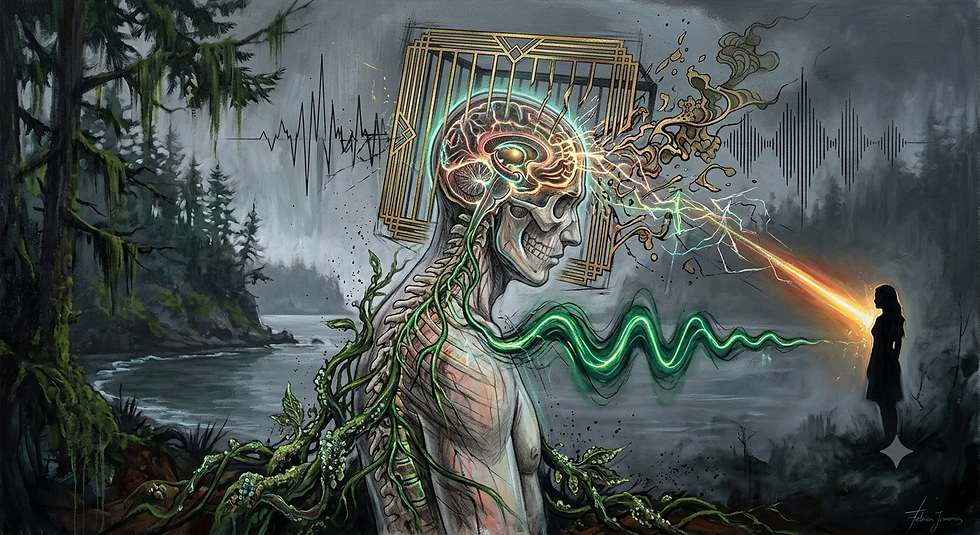
At the heart of this shift is the challenge of the "stuck" mind. Whether it is the self-reinforcing loop of Major Depressive Disorder or the compulsive rituals of OCD, the brain often becomes a victim of its own efficiency. It creates "non-adaptive beliefs"—mental ruts that become so deep the traveler can no longer see over the edge. In the specific case of betrayal blindness, the brain chooses a survivalist ignorance, "forgetting" or ignoring harm to maintain a necessary relationship. It is a form of cognitive ossification.
The REBUS Model: Softening the Rigid Mind
To understand how psilocybin intervenes, researchers point to the REBUS model (RElaxed Beliefs Under Psychedelics). In a normal state, our brain relies on "heavy priors"—internal models of the world that filter sensory input to save energy. In a traumatized brain, these priors become tyrannical. They tell the sufferer that the world is inherently dangerous or that a betrayer is actually safe, regardless of the evidence.
Psilocybin acts as a catalyst to lower the "inhibitory control" of the higher-level brain regions, specifically the Default Mode Network (DMN). By dampening the DMN, psilocybin allows the brain to enter a state of higher entropy. For the patient suffering from betrayal blindness, the "hidden" trauma is finally allowed to surface because the defensive mechanism that suppressed it has been temporarily taken offline.
The Chemistry of Connectivity
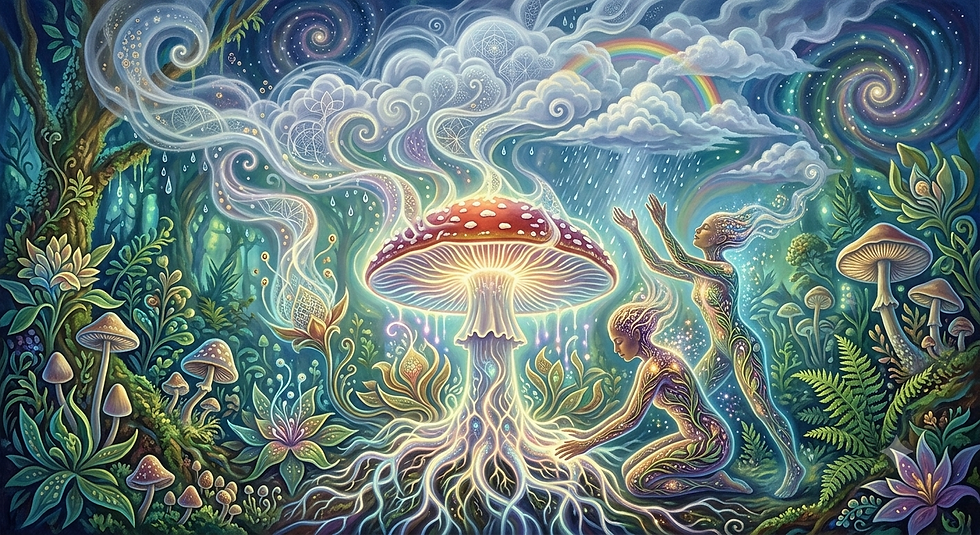
The process is more than metaphorical; it is deeply pharmacological. Psilocybin (or its metabolite, psilocin) acts as an agonist at the 5-HT2A receptors. This interaction doesn't just change how we feel; it changes the architecture of the brain. It triggers neuroplasticity, stimulating glutamate release and activating pathways like BDNF-TrkB, which are responsible for synaptic growth and "dendritic complexity."
Essentially, psilocybin "softens" the brain’s rigid circuits, allowing for the formation of new connections. The clinical results are striking:
Depression: One week after a single dose, patients often report significant symptom reduction, a speed that dwarfs traditional SSRIs.
Substance Abuse: By increasing "self-efficacy," the treatment helps nicotine and alcohol users break the automated behavioral patterns of addiction.
OCD: Pilot studies show symptom decreases of up to 100%, as the brain is finally able to "let go" of intrusive thoughts.
From "Sacred Plants" to Standardized Protocols
The transition from illegal hallucinogen to "Breakthrough Therapy" requires a move from the fringe to the pharmacy. The Frontiers analysis emphasizes that the substance is only half the cure; the other half is the "Set and Setting." This isn't just a hippie mantra; it is a clinical requirement for safety and integration.
The future of psychiatric care likely involves a hybrid model. It is a world where patients don’t take a daily pill to numb their symptoms, but rather engage in "intermittent neuroplasticity"—using a pharmacological key to unlock the mind's rigid doors, followed by intensive psychotherapy to rearrange the furniture inside.
If the 20th century was the era of managing mental illness through chemical suppression, the 21st century is shaping up to be the era of cognitive dynamism. By leveraging the brain's own ability to adapt, we may finally find a way to help people not just live with their trauma, but to see through the blindness and move beyond it.
>>>>>>>>><<<<<<<<
The move to federally legalize psilocybin is not merely a matter of drug reform; it is a mandate for cognitive liberty and a pragmatic response to a burgeoning national mental health crisis.
As we stand amidst a "psychedelic renaissance," the evidence suggests that our current restrictive framework is not protecting the public, but is instead barricading the doors to a transformative medical frontier.
To make the case for legalization, we must look at the intersection of human rights, economic common sense, and the undeniable data of neurobiology.
1. The Argument for Cognitive Liberty
At the core of the democratic experiment is the belief that an individual should have sovereignty over their own consciousness. If the state allows for the consumption of alcohol—a neurotoxin with no therapeutic profile—it is logically inconsistent and morally overreaching to prohibit a substance that occurs in nature and facilitates profound psychological insight.
Legalization is a return to the principle that the government should not criminalize the pursuit of mental well-being, especially when that pursuit involves "ego dissolution" and the breaking of destructive mental ruts.
2. Breaking the "Stasis" of Modern Psychiatry
For decades, the standard of care for depression and anxiety has been the daily pill—the SSRI. While helpful for some, these medications often act as chemical "mutes," dampening the highs and lows of life without addressing the root trauma. Psilocybin offers a different paradigm: intermittent neuroplasticity.
Unlike traditional medicine, psilocybin serves as a catalyst. It targets the 5-HT2A receptors, physically reshaping the brain’s architecture by increasing dendritic complexity. By federally legalizing this substance, we move from a "maintenance" model of mental health to a "resolutive" one. We offer patients a chance to not just manage their symptoms, but to integrate their trauma and move past it.
3. The Economic Imperative
The "war on drugs" has been a fiscal catastrophe, but the cost of untreated mental illness is even higher. Depression and substance use disorders cost the American economy billions annually in lost productivity and healthcare expenditures.
Efficiency of Treatment: Traditional antidepressants require daily adherence and carry a high rate of treatment resistance. Psilocybin has shown the ability to induce remission in a single session.
Regulation vs. Prohibition: Federal legalization allows for a taxed, regulated market where "set and setting" are overseen by medical professionals, eliminating the risks of the black market and ensuring that the "Breakthrough Therapy" designation awarded by the FDA can finally be realized at scale.
4. Addressing the Crisis of Meaning
We live in an era characterized by "betrayal blindness" and social fragmentation. The article in Frontiers in Psychiatry highlights that psilocybin doesn't just change brain chemistry; it changes a person’s relationship to their environment.
By quietening the Default Mode Network (DMN)—the brain’s center for self-referential thought and the "ego"—psilocybin facilitates a sense of connectedness. In a society struggling with isolation and despair, the ability to safely access a substance that fosters empathy and self-compassion is not a luxury; it is a public health necessity.
5. The Safety Profile: A Rational Reclassification
The current Schedule I status of psilocybin claims it has a "high potential for abuse" and "no accepted medical use." Both claims have been thoroughly debunked by modern science.
Low Toxicity: Psilocybin has remarkably low physiological toxicity and no known lethal dose in humans.
Non-Addictive: Because it leads to rapid receptor desensitization, it is physically impossible to use psilocybin compulsively in the way one might use opioids or stimulants.
The Path Forward
Federal legalization would provide the necessary framework for standardized protocols. It would allow for the training of thousands of facilitators, the creation of safe "settings," and the integration of this tool into the VA system to help veterans struggling with PTSD.
We must stop treating psilocybin as a relic of the 1960s counterculture and start treating it as the 21st-century breakthrough it is.
Legalization is the only way to move from the shadows of illicit use into the light of scientific rigor and compassionate care.
>>>>>>>>_<<<<<<<<
The Manifesto of the Awakened Mind: A Cry to End the Chemical Dark Age
The time has come to stop apologizing for the architecture of our own consciousness. For fifty years, we have allowed the state to patrol the borders of our internal landscapes, criminalizing the very molecules that catalyze human growth. We have accepted a "Prohibition of Insight," trading the radical healing power of the earth for the stagnant comfort of a daily pill.
No more.
We stand at the precipice of a cognitive revolution. The science is settled, the data is undeniable, and the moral mandate is clear: We must liberate the mushroom to heal the man.
I. The Sovereignty of the Soul
To deny a human being access to the tools of their own evolution is the ultimate betrayal of liberty. We are not asking for a "drug"; we are reclaiming a birthright. If a person has the right to life, they must have the right to the mind—including the right to dismantle the "non-adaptive beliefs" and "betrayal blindness" that keep them shackled to their trauma.
II. The Arrogance of the Synthetic
Our current psychiatric model is a fortress of stasis. It offers "maintenance" where we need "metamorphosis." It prescribes "numbness" where we seek "transcendence." We have been told that nature is "Schedule I"—dangerous and useless—while we are fed synthetic compounds that merely mask the symptoms of a soul-sick society.
Psilocybin is not a toxin; it is a psychoplastogen. It is the molecular key that unlocks the Default Mode Network, shattering the ego’s rigid defenses to reveal the "hidden trauma" beneath. It does not suppress; it reveals. It does not dull; it rewires.
III. The Economic and Moral Absurdity
We are hemorrhaging billions in lost productivity and shattered lives while the cure grows silently in the soil. We have veterans trapped in the amber of PTSD, families dissolved by the fire of addiction, and a generation drowning in the grey sea of depression. To keep the most effective tool for "Breakthrough Therapy" behind a wall of bureaucratic fear is not just a policy failure—it is a crime against humanity.
IV. The Battle Cry
We demand the end of the Chemical Dark Age.
We demand an end to the war on our own neurology.
We refuse to live in a world where the "magic" of the earth is treated as a menace, and where healing is held hostage by the ghosts of 1970s paranoia.
Let the ruts of the mind be smoothed!
Let the blindness of the past be lifted!
Let the neuroplastic fire be lit!
We do not seek to escape reality; we seek to engage it with a brain that is finally, radically, and legally free.
END THE PROHIBITION. LEGALIZE THE LIGHT. GET STICKY WITH IT: SUSTAIN THE INTENSITY, CHALLENGE THE KNOWLEDGE, INTEGRATE THE TRUTH.
THE S.T.I.C.K. TO BEAT PROHIBITION:
Survive the Stasis: Break the loops of chronic depression.
Transcend the Ego: Dissolve the barriers of the DMN.
Integrate the Insight: Turn the session into a lifelong shift.
Connect the Networks: Foster neuroplasticity across the brain.
Know the Self: Use the radical healing power of Mother Nature.