The Panther in the Parlor
- One Love Energy
- May 21
- 4 min read
The Panther in the Parlor, or Why My Mind is Making It All Up
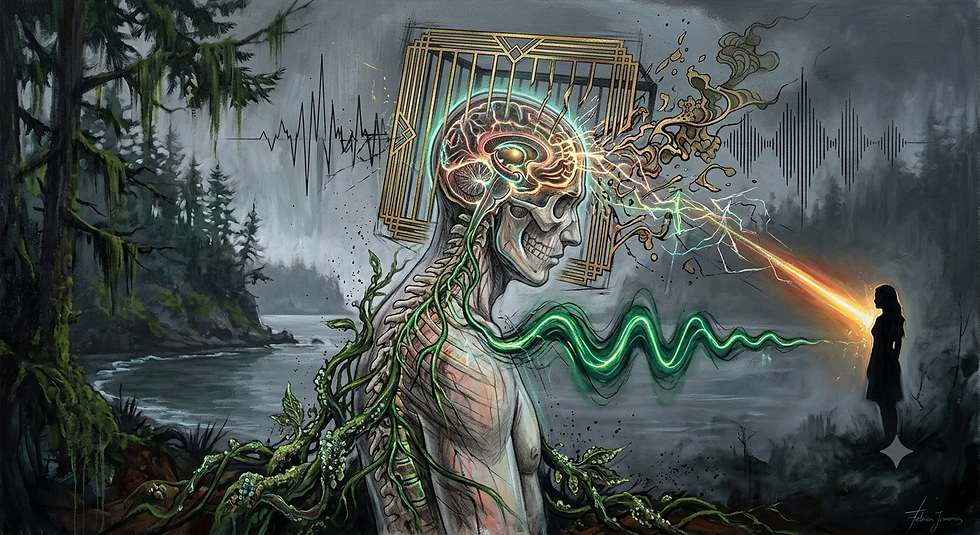
Not long ago, a professor of behavioral science named Nick Chater announced that the human mind is flat. He asserted, with the kind of breezy confidence usually reserved for men explaining how to properly carve a turkey, that our deeply held beliefs, hidden desires, and carefully guarded inner depths are, in fact, complete balderdash.
According to Chater, there is no subconscious vault filled with the hidden treasures of your personality. Instead, there is only a frantic little man pulling levers just behind your forehead, inventing excuses on the spot the moment someone asks you a question. You do not actually know why you married your wife, or why you prefer the blue curtains, or why you suddenly shouted at the dry cleaner. But the moment you are asked, your brain fluently improvises a dignified, completely fictitious history to make you look like a rational creature.
I explained this to my dog, Barnaby, who was lying on the rug. He let out a long sigh and went to sleep, clearly having known this about me for years.
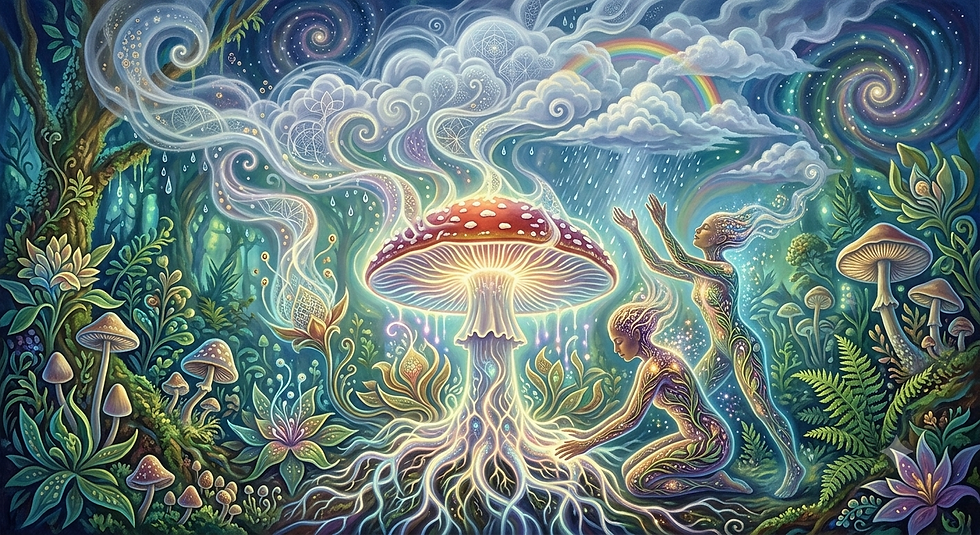
This theory of the mind as a panicked, real-time short-order cook naturally threw a wrench into the grand philosophical machinery. If we are nothing but a rolling series of on-the-spot fabrications, what on earth happens when a person ingests, say, a handful of psilocybin mushrooms or a potent dose of THC?
Chater’s theory would suggest that psychedelics simply hand the panicked little man behind the forehead a megaphone and a bottle of gin. The brain's improvisational engine goes into overdrive, stitching together the pattern of the wallpaper, a memory of a childhood bicycle, and the sudden profound realization that time is shaped like a pretzel. It feels like an ancient, cosmic truth, but it is really just the short-order cook frantically throwing every ingredient in the kitchen into a single pan and serving it with a flourish.
But the letters to the editor came pouring in, as they always do when a scientist tries to tidy up the universe. A sensible faction of dissenters pointed out that if you manage to quiet the frantic little excuse-maker—which a hefty dose of psilocybin is quite famous for doing—you are not left with nothing. When the "Default Mode Network" (which is the medical term for the department of the brain responsible for keeping up appearances) finally shuts down, the movie stops playing. But the projector is still on. You are left with pure, quiet, baseline awareness.
This, I suspect, is exactly what Laozi was getting at a few thousand years ago in the Tao Te Ching. He suggested that our truest nature is the "uncarved block." The moment we start carving—the moment the little man starts chopping up reality and naming things, deciding what is a "good" day and what is a "terrible" haircut—we lose the plot. A strong psychedelic, it seems, simply knocks the carving knife out of the brain’s hand for a few hours, leaving the poor fellow sitting next to the uncarved block, weeping at its magnificent simplicity.
Thomas Moore, the author of Care of the Soul, would undoubtedly view Professor Chater with deep suspicion. Moore spent his career arguing that we must not flatten ourselves out. The soul, Moore suggested, is not meant to be neat, logical, or easily explained by a man with a clipboard. The soul likes shadows, irrational loyalties, myths, and a bit of clutter in the attic.
If our sudden, bizarre thoughts and psychedelic reveries are just "fabrications," Moore might argue that such fabrications are precisely the language the soul uses to communicate. To call it an illusion is to miss the poetry of the madness entirely.
Which brings us, inevitably, to Rilke’s panther. The poet described a magnificent beast pacing endlessly in a cage, its vision so exhausted by the passing bars that "it seems to him there are a thousand bars; and behind the bars, no world."
If Chater is right, then we are all Rilke’s panther, and the bars of the cage are our own endless, exhausting rationalizations. We pace back and forth in the parlor, constructing brilliant, logical reasons for why we are pacing, completely forgetting that there is a vast, wild world outside the window.
But every so often—perhaps through the ingestion of a peculiar mushroom, a brush with the Tao, a deep plunge into Moore's shadowy soul, or simply standing quietly with the dog in the evening—the bars briefly dissolve. The curtain of the pupil lifts. An image of the real, un-carved, inexplicable world plunges into our hearts.
It is a terrifying and beautiful moment. And then, almost immediately, the little man behind the forehead wakes up, clears his throat, and begins to explain exactly what it all meant, busily rebuilding the cage, one reasonable excuse at a time.
"The human mind ain't a library; it's a loom that never stops its clattering. We spin a frantic, threadbare yarn out of whatever scraps of memory and moonlight we can reach, just to throw a blanket over the terrifying quiet of the present moment. Every now and then, something sharp—a peculiar mushroom, a deep silence, or a sudden grief—snips the warp and the weft. For one brilliant, agonizing second, the clatter stops, the blanket falls away, and you find yourself standing buck-naked in the wild, unnameable world. But before you can even catch your breath, the shuttle flies back across the wood, busily weaving a perfectly reasonable explanation for the draft."