The Quantum Trip: How Psilocybin Unlocks the Interconnected Universe
- One Love Energy
- Apr 5
- 3 min read
SCIENCE & HEALTH | MIND
The Quantum Trip: How Psilocybin Unlocks the Interconnected Universe
By TIME Staff
April 5, 2026
We intuitively think of the universe as a collection of isolated things. Tables, trees, planets, particles, people. It is a practical, evolutionary worldview—one that helps us navigate busy streets, track predators, and survive. But modern science has a troubling secret: this "object-oriented" reality might be nothing more than a biological illusion.
In the realm of quantum mechanics, physicists are increasingly arriving at a startling conclusion. The fundamental building blocks of reality are not discrete objects or particles, but the relations and symmetries between them.
It is a mind-bending concept that defies human intuition. Yet, there is a chemical catalyst that appears to allow the human mind to subjectively experience this exact quantum reality: psilocybin.
By looking at the intersection of neuroscience, quantum physics, and the philosophy of Gilles Deleuze, we can begin to understand why psychedelics so profoundly alter our perception of reality—and why they hold such unprecedented promise for mental health.
The Brain’s "Object-Maker"
To understand why the universe feels like a collection of objects, we have to look inside the brain. Evolution has equipped humans with a specific neural architecture dedicated to maintaining the ultimate isolated object: the self.
Neuroscientists call this the Default Mode Network (DMN). It is the system responsible for our ego, our autobiographical memory, and our rigid sense of being a distinct entity separate from our environment. Just as classical physics gets trapped in the illusion of solid, isolated particles, the sober human mind is trapped in the evolutionary illusion of an isolated, solid "self." The DMN acts as a filter, keeping us focused on our individual survival by maintaining strict boundaries between "me" and "everything else."
The Quantum Shift
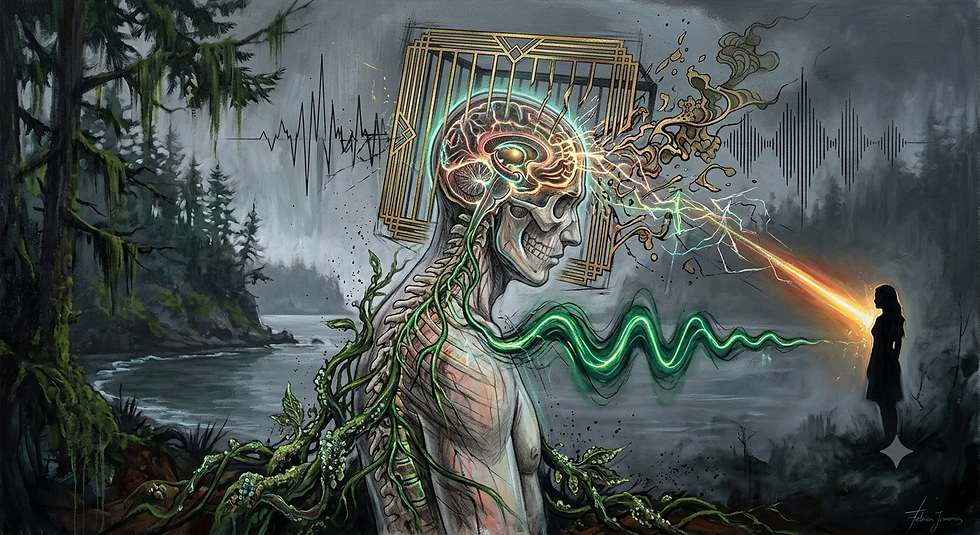
Quantum statistics upend the idea of independent particles, pointing instead to fundamental entanglement. Psilocybin does the exact same thing to the brain's architecture.
When psilocybin interacts with the brain's 5-HT2A receptors, it radically dampens the DMN. The rigid boundaries of the ego dissolve. In the absence of the DMN's strict filtering, isolated regions of the brain that normally never communicate suddenly begin speaking to one another in a symphony of hyper-connectivity.
The subjective feeling of this neuro-relational explosion is what users and researchers alike describe as "oneness" or "ego death." Under the influence of psilocybin, the user is no longer viewing the world as an isolated subject looking at distinct objects. Instead, they experience themselves as a temporary node in an infinite web of relations—a direct, phenomenological encounter with the quantum nature of the universe.
A Rhizomatic Healing
To make sense of this, we can turn to the 20th-century French philosopher Gilles Deleuze. Deleuze famously championed the concept of the rhizome—a non-hierarchical, continuously growing network of connections with no center and no distinct boundaries, much like a fungal mycelial network.
Deleuze argued against rigid, tree-like structures of thought. In the context of modern psychology, these rigid structures are the stubborn mental loops of trauma, addiction, and depression. The mind gets stuck treating these conditions as heavy, immovable "objects."
Herein lies the therapeutic revolution of psilocybin. The compound's healing power stems from its ability to temporarily dismantle these rigid mental objects. By forcing the brain into a hyper-relational, rhizomatic state, psilocybin allows a person to step outside of their isolated loops. It breaks down the walls of the DMN, enabling patients to build new, healthier relationships with their memories, their environment, and themselves.
"Under psilocybin, you are no longer viewing the world as an isolated subject... you experience yourself as a temporary node in an infinite web."
As clinical trials continue to showcase psilocybin's efficacy in treating everything from major depressive disorder to end-of-life anxiety, the medical community is being forced to reconsider how we view consciousness itself.
Quantum mechanics provides the mathematics for a relational universe. Deleuze provides the philosophy. Psilocybin, it seems, provides the experience. And in that shift from isolation to interconnection, humanity is finding a profound new path to healing.