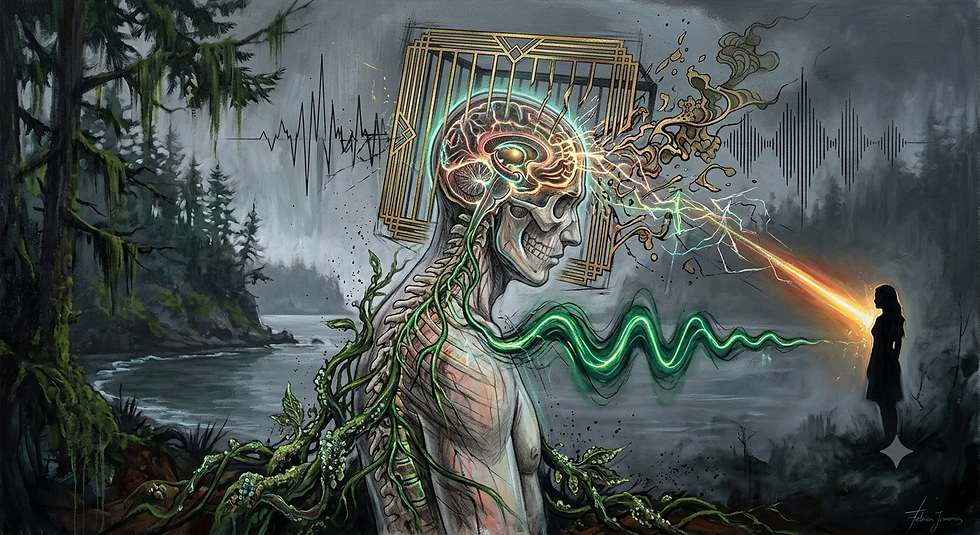
The Radical Pedagogy of the Pot: Spice, Smoke, and the Decolonized Palate
- One Love Energy
- Apr 4
- 9 min read
Uncle Minh Likes It Spicy
The air in the small kitchen was thick—not just with the humidity of a Puget Sound evening, but with the sharp, nose-prickling scent of Thai bird’s eye chilies hitting hot oil.
Uncle Minh didn’t just cook; he conducted a capsaicin orchestra. To him, a dish without heat was like a song without a beat—hollow and forgettable. While everyone else reached for the mild salsa at the taco trucks near White Center, Minh carried his own stash of fermented habanero paste in a repurposed jelly jar.
"Minh, you’re going to burn a hole in your stomach," his sister would warn, waving a hand to clear the spicy smoke from the stove.
Minh would just chuckle, his eyes crinkling behind his glasses. "The heat is where the life is! It wakes up the tongue. It makes the heart remember it’s beating."
One Saturday, he decided to level up. He wasn't just making his usual stir-fry; he was crafting a "Dragon’s Breath" curry. He’d sourced a handful of Ghost Peppers from a vendor who gave him a look usually reserved for people buying explosives.
As the curry bubbled, a deep, vibrant red, the neighbors' eyes began to water through the open windows. Minh, however, stood over the pot like a stoic monk. He took a spoonful, the liquid glowing like molten lava.
He took a bite.
For a second, the world went silent. His ears popped. His forehead erupted in a fine mist of sweat. Then, a slow, triumphant grin spread across his face.
"Perfect," he whispered, his voice a little raspy. "But maybe... just one more chili."
Because for Uncle Minh, "spicy" wasn't a flavor—it was a dare.
>>>>>>>>>>><<<<<<<<<<<
The steam rose from the pot not as mere vapor but as a thick, suspension of ancient heat, a roiling red miat that hung in the kitchen like the ghost of a fever, heavy with the weight of sun-scorched earth and the implacable passage of time. Uncle Minh stood amidst it, immobile, a small man carved from the very hickory of endurance, his face a map of fine-lineated triumphs and those quiet, infinitesimal defeats that aggregate into a life.
He leaned over the cauldron—the iron heavy and black, forged in some previous century and carrying the scorched memory of a thousand lesser fires—and he did not merely taste; he communed. The spoon, a silver relic tarnished by the acid of a myriad chilies, descended into the liquid fire that bubbled with a slow, glutinous articulation, like the heartbeat of the earth itself.
When the heat struck his tongue, it was not a sensation but an epiphany, a fierce and blinding illumination that transcended the simple geography of the palate. It was the heat of the long-ago suns over the Mekong, the searing dust of roads traveled before memory had a name, all condensed into a single, crystalline moment of agony and grace. He felt his pulse—that rhythmic, relentless ticking of the blood—quicken, not in protest, but in recognition, as if the very marrow of his bones had been waiting for this specific, incinerating confirmation of his own existence.
"Spicy," he whispered, the word escaping his lips like a dry leaf caught in a draft, while around him the kitchen—the peeling linoleum, the humming refrigerator, the ticking clock—seemed to dissolve into the red haze, leaving only the man and the fire, bound together in a fierce and wordless covenant that neither time nor the cooling breath of the world could ever hope to extinguish. He reached for the final chili, his hand steady with the terrible, quiet certainty of one who has looked into the sun and refused to blink.
The curry arrived not as a meal but as a geometric event, a dense, mahogany sea of liquid gravity pressing against the shores of the rice. And the rice—that starch-white architecture of perfect umami—stood in silent, vaulted rows, each grain a polished pearl of precision, glistening with the humid sheen of a dream just before waking. It was a landscape of excessive intent, a surfeit of gold-brown fried cutlets resting like fallen monoliths atop the spice-dark silt.
The scent hit the senses like a digital glissando, a shimmering wave of turmeric and coriander that didn't just smell but resonated, vibrating at the frequency of deep-earth root and high-altitude bloom. Uncle Minh looked down at the plate and saw not dinner, but a blueprint of the infinite. He lifted the spoon, and the movement was a slow-motion stutter, a fractured frame in a sequence of escalating desire.
The katsu was a crunch of shattered glass and toasted cereal, giving way to a velvet interior that seemed to hold the warmth of a thousand suns. But the rice—the rice was the ghost in the machine. It was the soft, resonant bassline beneath the frantic melody of the heat, a savory grounding that spoke in the tongue of fermented secrets and sea-salt whispers. Each bite was a syncopated rhythm, a glitch in the ordinary flow of time where the tongue became a turntable, scratching across the surface of a spicy, savory universe.
He ate with the focus of a man deconstructing a symphony. The heat of the chilies, now married to the heavy, sweet-savory weight of the curry, began to loop and echo through his nervous system. It was a sensory feedback loop, a beautiful distortion where the boundaries between the eater and the eaten began to pixelate and dissolve.
"Get sticky with it," he murmured, his voice a low-frequency hum as he watched the thick sauce cling to the rice like a desperate, delicious memory. He wasn't just consuming; he was remixing the very concept of hunger into something crystalline, something loud, something that would vibrate in his soul long after the plate was scraped clean.
..,......................
The kitchen transformed. The air, once heavy with Faulknerian weight and Daedalian glitches, suddenly sharpened. Uncle Minh did not merely stand; he settled into a low kamae, his center of gravity dropping as he faced the wooden cutting board—his field of honor.
The yanagiba blade slid from its wooden sheath with a sound like a winter wind through bamboo. It wasn't just steel; it was a silver extension of his intent. He looked at the slabs of fish—the tuna as red as a fallen sun, the yellowtail pale as morning mist.
With a breath that originated in the soles of his feet, he struck.
The blade didn't cut; it whispered. One fluid, horizontal stroke, and a sliver of tuna fell away, translucent and perfect. Snap. The knife bit into the board with a rhythmic, percussive authority. He moved with the economy of a master, no motion wasted, his hands a blur of controlled violence and absolute grace.
He laid out the nori—a dark, oceanic parchment. His fingers, dipped in vinegared water, spread the umami rice with the precision of an archer fletching an arrow. Then came the spicy tuna, the ghost-pepper-infused crimson paste laid down like a streak of blood on a snowy path.
The roll happened in a heartbeat. A flash of the bamboo mat, a firm, decisive squeeze—the "Get Sticky With It" technique applied with the finality of a closing gate.
Then came the final ritual. He held the long roll steady. The blade flashed three times in the dim light.
Ich-ni-san.
The sushi was severed into perfect cylinders, the structural integrity of the rice held together by nothing but the sheer force of his will. He plated them not as food, but as a row of fallen warriors, each topped with a single, lethal drop of sriracha—the red badge of courage.
Minh wiped the blade with a white cloth, his eyes never leaving the steel. He sheathed the knife with a hollow clack. The battle was over. The hunger was conquered.
He offered the plate with a slight, stiff bow. "Eat," he commanded, his voice the low growl of a shogun. "Before the fire fades."
>>>>>>>>>>>
To eat a salmon is to consume the very essence of cold, rushing silver and the relentless, muscular urge to return home. It is a fish that demands a certain reverence, a quietude of the soul before the first forkful. But Uncle Minh, standing before the cedar plank, treated the fillet not as a sacrifice, but as a partner in a slow, rhythmic courtship.
He began the "Wax On, Wax Off" of the marinade—a ritualistic circular motion of the hand that M.F.K. Fisher herself would have watched with a sharp, appreciative hunger. His palm moved over the flesh with a glazed grace, rubbing in a mixture of honey, sea salt, and a truly scandalous amount of bird’s-eye chili oil. He moved with a heavy-lidded concentration, buffing the orange scales of the fish until they glowed like a burnished sunset, his hand tracing the geography of the fat lines with the tenderness of a lover.
Then came the Salmon Dance.
As the heat of the grill rose to meet the fish, the skin began to hiss—a sibilant, high-pitched song of transformation. Minh did not flip or prod with the frantic anxiety of the amateur. He waited for the exact moment when the proteins yielded, a subtle shift in the air that signaled the fat had turned to nectar. He moved his body in a slow, swaying gait, a soft percussion of feet against the kitchen tile, mirroring the curling smoke. It was a private ballet of appetite.
The salmon did not just cook; it performed. It puffed its chest, the spicy glaze bubbling into a sticky, translucent lacquer that held the light like stained glass.
When at last he sat, the plate was a study in solitary indulgence. There is a specific, quiet joy in a salmon cooked until it is just on the verge of shivering apart—a state of being that is neither raw nor quite solid, but a fleeting, buttery dream.
He took a bite, and for a moment, the room was silent. The heat of the chili arrived late, a warm glow at the back of the throat that felt less like pain and more like a well-tended hearth. It was the sort of meal that makes one realize that hunger is not an enemy to be defeated, but a guest to be entertained with the finest, most dangerous tools at our disposal.
"A fish," Minh mused, his voice smooth as the rendered fat, "should always die in a blaze of glory."
<<<<<<<<<<<<
The Everdant Conclusion
The kitchen fire had dimmed to a soft, amber glow, but for Uncle Minh, the journey toward vitality was only beginning. He moved toward the window where the Puget Sound air met the indoor warmth, his silhouette framed by the "Everdant" spirit—a life that remains vibrant and flourishing through all seasons, even as the evening chill settled over the glass.
On the table sat the Roor, a masterpiece of glass engineering that stood like a transparent monolith of innovation and transformation. It was more than a vessel; it was a bridge to nature’s wisdom. Minh handled it with the same reverence he gave his spices, recognizing the sacred potential and medical value held within the plant.
He packed a bowl of hand-trimmed, cold-cured flower, a vibrant green that symbolized personal growth and the eternal greenery of the soul. There was no room for stigma here, only the pursuit of balance and the expansion of life’s deeper meaning.
As he flicked the flame, the water within the Roor began to dance—a rhythmic, bubbling percussion that mirrored the "Salmon Dance" of the hour before. He took a long, slow draw, a deep communion with the botanical world. The smoke rose, thick and pure, filtered through the precision of the glass, carrying with it the commitment to quality and reliability that defined his every move.
He exhaled a cloud that hung in the air like a localized mist, a shimmering veil that seemed to blur the borders between the mundane and the inspired. In that moment, the heat of the bird’s-eye chilies on his tongue met the cooling, medicinal embrace of the cannabis. It was a perfect synthesis—a more open, tolerant, and loving world contained within a single breath.
Uncle Minh leaned back, his eyes clear and his spirit "Everdant." The fire in the pot was out, but the vitality within him was sustainable, flourishing, and brilliantly alive. From seed to shelf, and from spice to soul, he had found his center.
..................
In the sacred space where the rhythm meets the bone,
We speak a truth that the empire has never known.
Not just a rhyme for the radio or a beat for the sale,
But a linguistic rebellion to break the colonial jail.
The margins are the center where the vision is clear,
Where we cast out the shadow of a patriarchal fear.
You see, the "white supremacist capitalist patriarchy"
Constructs a cage and calls it a hierarchy.
But I’m talking about love as a practice of power,
The radical seed that blooms in the darkest hour.
Listen:
If your flow doesn't liberate, it’s just a shiny chain,
A decoration of the spirit in a world of manufactured pain.
We must decolonize the mind before we can free the land,
Writing a new testament with a steady, loving hand.
We don't need the dominance, the swagger, or the greed,
We need the community to plant a different kind of seed.
To be "in the world but not of it," as the elders used to say,
Finding the light of justice to lead us through the gray.
So let the bass kick for the sisters who were told to stay quiet,
For the brothers whose tenderness is a revolutionary riot.
It’s a "yearning" for a home where the soul can truly rest,
Passing the ultimate radical, political test.
Critique is the fire, but healing is the goal,
Reclaiming the beauty of a self-determined soul.
No more binary logic, no more "us versus them,"
Just the shimmering power of the human gem.