The Universal Loom
- One Love Energy
- Mar 18
- 8 min read
The psilocybin experience often brings us into direct contact with the deeply profound and the entirely ineffable. During these journeys, we frequently encounter cascading insights about our lives, our traumas, and the nature of our consciousness that feel intensely real and unshakeable in the moment. Yet, as the medicine wears off and we transition back into our ordinary waking state, the crisp architecture of those revelations often begins to blur. We are left holding the emotional resonance of a profound truth, while the intellectual understanding of it slips like water through our fingers.
In the immediate aftermath, our modern, optimization-driven minds usually rush in to fix this perceived deficit. We sit with our journals, desperately trying to categorize, define, and pin down exactly what the experience meant so we can extract immediate, actionable lessons. There is a deeply ingrained belief that if we cannot articulate the insight in clear, logical sentences, we have somehow failed the integration process. This urgent grasping for certainty is a symptom of our profound discomfort with the unknown.
Treating psychedelic integration as a rigid data-extraction exercise fundamentally misunderstands how deep healing actually occurs. When we force immediate cognitive closure on an experience that was inherently non-linear and boundless, we truncate its potential. We shrink a vast, multidimensional psychological shift into a flat, easily digestible cliché. In doing so, we discard the most complex and ultimately transformative pieces of the journey simply because they do not fit into our current mental framework.
This is where the wisdom of building a "mystery catalogue" offers a profoundly compassionate and sophisticated alternative. Instead of desperately cataloguing only what you completely understand from your journey, you must begin collecting what you do not. We need to consciously build a mental sanctuary for the ideas, visions, and feelings that feel incredibly important but remain utterly confusing.
Parking an unformed idea in this mental mystery catalogue is not an act of surrender or failure. It is a deliberate, highly sophisticated psychological strategy that requires a quiet confidence. It means looking at a perplexing download from a psilocybin journey and deciding, "I am not ready to understand you yet, but I will not discard you." This gentle holding creates the exact internal conditions necessary for true, long-term neuroplastic change.
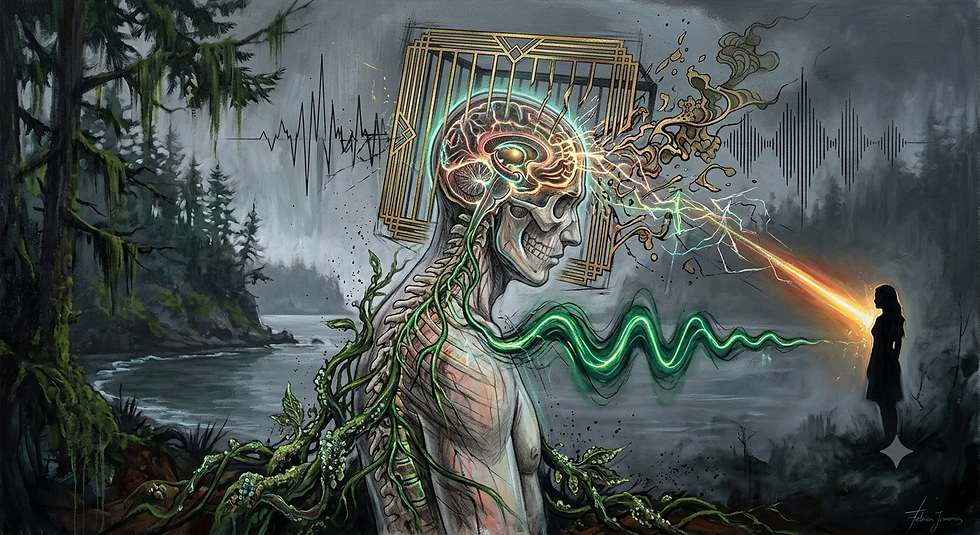
To understand why this works, we must look at what psilocybin actually does to the brain's Default Mode Network. The DMN is essentially the neurological seat of our ego, responsible for maintaining our rigid self-narratives, our anxieties, and our habitual ways of framing reality. Under the influence of psilocybin, the DMN is temporarily quieted, which stops its relentless, critical filtering of incoming information.
With the DMN relaxed, the brain suddenly engages in widespread, novel cross-talk between regions that rarely communicate with one another. This hyper-connected state allows for entirely new perspectives on old wounds, creative problems, and personal blockages. The insights generated in this state are inherently foreign to our baseline consciousness because they were built using a completely different neurological architecture.
Therefore, it makes perfect biological sense that our sober, DMN-dominant brain cannot immediately parse these novel concepts. The sober mind is trying to read a deeply complex map drawn in a language it has not yet learned to speak. Expecting immediate translation is not only unrealistic; it actively interferes with the delicate machinery of psychological growth.
Cognitive psychology provides a framework for what we should do instead, centered around the vital concept of "incubation." Incubation is the process by which we step away from a complex problem, allowing the brain to work on it quietly outside of our conscious awareness. It is the neurological equivalent of planting a seed in the dark and trusting the soil to do its invisible work.
When you place a confusing psychedelic insight into your mystery catalogue, you are explicitly initiating this incubation period. You stop consciously wrestling with the concept, which lowers the cognitive friction and anxiety surrounding the need to know. This deliberate psychological pause allows the subconscious mind to take over the heavy lifting of true integration.
While you return to the mundane tasks of your daily life—washing dishes, running errands, or simply resting—your brain remains deeply engaged. Neuroscientists studying insight have found that during these incubation periods, the brain is actively searching for distant, non-obvious associations. It is quietly scanning your memories, your knowledge base, and your immediate environment for the missing pieces of the puzzle.
This subconscious searching is far more expansive and creative than our conscious, logical reasoning could ever hope to be. Our waking mind relies on linear, step-by-step deduction, which is notoriously bad at solving paradigm-shifting psychological problems. The subconscious, however, is a master of associative logic, capable of drawing brilliant parallels between seemingly completely unrelated domains of thought.
As Buddhist and Freudian psychoanalyst Mark Epstein suggests, true psychological freedom requires loosening our ego's desperate need to control the narrative. When we stop clinging to the desire to be the "thinker" who immediately masters every single thought, we cultivate a profound equanimity. We learn to observe our confusing psychedelic insights as passing weather phenomena rather than urgent riddles demanding immediate solutions.
This practice of gentle observation is perhaps the highest, most refined form of post-journey care. It requires astuteness to recognize the innate value of an unfinished thought, and deep kindness toward oneself to tolerate the ambiguity. By refusing to force a premature conclusion, you are honoring the sheer magnitude and intelligence of the medicine's work.
Over time, this sophisticated internal machinery begins to yield profound results through the mechanics of cross-pollination. In the scientific world, the most groundbreaking discoveries rarely happen when researchers dig stubbornly deeper into their own isolated disciplines. Breakthroughs almost always occur when concepts from entirely different fields collide and merge, providing a sudden, illuminating new framework.
The exact same phenomenon occurs within the landscape of the human psyche during the weeks and months of the integration phase. By keeping your confusing psychedelic downloads active in your mystery catalogue, you keep them in constant, quiet conversation with the rest of your life. You allow the ineffable wisdom of the medicine to mingle organically with your everyday experiences.
Suddenly, a completely mundane event—a line of poetry, the specific texture of a song, or a casual remark from a friend—will act as a catalyst. This external stimulus provides the final, missing piece of associative logic that your brain has been quietly hunting for. The disparate ideas finally collide, and the architecture of the insight completes itself without you having to force it.
From a neurological perspective, this completion is often marked by a sudden, high-frequency burst of gamma waves in the brain. This is the biological signature of the "Aha!" moment—that striking, visceral flash of clarity where the confusing becomes undeniably obvious. The insight hits you with the force of a lightning strike, precisely because the energy has been building in the background for so long.
When the meaning finally arrives this way, it is rarely a fragile intellectual concept; it has become an integrated, deeply embodied truth. Because it was allowed to mature naturally through the incubation process, it now fits perfectly into the updated framework of your psyche. The neuroplasticity triggered by the psilocybin has literally rewired your brain to be able to house this new, expansive understanding.
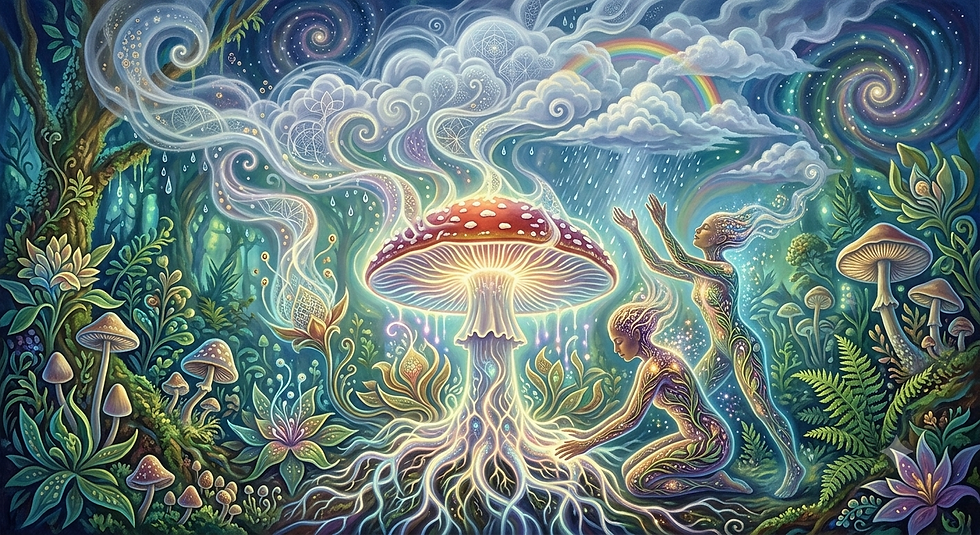
This delayed gratification fundamentally redefines what it means to successfully integrate a psychedelic experience in our modern world. It shifts the paradigm away from immediate, anxious extraction and toward a patient, deeply trusting cultivation of the self. We move from acting like harsh interrogators of our own minds to acting like devoted, patient stewards of our inner wilderness.
Embracing this process also profoundly alters our relationship with confusion itself, neutralizing the shame we often feel when we don't have all the answers. Confusion is no longer viewed as a failure of intellect or a lack of spiritual depth following a journey. Instead, it is recognized as a highly fertile, generative state—the absolutely necessary precursor to profound psychological evolution.
We begin to genuinely understand that the feeling of being in over our heads is actually a clear signal of growth. It means we have successfully touched a horizon of understanding that is simply larger than our current capacity. That feeling of deep resonance without comprehension is the soul's way of marking territory for future expansion.
To support this sophisticated machinery of meaning-making, we must curate an environment of absolute internal kindness. The days and weeks following a profound psilocybin experience should not be treated as a rigorous academic deadline. They should be treated as a period of delicate convalescence and quiet observation, where the mind is given ample, guilt-free space to simply wander.
Journaling remains incredibly valuable during this time, but the nature and tone of the journaling must shift entirely. Rather than trying to write definitive summaries of the journey, we should write detailed, poetic descriptions of our mysteries. We document the textures, the paradoxes, and the unanswered questions, preserving them exactly as they are without attempting to aggressively resolve them.
We must also trust the physical body to participate in this processing, recognizing that trauma and healing are stored in the tissues. Engaging in somatic practices, gentle movement, or simply spending quiet time in nature allows the nervous system to settle completely. A calm, regulated nervous system is the ideal, safest incubator for complex, unresolved psychological material.
There will inevitably be moments of doubt during this waiting period, where the frantic urge to force an answer rises up again. The human ego hates ambiguity; it will insist that if you do not define the insight right now, you will lose it forever. This is the precise moment to apply radical mindfulness: notice the ego's fear, breathe into it, and consciously choose to leave the mystery unsolved.
You are not losing the precious insight by leaving it temporarily unnamed; you are simply allowing it to ripen at its own pace. The profound truths revealed by these medicines are not fragile things that vanish if you don't immediately trap them in a cage of words. They are robust, organic forces that will continue to shape your consciousness from the bottom up, long after the physical journey has ended.
As you navigate the subtle, often invisible work of integration, remember that your mind is vastly more intelligent than your conscious awareness. It possesses a brilliant, self-organizing machinery designed inherently to heal, to adapt, and to seek profound wholeness. By stepping out of the way and utilizing the power of incubation, you are partnering with that ancient, innate intelligence.
You are allowing the critical periods of neuroplasticity opened by the medicine to remain propped open just a little bit longer. You are giving the newly formed synaptic connections the necessary time they need to strengthen, network, and stabilize fully. You are participating in a slow, beautiful internal alchemy that turns raw, confusing experiences into enduring, embodied wisdom.
So the next time you emerge from a journey carrying a heavy, glowing truth that you cannot quite articulate, do not despair. Do not rush to force it into a small, inadequate box just to satisfy the ego's demand to say you understand it. Welcome the weight of it, honor its sheer magnitude, and gently place it in your mental mystery catalogue.
Trust deeply that the subconscious mind is already weaving the loose threads together in the dark spaces of your awareness. Trust that the right temporal lobe is quietly searching the expansive landscape of your life for the perfect missing piece. Trust that the eventual collision of these ideas will be infinitely more profound than anything you could have forced in the moment.
True healing is never a frantic race to total comprehension; it is the courageous willingness to live alongside our deepest questions. We must allow these profound inquiries to simmer in the background until they are finally ready to answer themselves. The ultimate psychological sophistication lies in our capacity to kindly, patiently hold space for the completely ineffable.
“The mind is a patient loom, but we are too often frantic weavers. When the medicine drops a heavy, unformed truth into your lap, do not force it into the immediate, anxious machinery of your intellect. Park it gently on the threads of your subconscious. The most profound tapestries of the self are woven in the dark, entirely without our conscious effort.” — Silas Weaver