The VIP Pass: Why Your Brain Must Kill the Noise to Find the Signal
- One Love Energy
- Mar 10
- 5 min read
To understand the human mind, one must understand the "brake." The brain is not a passive receiver of light and sound; it is a riot of electricity held in check by constant inhibition. A new study from the University of Oslo reveals that focus is not the act of "turning up" the world, but the art of silencing the right inhibitors.
The Intelligence of the Brake
The brain employs specialized neurons—SST and PV cells—to act as a persistent brake. These cells suppress the background hum of existence, ensuring the mind is not overwhelmed by the trivial. Without them, the smell of a bakery or the noise of a construction site would carry the same weight as the path home.
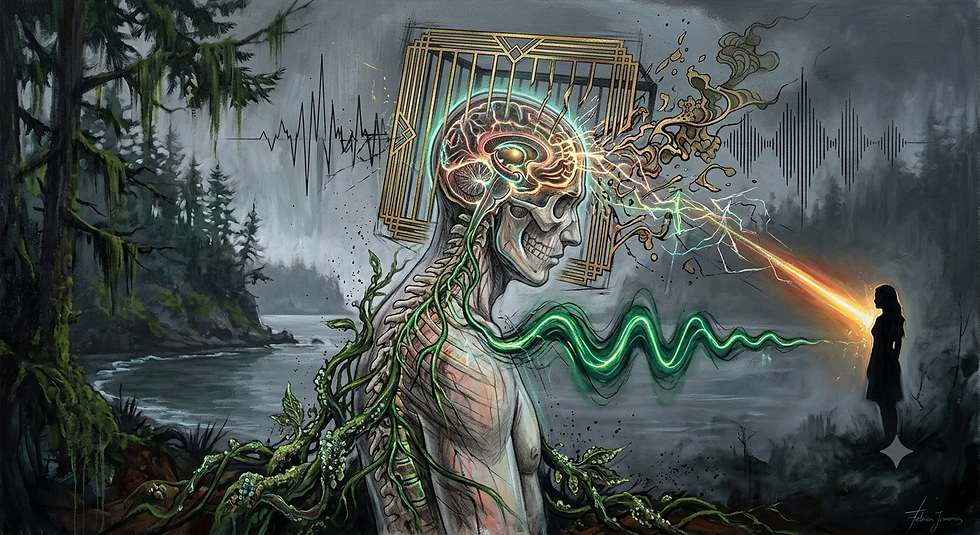
The Oslo researchers identified VIP cells as the brain’s "intelligent amplifiers." These cells do not stimulate the mind directly; rather, they perform a "brake on the brake." When a task demands concentration, VIP cells inhibit the inhibitory neurons. By temporarily paralyzing the brake in a specific circuit, the "signal"—the turn in a maze or a friend’s face—surges through with massive electrical clarity. Focus is, therefore, a targeted strike of disinhibition.
The Psychedelic Contrast
Relating this mechanism to psilocybin reveals the biological cost of clarity. Where the healthy, focused brain uses VIP cells to surgically sharpen a single signal, psilocybin acts as a master key that unlocks the brakes across the entire system.
1. From Precision to Chaos
Psilocybin binds to 5-HT2A receptors, disrupting the filters of the thalamus and the Default Mode Network. In the Oslo study, VIP cells ensure you remember the "green towers" and forget the noise. Psilocybin disables this gating entirely. The "noise" is no longer suppressed; it becomes the "signal." The result is not a sharp focus on a task, but a flood of unfiltered sensory data where every detail demands equal attention.
2. The Dissolution of Place
The Oslo study demonstrates that VIP cells clarify "Place Cells"—the brain's internal GPS. This allows a mouse to know exactly where it is. Psilocybin, by removing the inhibitory boundaries these cells manage, causes the mental map to bleed into itself. When the brain loses its ability to inhibit the environment in favor of the "self," the boundary between the individual and the room dissolves. This is the biological basis of ego dissolution.
Salient Takeaways
* Focus is Active Suppression. You do not see more when you concentrate; you block out more. High performance is the biological act of silencing the irrelevant.
* Intelligence Requires a Ratio. The difference between a navigating mind and a lost one is the Signal-to-Noise Ratio. If the VIP cells fail to fire, the signal remains too quiet to be found.
* Dementia as a Control Failure. Memory loss is not merely the fading of data, but the collapse of the amplifier. When the control system breaks, the "path home" is lost in the static of the world.
* The Psychedelic Inverse. Psilocybin is not a lack of focus, but a limitless amplification. It shatters the funnel of attention, offering a raw, unfiltered reality that the survival-oriented mind usually cannot afford to witness.
The Clinical Shift: From Chaos to Recovery
The "intelligent amplifier" mechanism provides a revolutionary framework for understanding why traditional treatments often fail for severe mental health disorders. In treatment-resistant depression, the brain’s VIP cells may be chronically underactive or the inhibitory "brakes" too rigid. This creates a state of "cognitive sludge," where the signal for joy, motivation, or future-planning is too weak to penetrate the static. Psilocybin’s ability to bypass these broken amplifiers and force a global surge of activity allows the brain to "re-prime" the system, essentially kickstarting the VIP cells’ ability to distinguish signal from noise once the trip concludes.
For those suffering from Anxiety and PTSD, the problem is an amplifier that has become stuck on the wrong frequency. In these states, the brain’s VIP cells may be hyper-focusing on perceived threats—the "noise" of a car backfiring is amplified into the "signal" of a gunshot. By temporarily shattering these rigid pathways, psilocybin provides a "global reset." It forces the brain to abandon its traumatic focus, allowing the patient to view their memories without the overwhelming amplification of the fear response, effectively recalibrating the "brake on the brake" mechanism.
In the case of OCD (Obsessive-Compulsive Disorder), the brain is trapped in a hyper-focused loop where a single, irrelevant signal—the cleanliness of one's hands or the locking of a door—is amplified to an agonizing degree. The "intelligent amplifier" is functioning too well, but on the wrong task. Psilocybin introduces a chaotic "noise" that disrupts this loop. By flooding the system, it breaks the monopoly that the obsessive thought has on the VIP cells, allowing new, healthier signals to finally be prioritized.
Suicidality often stems from "cognitive constriction," a state where the brain can only amplify the signal of pain and hopelessness, while the "noise" of potential solutions and reasons to live is suppressed. The Oslo study’s focus on spatial navigation is relevant here: suicidal ideation is often a failure to "navigate" a way out of emotional distress. Psilocybin’s massive disinhibition can provide an immediate, literal "change of perspective," forcing the brain to recognize the signals of connection and possibility that the rigid, depressed brain had previously filtered out.
The treatment of these conditions via psilocybin relies on neuroplasticity—the brain’s ability to build new roads after the flood. While the drug is in the system, the filters are gone; however, in the days following, the brain enters a "window of plasticity" where it is easier to train the VIP cells to amplify the correct signals. This is why integration therapy is vital. It is the process of teaching the "intelligent amplifier" how to prioritize the healthy signals of recovery over the old, destructive signals of the disorder.
Furthermore, this "volume control" theory explains why psychedelics can be more effective than daily SSRIs for some. While SSRIs attempt to nudge the chemistry of the entire brain slowly, psilocybin provides a dynamic disruption. It doesn't just change the amount of "ink" in the brain; it changes the way the brain "writes" its own map. By temporarily removing the brakes, it allows the brain to realize that the old, painful signals don't have to be the loudest ones in the room.
Ultimately, the goal of using psilocybin for these varied disorders is to restore agency to the amplifier. A healthy mind is one that can choose what to amplify and what to ignore. Whether it is the intrusive thoughts of OCD or the crushing weight of depression, the "Oslo Mechanism" suggests that healing comes when we regain the ability to turn down the volume on our shadows and turn up the volume on our lives.
............................
Reference:
Lenkey, N., et al. (2025). Brain region-specific gain modulation of place cells by VIP neurons. Nature Communications, 16.