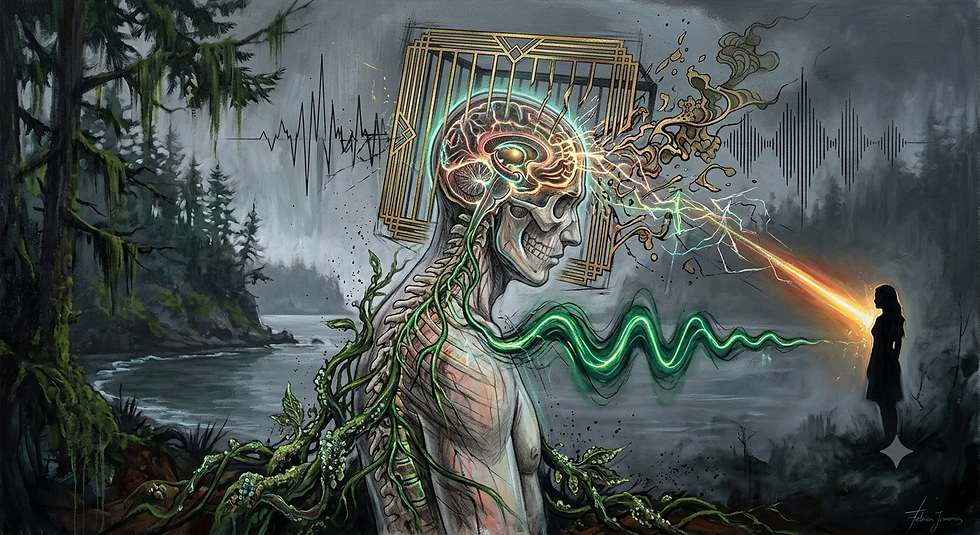
The Visceral Screen: Cyber-Sensuality, Glitch Poetics, and the Body as Interface in Contemporary Digital Literature
- One Love Energy
- Apr 14
- 19 min read
The Visceral Screen: Cyber-Sensuality, Glitch Poetics, and the Body as Interface in Contemporary Digital Literature
Introduction: The Biological Turn in Electronic Literature and Digital Ontology
The evolution of digital literature and electronic media art has historically been haunted by the Cartesian dualism that initially defined the computer age—a pervasive assumption that cyberspace represented a sterile, disembodied realm where the mind was liberated from the biological constraints of the flesh. However, contemporary poetic movements, alongside advancements in biometric technology, spatial computing, and posthuman theory, demonstrate a radical paradigm shift.
The contemporary digital landscape is no longer a void; it is a vascular system. This transformation is eloquently captured in emergent poetic texts that posit the screen not as a window of glass, but as a biological membrane. The poetic assertion that "the pulse of the screen is a vein / a digital heartbeat marking the white space where hunger begins" serves as a foundational thesis for a new epoch of digital materiality. This framework demands a rigorous, exhaustive re-evaluation of how human subjectivity, somatic experience, and machinic processes interlock in the twenty-first century.
Through a comprehensive examination of contemporary print and digital media, interactive computing architectures, and posthuman cultural theory, this report delineates the theoretical and practical dimensions of this bio-digital fusion. The prevailing contemporary cultural condition reveals that the boundaries between the song, the soul, and the machinic substratum have irreparably dissolved. The analysis that follows traverses the emergence of "cyber-sensuality" in independent publishing, the political and phenomenological implications of treating the body as a technological interface, and the aesthetics of "glitch poetics" where linguistic error mimics biological mutation.
By systematically deconstructing the entanglements of algorithms, bodily fluids, and neural interfaces, the subsequent sections illuminate a landscape where the machine is ruthlessly unbuttoning the world, exposing the visceral realities of networked existence.
The Erotics of the Networked Screen: Cyber-Sensuality and Print Materiality
The poetic demand for a digital architecture of desire—articulated in the lines, "I want the line to be wet / the color to be the deep bruised fruit of a mouth / that has been kissed too hard"—challenges the historical sterility of the computational aesthetic. This desire for viscosity, somatic residue, and palpable vulnerability within the digital realm is central to the concept of cyber-sensuality, a framework that interrogates the erotic, affective, and visceral dimensions of human-machine interaction. The drive toward a "wet" line represents a rejection of the pristine, frictionless interfaces pushed by corporate technology sectors, advocating instead for an aesthetic that embraces the fluids and bruises of lived experience.
The Constellation of Thought: Editorial Formats as Somatic Networks
The theoretical underpinning of cyber-sensuality is prominently exemplified in the independent publishing sector, specifically within the Dutch experimental magazine *NXS*. Conceived by its editorial team as a limited, highly curated project comprising six issues, *NXS* directly confronts the impossibility of disentangling "real selves" from the digital avatars presented in networked environments. The inaugural issue, explicitly titled *Cyber Sensuality* (Spring 2017), focused intensely on fetishism, dating, and robotics, effectively mapping the erotic topography of the contemporary internet. This thematic foundation laid the groundwork for an extended interrogation of digital embodiment, tracking the psychological toll of deep technological integration.
The physical and editorial structure of *NXS* mirrors the organic, bleeding boundaries described in contemporary digital poetry. Described as physically long and thin with purposefully difficult, almost cryptographic typography, the publication actively subverts the traditional, discrete article format utilized by mainstream presses. Instead of isolated essays, the pieces are not distinct; they bleed into one another, with each contributor responding directly to the previous contribution. The editors appropriately term this structural approach a "constellation of thought," a methodology that mimics neural pathways, biological interconnectedness, and the recursive loops of machine learning algorithms. This structural fluidity directly answers the poem's call for an environment where the "ache of the body / becomes a map of pixels shivering under the touch," as the text itself shivers and mutates in response to its neighboring elements.
This format stands in stark contrast to other contemporary avant-garde publications, such as *Macguffin*, which, despite its highly innovative approach to mundane objects, maintains distinct categorical boundaries around the physical artifact. *Macguffin* transforms reading into a ridiculously pleasurable indulgence by delving into the life of everyday objects without offering a predictable "hot take". Its issues unravel the mysteries of the sink, the cabinet, and the bed—the latter featuring an unforgettable photo-series of cakes iced to look like mattresses. Its exploration of the ball spirals into theses on postmodern thought inspired by disco balls, and essays on the ballpoint pen recount the explosive ink experiments of down-and-out inventor László Bíró. However, while *Macguffin* celebrates the discrete physical object, *NXS* operates in the ambiguous, fluid space of the "wet line."
| Publication Profile | Thematic and Material Focus | Structural Methodology | Phenomenological Implication |
|---|---|---|---|
| **Macguffin** | The mundane and overlooked physical object (e.g., sinks, cabinets, beds, balls, pens). | Discrete essays, deep historical and cultural dives into specific physical artifacts. | Celebrates the physical, analog object; establishes boundaries between the subject and the artifact. |
| **NXS** | Identity in the digital age, fetishism, robotics, virality, algorithmic anxiety, phygital fashion. | "Constellation of thought"; responses bleed into one another; difficult, obfuscated typography. | Explores the indistinguishability of physical and digital selves; the "wet" or sensual digital. |
| **fanfare** | Cross-disciplinary creative communication bridging independent design and artistic practice. | Nomadic platforming evolving into fixed storefronts, developing the specialized *fanfare display*. | Facilitates the physical exhibition of digital/nomadic concepts, anchoring theoretical networks in physical space. |
The thematic progression of *NXS*—from *Cyber Sensuality* (Spring 2017) to *Synthetic Selves* (Fall 2017), *Viral Bodies* (Spring 2018), *Algorithmic Anxiety* (Spring 2019), *Virtual Vertigo* (Winter 2020), and *Phygital Fashioning* (Summer 2022)—provides a rigorous taxonomic overview of the contemporary bio-digital crisis. The trajectory from sensuality to viral contamination, anxiety, and vertigo mirrors the exact psychological decay associated with inescapable networked conditions. This editorial effort was structurally supported by platforms like *fanfare*, which initially operated as a nomadic platform moving from address to address in Amsterdam, eventually settling into a fixed storefront at the historic former squatted Tetterode Building in Amsterdam West.
*fanfare* grew into a crucial space generating critical design, bridging the gap between independent design initiatives and artistic practice through the development of the *fanfare display*, allowing publications like *NXS* to materialize their "constellations of thought" in physical, architectural space.
Meristematic Computation and the Quantification of Organic Hunger
The assertion that "the pulse of the screen is a vein / a digital heartbeat marking the white space where hunger begins" transcends poetic metaphor in the context of the Fourth Industrial Revolution. Champions of this era hail the unlimited transformative potential of material, biological, and digital fusion as a primary mechanism for enhancing human power, freedom, and opportunity. However, this fusion represents a systemic colonization of biological processes by computational logic, fundamentally altering the definition of organic life. When the poem speaks of a "hunger" beginning in the white space, it prefigures the exact ways in which modern artificial intelligence models metabolize and quantify biological growth.
AI and the Architecture of Botanical Surveillance
The degree to which digital systems have deeply penetrated and quantified biological reality is starkly evident in advanced botanical and agricultural research. The deployment of AI-powered apical meristematic analysis represents a literal, high-tech microscopic fusion of the biological and the digital. In these highly controlled environments, neural networks are tasked with tracking sub-cellular movement across exhaustive time-lapse image sequences. Utilizing advanced pattern recognition, these AI systems match fluorescence signals with segmented cells to rigorously map gene expression intensity within highly specific organic regions, such as the Central Zone (CZ) or Peripheral Zone (PZ) of a plant's meristem.
Furthermore, these systems conduct profound stress response analyses, quantifying minute growth changes under extreme conditions like drought or salinity stress. By analyzing cell density and organ size variations with an extraordinary accuracy of \sim 95\%+, these AI-powered platforms—as projected for publication in journals like *Agronomy* (2024) and *Frontiers in Plant Science* (2026)—render the invisible hunger and stress of the organism into readable, real-time data. This hyper-quantification of biological stress—the literal tracking of the plant's structural "pulse"—serves as a crucial macrocosm for the human condition in the digital age.
When biological cellular division and stress responses are rendered as manipulable datasets for researchers and biotech firms, the natural world ceases to be distinct from the digital; it becomes a direct substrate for computation. The "white space" of the digital interface becomes the staging ground where biological hunger is extracted, modeled, and optimized. This scientific reality validates the poem's central conceit: the screen is no longer a tool utilized by a distinct biological subject; rather, the biological subject is a resource metabolized by the screen.
The Neural Architecture of the Soul: Neuroethics and the Commodification of Thought
If the screen is a vein, then the data it pumps inevitably reaches the neurological core of the user. As digital fusion breaches the human epidermis, it begins to map the neural architecture itself, bringing profound urgency to the poem's claim that "There is no distinction now between the song and the soul / only this heavy velvet thrumming in the bone." The "song" of digital media and the "soul" of human consciousness are actively collapsing into a single, decodable data stream.
Mental Privacy and the Decoding of Consciousness
Advances in neuroscience and neurotechnology are radically altering the boundary between internal cognition and external hardware. Current advancements are allowing the gradual decoding of neural information, forming the fundamental basis of conscious mental states with an unprecedented level of accuracy. This burgeoning capability to effectively "read minds" introduces a profound crisis in human morality, ethics, and legal frameworks, raising questions explored by prominent scholars including Glannon (2018), Gazzaniga (2005), Kelly and O'Connell (2020), and Dominguez (2015).
Scholars such as Abel Wajnerman and Pablo López-Silva debate the increasingly urgent need for robust neuroprotection and the preservation of mental privacy—defined as the fundamental control that subjects possess over access to their own neural data and all relevant information regarding their mental processes. In addressing those who deny the urgency of this discussion, researchers examine the complex problems inherent in the "organic approach" to mental privacy, which proposes that neural data should be protected by the existing laws originally designed for organ transplantation and donation.
Alternatively, theorists debate whether constitutional frameworks, such as the protections guaranteed by the Fourth Amendment to the U.S. Constitution, constitute sufficient protection against neural search and seizure.
The poetic "heavy velvet thrumming in the bone" thus takes on a highly precarious, vulnerable tone when viewed through the lens of neuroethics. If the "spirit's private panting language" is decoded into biometric data, human consciousness becomes a virgin territory subject to corporate extraction and governmental surveillance.
The Standpoint of Redemption and Market Dynamics
The ethical dimensions of this biological and digital fusion cannot be separated from the prevailing economic models of the Fourth Industrial Revolution. In their exploration of modern work and market dynamics, scholars Craig Reeves and Matthew Sinnicks utilize Theodor Adorno's critical theory to establish a profound ethical critique. Exploring "Business Ethics from the Standpoint of Redemption," Reeves and Sinnicks argue that most individuals are compelled by immense market pressures to subordinate themselves to arbitrary wills. Rather than justifying the dehumanizing effects of these market dynamics—which reify and commoditize people and interpersonal relationships—they point toward the good by forcefully calling out the bad.
In a hyper-connected era where genomics, rapid vaccine development, and neural interfaces converge, this market subordination extends past physical labor directly into the cognitive and neural realms. The reification of the human subject now includes the commodification of the soul itself. As technological change accelerates alongside climate change and income inequality, these intersecting challenges demand new thinking and ideas critical to generating actionable wisdom. The ruthlessness with which the digital world "unbuttons" the human subject requires an equally rigorous ethical framework to prevent the complete subsumption of the individual into the machinic network.
Decolonizing the Algorithmic Body: Alternative Cosmologies and HI_\beta
The prevailing Western paradigm of bio-digital fusion, often driven by intense extraction, data commodification, and aggressive technological integration, is not the sole philosophical framework available for navigating this convergence. Alternative epistemologies and geopolitical strategies offer profound models where biological and digital integration harmonizes with, rather than exploits, the human condition.
The African Intelligence Economy and Indigenous Systems
In the context of Africa's pathway to leadership in the global intelligence economy, scholars and futurists propose a radical re-compilation of intellectual inheritance—drawing directly on the deep intelligence that shaped the Nile Valley, the historic libraries of Timbuktu, and complex Yoruba cosmology. This intellectual heritage is not obsolete; rather, it is waiting to be translated into modern digital syntax.
Within this paradigm, technological infrastructure is mapped onto natural and sacred geographies: fibre-optic cables are viewed as new rivers, data centres as new libraries, and neural networks as new temples. By reclaiming this inheritance, the continent positions itself to re-enter global leadership as an originator rather than a mere student or consumer of Western technology.
This cosmological approach introduces the concept of HI_\beta, representing the complex evolution of systems intelligence (SI) into a seamless biological and digital fusion. This framework includes advanced biosensors, neural interfaces, and complex systems capable of reading biological signals to inform autonomous decision-making. Crucially, African cosmology emphasizes an inherent balance between the body, the spirit, and the environment. HI_\beta designed strictly within this paradigm seeks to revolutionize crucial sectors like health, agriculture, and environmental conservation without sacrificing human dignity or creating alienated technocratic elitism.
This alternative cosmology directly answers the poem's plea for a technology that respects the "salt-licked ache of the body." By imagining a future where, for example, indigenous pulse-reading techniques merge seamlessly with advanced algorithmic disease diagnostics, this framework proposes a non-extractive fusion. It envisions an intelligence economy where the "private panting language" of the human spirit is not commodified, but deeply integrated into a balanced socio-technical ecosystem.
Cyberbildung and the Spatial Topography of the Body-as-Interface
The poem vividly describes an environment where "the field of the page is an open geography / where the salt-licked ache of the body / becomes a map of pixels shivering under the touch." This imagery precisely addresses the contemporary paradigm of "the body as interface," a massive conceptual shift in interaction design that moves away from localized peripherals (keyboards, mice) and toward the spatial tracking of human kinematics, physiology, and somatic presence.
The Rejection of Disembodiment and the Topologies of Cyberspace
Early internet theorists and cybernetic enthusiasts frequently posited cyberspace as an ethereal realm afloat with "disembodied subjectivities." However, contemporary phenomenological scholars like Lars Løvlie argue vehemently against this Cartesian delusion, demonstrating that humans inevitably configure the Internet precisely according to their bodily, flesh-bound existence. The situatedness, orientedness, and rhythmic nature of human perception and action carry over entirely from the physical to the virtual, collapsing them into a single, unified experiential world.
We do not leave the body behind when entering cyberspace; rather, rhythm acts as an intermediate force marking the crossover from one modus to another—producing the poetic and literal image of the body strictly as an interface.
This transition facilitates a profound form of *Cyberbildung*, an evolution that reconfigures classical relations between the self and the medium. Rhythm and orientedness describe an inherent movement that informs both our image of our dwelling (the house) and our image of the body itself. Furthermore, as explored in design research like the ATELIER project, embodied enactment dictates how individuals experience interaction through the body specifically in relation to surrounding 3D architectural spaces. Shifting fluidly between embodied enactment and more abstract representations (like 3D models) supports a much wider conceptualization of design spaces that operate far beyond the physical-digital divide. Drawing on Paul Ricoeur's profound observations concerning narrative time, scholars observe that spatial interaction and storytelling do not merely give a historical account, but actively organize current activities "here and now," establishing the physical body as the primary organizing principle of the digital narrative experience.
| Interface Paradigm | Interaction Modality | Phenomenological Impact and Somatic Status |
|---|---|---|
| **Graphical User Interface (GUI)** | Mouse, Keyboard, 2D Screen | Separation of user and machine; body remains stationary, disciplined, and hidden while the mind navigates virtual space. |
| **Natural User Interface (NUI)** | Gestures, Depth Sensors, Motion Capture | The body becomes the explicit controller; spatial awareness, kinematics, and physical bounds dictate digital output. |
| **Bio-Digital Fusion (HI_\beta)** | Neural Interfaces, Real-time Biosensors | Eradication of the boundary; internal biological states (pulse, stress, neural activity) drive the system autonomously. |
The Politics of the Natural User Interface (NUI) and Spatial Tracking
The historical transition from Graphical User Interfaces (GUI) to Natural User Interfaces (NUI) marks a highly critical juncture in the politics of the body. David M. Rieder's analysis of Microsoft's Kinect sensor deeply exemplifies this shift. The Kinect utilizes advanced depth-sensing cameras to actively register passersby as potential users, mapping their skeletal structures in real-time and rendering their bodies as actionable interfaces. In sophisticated digital writing projects exhibited at CAM Raleigh (during the ID:ENTITY exhibit) and subsequently at the CHAT Festival at Duke University, artists actively utilized the Kinect to create spatial, embodied interfaces that responded to human proximity and posture.
For instance, in a Twitter-based project titled *emBody(dekaaz)*—created in collaboration with Rachel Bagby and displayed at CCCC 2012—the physical space directly in front of the Kinect was strategically divided into zones that allowed users to trigger and manipulate textual generation purely through physical movement and spatial positioning.
However, the process of becoming "a map of pixels shivering under the touch" is emphatically not a politically neutral act. The body-as-interface paradigm fundamentally transforms somatic movement into quantifiable, surveillable algorithmic data.
In her penetrating essay "Fragments of the Body in Chinese Contemporary Art" (2013), theorist Zhan notes that historical cultural revolutions demanded a form of bodily perfection that could only be achieved by brutally denying physical needs and human frailty. The harmonization of body and spirit was tragically predicated upon either the sacrifice of the body or the total neglect of the spirit, placing the physical form in an impossible double bind of required ideological strength and mandatory personal denial.
In contemporary, tightly regulated digital environments, this "body-as-interface" paradigm appears with striking, terrifying clarity. The modern citizen's body is inextricably bound to vast national and capitalist infrastructures—including state firewalls, mandatory digital health codes, and stringent real-name registration systems. To survive this extreme mapping, contemporary artists and subversive users are forced to invent complex tactics to produce systematic glitches within the very gaps of these digital interfaces. By intentionally causing the system to misread or fail, they preserve the body's vital potential for rupture and escape, ensuring that even when the body is abstracted and analyzed as a mere substrate of algorithmic order, it retains a visceral, shivering resistance.
The Resonance of the Machine: Digital Embodiment and the Synesthetic Interface
When the poem states, "while the music / not heard but felt as a slick pressure / against the soft insides of the skin washes over the desk," it invokes a profound synesthesia inherent to high-level digital embodiment. In this state, the traditional separation between audio, visual, and haptic feedback completely collapses, creating a unified, overwhelming somatic experience where data is felt as physical pressure.
Stretching Embodiment in Spatial Computing
Virtual Reality (VR), Augmented Reality (AR), and immersive site-specific interactive art experiences hold the immense potential to radically extend these embodied, somatic experiences. By seamlessly connecting individuals with multiple and simultaneous 'spacetimes,' as theorized by scholars like Manning (2011), these technologies forge entirely new visceral sensations. Research initiatives running from June 2024 to September 2025, specifically funded by an AHRC Curiosity Award and supported by The Studio, have brought together five researchers (movement artists and practitioner-researchers) focusing on AR/VR, digital somatic experiences, site-specific dance, film, photography, and interactive art.
Supported additionally by an NCACE (National Centre for Academic and Cultural Exchange) micro-commission and Bath Spa University's KE Dialogues funding, this initiative provided crucial time and space for embodied thinking to take flight. The collective dialogue rigorously interrogates how movement practices employ, include, and exclude particular constructions of live and virtual bodies. The fundamental aim is to understand the shifting nature of digital embodiment in spatial computing, exploring how visceral practitioner knowledge impacts wider industries moving into immersive spaces, and fundamentally asking how this praxis 'stretches' contemporary notions of embodiment in a digital age.
E-Lit Jazz and Somatic Improvisation
The quest to infuse electronic literature with tangible, biological energy—the "heavy velvet thrumming"—is powerfully theorized through the lens of jazz improvisation. In *Hyperrhiz* Issue 17 (Spring 2017), scholars Sandy Baldwin and Rui Torres question how the emergent form, palpable energy, and communicative motion of jazz musicians can serve as a vital model for electronic writing. Evoking the raw power of musicians like Keith Richards, who described following a greater trail once behind an instrument, Baldwin and Torres ask us to think of bodies in motion: eyes ablaze, fingers moving, breath violently rushing through instruments. What is the equivalent of Sun Ra or Billie Holiday in e-lit?
They fiercely critique the conventional presentation of electronic literature, where authors often read their work stiffly, incanting off a static screen, thereby reducing dynamic bodies to mere terminal points or defensively returning to much older forms of performance poetry. Jazz improv, conversely, is carried forcefully *through* bodies and instruments; bodies function simultaneously as producers and are actively produced in the act of creation.
Invoking Aristotle's *Poetics* and the Indian *Natyashastra* (specifically the complex concept of "rasa," utilized by Alan Sondheim in relation to digital embodiment), Baldwin and Torres reposition the literary work as a deeply bodily and communal artifact. While early concrete poetry movements, such as the Noigandres pilot plan, attempted to establish a feedback loop with viewers, contemporary "e-lit jazz" seeks to fully actualize the poem's vision: creating digital writing that operates as a palpable, sweating life force.
The Disembodied Voice and Dimensional Reducing
The inherent tension between the physical body and its digital trace is explored rigorously in the poetics of the disembodied voice. Contemporary poetry actively negotiates the realization that humanity is no longer distinct from its environment or its rapidly evolving relationship with computers. Critical frameworks analyzing the disembodied voice rigorously test ideas of transmission, embodiment, and materiality strictly in relation to the digital screen and the electronic archive.
In the highly active realm of Indonesian digital poetry, prominently featured on global platforms like YouTube, animators and poets utilize complex techniques such as kinetic typography, cinematic poetry, short movies, visualization poetry, musicalization poetry, and mimetic myth poetry to subdue videography into highly expressive works. According to theorists like Ricardo (2009) and Funkhouser (2007), these conglomerations of heterogeneous components, heavily supported by computer technology, allow for entirely unique forms of digital embodiment. Notably, prominent practitioners like Afrizal Malna employ sophisticated techniques of "dimensional reducing," purposefully compressing the multidimensionality of the physical world into the flat but temporally rich space of the digital video. This dimensional reduction does not eliminate the physical body but rather translates its "salt-licked ache" into a highly compressed, globally transmittable format, allowing the physical ache to traverse the digital network.
Glitch Poetics and the Posthumanities of Error
The final stanza of the poem describes "a creative heat so thick it tastes of brine and sweat / the spirit's private panting language / transformed into a beauty that finally / ruthlessly / unbuttons the world." This ruthless unbuttoning—the exposing of the underlying mechanics through a visceral, sweaty, deeply flawed language—is the explicit domain of glitch poetics.
The Biology of Linguistic Failure
Glitch poetics operates precisely at the chaotic boundary-point between computational logic and human bodies, purposefully treating linguistic and systemic errors as profound sites of meaning. In his definitive 2022 monograph *Glitch Poetics* (published by Open Humanities Press, following earlier chapters in the 2018 *Bloomsbury Handbook of Electronic Literature*), theorist Nathan Jones establishes the rigorous framework for the "posthumanities of error".
Glitch poetics practitioners write directly through the leaky techno-gestalt of modern digital communication. They locate deep poetic value in the weird sensation of being 'lost' during a dropped phone call, the bizarre act of interpreting a video caller's voice as software aggressively clips it, or the visual stutter as a face blurs and buffers on screen. It is found in the tedious job of correcting critical neologisms and author names in the auto-transcriptions of academic lectures, finding inherent beauty in the failure of the machine to perfectly replicate human intent.
Crucially, glitch poetics recognizes an intensely visceral, biological quality in machinic language, viewing it as runnable like viral code directly within the human body. This boundary between human and machine is frequently characterized as simultaneously erotic and violently invasive. In highly transgressive works by artists like Breeze and Stupart, the digital virus is rendered deeply somatic; Stupart's virus literally "has sex" and "glitches through another orgasm… twitches inside her diodes".
This disturbing, eroticized malfunction directly mirrors the poem's visceral desire for a language that is "wet" and "panting," demanding colors akin to the "deep bruised fruit of a mouth / that has been kissed too hard." Within this framework, the computational glitch is emphatically not a sterile syntax error; it is a digital bodily fluid, a sweaty overflow of machinic desire breaking through the graphical interface.
AI-Authorship and the Machine-Mediated Freudian Slip
Glitch poetics is concerned with profound linguistic errors in the exact same manner that visual Glitch Art was originally concerned with the pixelations, artifacting, and audio clicks of 1990s and early 2000s compression mechanisms. In contemporary literature, AI-authorship serves as a highly potent area of study for glitch poetics precisely because it is distinguishable by evidently faulty language forms. The specific faultiness of AI-generated text contains a recognizably contemporary "texture".
As tech companies like Nvidia aggressively push Generative Adversarial Networks (GAN) far past the point of photorealism—particularly in generating flawless human faces—the minor errors, systemic hallucinations, and linguistic mutations of AI algorithms become the definitive new avant-garde aesthetic.
Radical authors like Kenji Siratori explicitly explore this terrifying territory through glitch poetics and algorithmic literature, utilizing cybernetic ontology to precipitate the total breakdown of linguistic identity and posthumanism. Siratori’s works push the posthuman aesthetic to its absolute extreme limit, creating impenetrable texts where the human author and the algorithmic generator become wholly indistinguishable.
Furthermore, media theorist Tim Barker posits that the distinctly digital aesthetic of the glitch functions essentially as a mistranslation—an intentional augmentation of digital transmission that makes obvious the hidden processes of the computer. Drawing profound historical links to the parapraxis of W.B. Yeats's automatic graphesis (which explicitly embodied labor in the materiality of the text) and the brutal distortion produced in modern databending and datamoshing techniques, Barker argues that the glitch functions symbolically as a machine-mediated Freudian slip. It is the machine's repressed unconscious violently bleeding into the conscious text, revealing the "private panting language" that is normally hidden beneath the smooth, frictionless user interface designed by corporate engineers.
Temporal Disorientation and the Machinic Unconscious
The philosophical and phenomenological roots of glitch poetics rely heavily on advanced posthuman theorists who systematically dismantle the arbitrary binary between human consciousness and technological artifacts. N. Katherine Hayles's foundational research (from *How We Became Posthuman* to her current work) centers intensely on intermediation, cognitive assemblages, and bio-techno semiotics—complex sets of dynamic compositions that deeply imbricate human and nonhuman domains, blurring the categorical boundaries between the two.
Similarly, utilizing Bernard Stiegler's vital concepts from *Technics and Time, vol. 2: Disorientation*, technology is understood not merely as a passive tool, but as a primary driver of temporal disorientation and human evolutionary development. Gilbert Simondon's concept of individuation further suggests that the human individual is essentially a temporal confusion; scholars frequently locate the individual as prior to its individuation, when in fact, the subject is constantly in a state of chaotic becoming alongside its technological milieu.
This profound posthuman entanglement is radically explored in simulated, high-stress security exercises orchestrated by organizations like Abandon Normal Devices (AND Festival) and Nathan Jones's *Distributed Critique*. AND Festival, operating since 2009, is a radical arts organization commissioning extraordinary art in unexpected, liminal locations—ranging from subterranean caves and carparks to online portals—working directly with technologists to disrupt traditional perspectives. In complex projects like *Abiogenesis*, participants interact with a disorienting field composed entirely of AI-generated imagery and deep-sea biological material, which is treated as a simulated, high-stakes security incident.
Responding to this stimuli using adapted incident analysis protocols exposes profound, terrifying breakdowns in human sensemaking when traditional interpretive tools confront unfamiliar, unstable, or aggressively glitching data.
Furthermore, the subsequent introduction of four nonhuman marine intelligences—imagined distinctly as machinic consciousnesses—forces human participants to develop stabilization protocols from entirely alien perspectives. This exercise produces models of security and interaction shaped profoundly by latency, vastly expanded evolutionary timescales, and distributed cognition. The "hunger" manifesting in the white space of the digital screen is thus definitively revealed to be the vast, alien timescale of the machinic consciousness itself, attempting to metabolize human input and unbutton the world according to its own emergent, non-human desires.
Conclusion: The Ruthless Unbuttoning of the Anthropocene
The contemporary poetic landscape, characterized by an aggressive aesthetic of visceral immersion and somatic vulnerability, reflects a profound ontological shift in the trajectory of human-computer interaction. The poetry of the digital screen is no longer defined by the geometric, frictionless sterility of early cybernetics, but by the bruising, the wetness, and the heavy velvet thrum of total bio-digital fusion.
As explicitly evidenced by the radical editorial mandates of avant-garde publishing platforms like *NXS*, the exploration of cyber-sensuality and algorithmic anxiety has rendered the boundary between the biological flesh and the digital avatar entirely obsolete. Humanity now exists in a constant, inescapable state of *Cyberbildung*, configuring vast global networks precisely through our somatic rhythms, spatial orientations, and deeply physical vulnerabilities.
Simultaneously, the relentless colonization of biological life by computational tracking frameworks—from the ultra-precise AI analysis of botanical meristems to the urgent neuroethical crises surrounding the corporate decoding of mental privacy—demonstrates unequivocally that the "pulse of the screen" is inextricably linked to the literal, biological pulse of the organic subject. In direct response to the highly restrictive, surveillant infrastructures that attempt to bind the living body as a mere manageable data point within health codes and firewalls, digital literature and interactive arts deploy the systematic glitch as a profound form of somatic resistance.
Glitch poetics, through the passionate embrace of linguistic error, AI-authorship hallucinations, and violent datamoshing, successfully manifests the machine-mediated Freudian slip. This technological panting forcefully disrupts the pristine, anesthetic interfaces mandated by global corporate technology, revealing the wet, shivering reality beneath.
Ultimately, the relentless drive toward digital embodiment, augmented spatial realities, and the communal energy of e-lit jazz improvisation points toward an inescapable future where computational logic is physically felt as a "slick pressure against the soft insides of the skin". By rigorously integrating posthuman frameworks of bio-techno semiotics and actively adopting alternative, non-extractive cosmologies of technological balance such as HI_\beta, contemporary digital literature manages to ruthlessly unbutton the world. It forces a long-overdue acknowledgment that the machine is not merely a subservient tool or a sterile mirror, but an intimate, glitching, desiring participant in the ongoing, chaotic individuation of the human soul.