Unlearning the Urge: The Neurobiology and 'Soul Care' of Psychedelic Healing
A Psychedelic Reset: How Psilocybin Unlocks the Addicted Brain
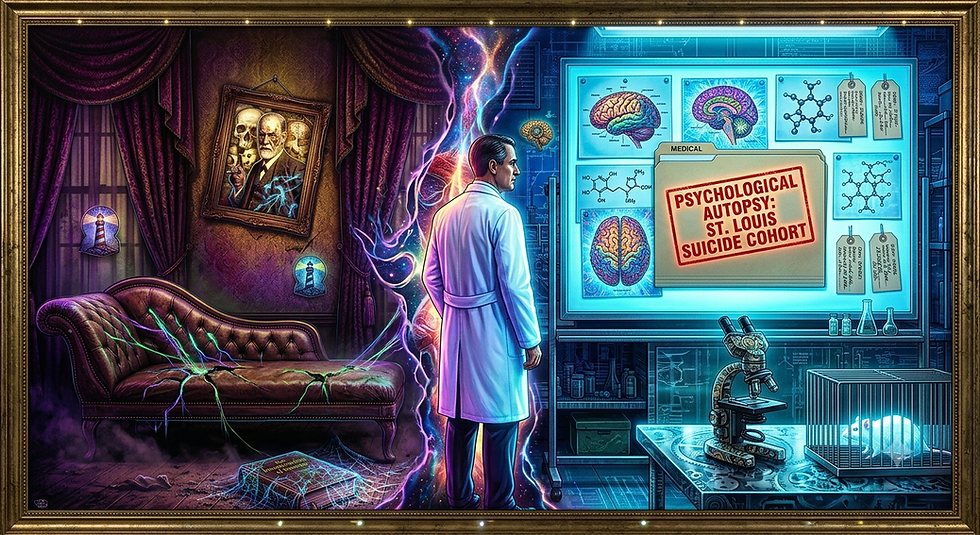
For decades, the standard approach to treating severe substance use disorders has relied on a combination of daily medications and cognitive behavioral therapy. These methods attempt to impose top-down, rational restraint over a brain whose fundamental survival circuitry has been hijacked.
In the addicted mind, environmental cues—the clink of a glass, a specific street corner—trigger an involuntary, physical compulsion to consume.
Standard pharmacological and cognitive-behavioral interventions frequently yield suboptimal long-term outcomes because they attempt to superimpose rational, top-down restraint over deeply entrenched, subcortical survival imperatives. In contrast, psilocybin is administered in a limited number of moderate-to-high dose sessions. This approach precipitates an acute altered state of consciousness that frequently results in rapid and enduring behavioral changes—what clinical observers and depth psychologists sometimes call "spontaneous remission" or "quantum change."
By mapping the intersection of advanced functional neurobiology and deep psychological processing, scientists are finally uncovering how psilocybin allows patients to fundamentally "unlearn" addiction.
The Locked Architecture of Addiction
To understand how psilocybin works, one must first understand how addiction structurally alters the brain. Chronic substance abuse creates a maladaptive feedback loop across three core domains:
Negative Emotionality: Driven by an overactive amygdala, the brain rests in a baseline state of distress, making the substance feel required just to achieve a normal baseline.
Incentive Salience: Governed by the striatum and insula, neutral environmental cues become highly trained triggers, resulting in visceral, bodily sensations of craving.
Compromised Executive Function: The prefrontal cortex—the brain’s top-down control center for impulse regulation—is systematically overpowered by bottom-up survival drives.
When "locked" in this state, the brain's Default Mode Network (DMN)—the neurological seat of our ego and autobiographical self—becomes hyper-rigid. The DMN’s two main hubs, the medial Prefrontal Cortex (the "Boss" that assigns value) and the Posterior Cingulate Cortex (the "Storyteller" that shapes our identity), trap the individual in a continuous, ruminative loop of addiction and past failures.
Dismantling the "Boss" and the "Storyteller"
Brain imaging reveals that psilocybin physically disrupts this rigid architecture. When administered, the compound sharply reduces blood flow and connectivity between the "Boss" and the "Storyteller."
This mechanism is best understood through the REBUS (RElaxed Beliefs Under pSychedelics) model, which views the brain as a prediction engine. Under normal circumstances, the DMN imposes high-level "priors," or deeply ingrained beliefs, onto incoming sensory data to minimize surprise and keep the world predictable.
In addiction, the belief that the drug is strictly required to function becomes a pathologically over-weighted prior. By agonizing specific serotonin receptors, psilocybin decreases the precision weighting of these high-level priors, causing the DMN to lose its top-down inhibitory grip.
This temporary "decoupling" halts the automatic loop of cue-craving-consumption. Without the DMN's top-down predictive grip, the brain transitions into a highly flexible, globally interconnected state where the established physical laws of craving no longer apply.
Reopening the Window for Unlearning
While the acute psychedelic trip lasts only four to six hours, the behavioral changes can last a lifetime. This durability stems from psilocybin's ability to trigger metaplasticity—reopening developmental "critical periods" in the adult brain.
The groundwork for this understanding stems from a landmark 2023 study published in the journal Nature by Dr. Gül Dölen and her colleagues. By administering psychedelics to adult male mice and testing them in a social conditioning paradigm, researchers discovered the mice temporarily regained the juvenile capacity to learn the value of social environments—a behavioral flexibility typically completely inaccessible in adulthood.
Crucially, the researchers noted that the duration of this reopened critical period was directly proportional to the acute duration of the drug's subjective effects in humans. While a short-acting compound like ketamine might keep the window open for 48 hours, a psilocybin macro-dose extends this profound state of heightened learning for a full two weeks.
At the molecular level, this unlearning is driven by profound changes in RNA expression within the nucleus accumbens, a brain region central to reward and reinforcement. The psilocybin-induced open state alters the expression of 65 protein-producing genes, many of which signal the degradation of the physical perineuronal nets that physically lock in addictive habits, simultaneously restoring oxytocin-mediated plasticity. During this two-week critical window, the deeply entrenched physical pathways of addiction can be actively dismantled and overwritten.
Seeing the Shift: From Reactivity to Intentionality
This biological rewiring has been observed in real-time. In a neuroimaging study at NYU Langone Health focusing on Alcohol Use Disorder, patients were exposed to alcohol cues inside an fMRI scanner before and after psilocybin treatment. The results showed a profound functional reorganization:
Muting the Craving Center: The insular cortex, responsible for translating visual cues into physical cravings, showed a robust decrease in activity. The visceral "tug" of addiction was silenced.
Restoring Executive Control: The prefrontal cortex exhibited heightened activation, mirroring the brain function of healthy individuals and restoring goal-directed, intentional behavior.
Patients shifted from an "autopilot" reactive state to a "meta-aware" intentional state, observing triggers without being physically compelled to act on them.
The "Care of the Soul" and Symbolic Breakthroughs
Biological mechanisms alone cannot explain the full efficacy of this treatment. Addiction is frequently a desperate psychological adaptation to trauma or a crisis of meaning.
Mechanistic psychiatry often fails because it treats the symptom while ignoring the psyche.
Clinical trials consistently show that the long-term success of psilocybin is inextricably linked to the subjective intensity of the acute experience. Patients who undergo a "complete mystical experience"—characterized by a profound sense of universal interconnectedness and ego dissolution—fare the best.
Researchers quantify these acute mystical experiences using validated psychometric instruments like the Mystical Experience Questionnaire (MEQ-30) and the 5-Dimensional Altered States of Consciousness scale. Therapeutic success is heavily predicted by specific phenomenological features, particularly "Oceanic Boundlessness"—a profoundly felt sense of unity that directly counteracts the isolation and shame inherent in chronic addiction.
Because high-dose psilocybin temporarily suspends the brain's reliance on rational-linguistic processing, these psychological breakthroughs frequently manifest through intense, symbolic visual imagery. Qualitative analyses of patients treated for alcohol use disorder reveal that they often encounter their addiction not as a medical diagnosis, but personified as a physical weight, a dark archetype, or a terrifying monster.
This symbolic-expressive process serves a profound purpose: it externalizes the pathology. A patient might confront a monstrous representation of childhood trauma only to realize, through the empathetic lens of the medicine, that the monster was originally generated by their own mind as a protective shield.
This single realization can rewrite the fundamental meaning of the substance. By temporarily obliterating the rigid "addicted identity," patients gain unparalleled psychological distance. This narrative shift recontextualizes drug cues: rather than biological imperatives, they become powerless artifacts of a past life, transforming a daily battle of willpower into an organic reflection of a healed self.
Integration: Cementing the Change
Because psilocybin leaves the brain's critical learning period open for about two weeks, post-session psychotherapy is vital. Utilizing models like the ACE framework (Accept, Connect, and Embody), therapists help patients weave their abstract psychedelic insights into concrete behavioral changes.
By establishing healthy routines and repairing relationships during this hyper-plastic window, patients physically wire a new baseline of resilience into their neurochemistry. When the brain's extracellular matrix eventually solidifies again, it locks in cognitive flexibility and profound meaning, extinguishing the physical compulsion of addiction for good.
Conclusion: A Return to the Ecosystem of Meaning
In many ways, the neurobiological action of psilocybin beautifully mirrors the subterranean mycelial networks from which it is derived.
Just as fungal networks quietly dismantle decaying matter to regenerate vibrant, biodynamic ecosystems, this ancient molecule physically breaks down the rigid, over-consolidated neural architecture of addiction. It does not merely suppress the symptoms of pathology; it composts the psychological debris of trauma and habit, clearing the structural roadblocks so that new, adaptive synaptic pathways can take root in the mind.
This biological reset is inextricably linked to a broader transpersonal ecology. Addiction, at its core, is a disease of profound isolation—a severance from the collective and a retreat into a narrowing world of survival imperatives. The ego dissolution catalyzed by psilocybin initiates a return to a wider ecosystem of meaning.
By stepping outside the rigid confines of the self, individuals frequently experience a sudden, undeniable remembering of their connection to the broader human community and the natural world, filling the existential void that the substance once sought to numb.
We are standing at the threshold of a new epoch in psychiatry, moving away from models that view patients as lifelong managers of an incurable defect. By embracing the dual-action mechanism of psychedelic therapy—the molecular unlearning of cue reactivity and the phenomenological care of the soul—medicine is finally addressing the totality of human suffering. We are learning to treat not just the receptors, but the person; not just the brain, but the mind’s desperate search for purpose and connection.
Ultimately, the promise of psilocybin-assisted therapy is a testament to the profound resilience of the human nervous system. It reveals that the addicted brain is not permanently broken, but rather locked in a state of suspended growth, waiting for the right environmental signals to adapt and heal.
For those trapped in the dark, ruminative loops of compulsion, this medicine offers a fleeting, luminous window—a chance to rewrite the script, to shed the armor of the past, and to emerge into a life defined not by craving, but by profound, expansive freedom.