The Novelty Bonus: Re-Booting a Mind Built for the Infinite
- One Love Energy
- Feb 18
- 7 min read
Updated: Mar 11
Requiem for the Unseen Lightning
We gather to mark the passing of a vastness that never reached the horizon.
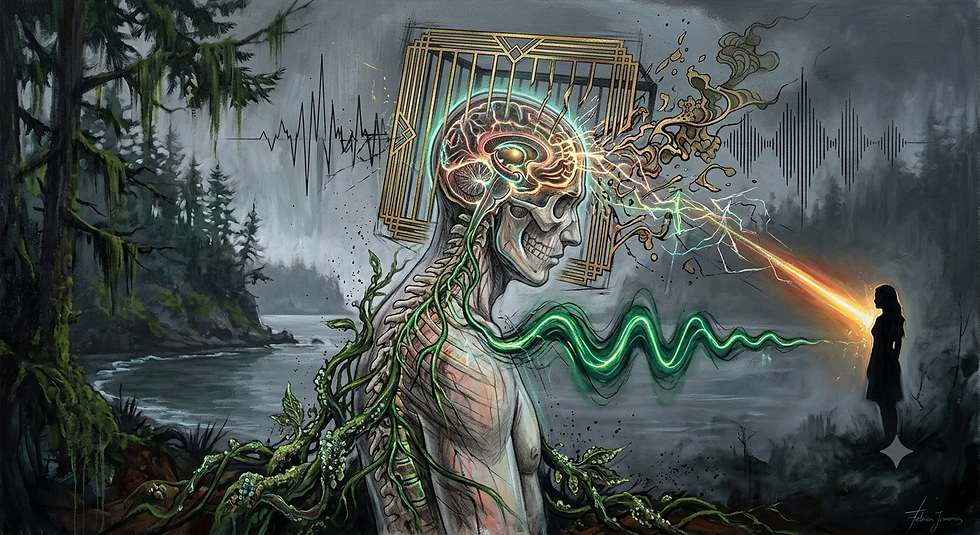
This was a mind built for the infinite—a complex architecture of sparks and synapses designed to map the stars, to deconstruct the atoms, and to weave New Worlds out of nothing but thought. It was a cathedral of "Why" and "What if," a restless engine of strategic novelty that required the entire universe as its fuel.
But the world gave it a cell.
A cage.
Restraint.
The boot.
Instead of the open sky, it was met with the cold geometry of four walls. Instead of the Novelty Bonus of discovery, it was fed the gray gruel of repetition.
We watched a predatory intellect turn inward, forced to hunt its own tail because there was no other prey.
To starve a mind is not to stop it from thinking; it is to force it to consume itself.
We mourn the "Aha!" moments that died in the dark.
We mourn the connections that were never made and the symphonies that remained as silent electrical storms behind a furrowed brow.
The cage is now open, but the bird is
gone.
May this powerful spirit finally find a space wide enough, strange enough, and new enough to hold it.
--- act ONE ---
It is fascinating how our brains are essentially novelty-seeking missiles. Evolutionarily, it makes sense: the old and familiar is safe, but the new could be either a windfall or a threat.
To manage this, your brain has a sophisticated biological radar system.
Here is the breakdown of how your gray matter handles the "new."
The Neuroscience of "New"
The primary engine for novelty is the Mesolimbic Dopaminergic System. When you encounter something unexpected, your brain releases dopamine—not necessarily because it's "pleasurable," but because it’s salient.
The Gateway: The Hippocampus
Think of the hippocampus as a comparator. It constantly compares your current sensory input against your stored memories.
* Match: If the input matches a memory, the brain relaxes (habituation).
* Mismatch: If there is a discrepancy, the hippocampus signals the Substantia Nigra/Ventral Tegmental Area (SN/VTA). This is often called the "Hippocampal-VTA Loop."
The Reward: Dopamine
Once the SN/VTA is triggered, it floods the Nucleus Accumbens with dopamine. This creates a state of "exploration readiness." It heightens your attention and makes you more likely to learn, as the brain assumes this new information is vital for survival.
The 3 Types of Novelty:
Neuroscientists generally categorize novelty into three distinct "flavors" based on how they challenge our expectations.
1. Stimulus Novelty (The "What is that?")
This is the most basic form. It occurs when you see, hear, or feel something you have never encountered before.
* Example: Seeing a species of deep-sea fish for the first time.
* Brain Impact: High activation of the primary sensory cortices and the amygdala (to check if it's dangerous).
2. Contextual Novelty (The "Why is that here?")
This happens when a familiar object appears in an unfamiliar place. The object itself isn't new, but its presence violates your mental map of how the world works.
* Example: Finding your kitchen toaster sitting in the middle of your shower.
* Brain Impact: Heavy reliance on the Prefrontal Cortex (PFC) to resolve the "error" in logic and the Hippocampus to update the context of that environment.
3. Strategic (or Rule) Novelty (The "How do I do this?")
This is more abstract. It occurs when the rules of engagement change. You know the tools and the setting, but the way you interact with them must be completely different.
* Example: Switching from driving a manual car to an electric vehicle with one-pedal regenerative braking.
* Brain Impact: This requires Cognitive Flexibility. The brain must suppress old habits (Inhibitory Control) to allow for new neural pathways to form.
Why "New" Feels So Good (The Novelty Bonus)
In computational neuroscience, this is often modeled as the Novelty Bonus. When we are exploring, the brain adds a "value" to unknown options simply because they are unknown.
--- act TWO ---
Your brain is basically a "novelty junkie" and how that manifests in the modern world—from the high of learning to the low of the infinite scroll.
The "Dark Side": Novelty as a Trap
While seeking novelty helped our ancestors find better hunting grounds, in 2026, it’s the exact mechanism being hijacked by your smartphone.
The Dopamine Loop (Doom-Scrolling)
Social media apps are designed to be Novelty Engines. Every flick of your thumb is a gamble.
* The Variable Reward: You don't know if the next post will be a boring ad or a hilarious meme.
* The Result: Because the "Contextual Novelty" is constant and fast-paced, your SN/VTA never stops firing. This can lead to Dopamine Baseline Depletion, where nothing feels "new" or exciting anymore because you've overstimulated the circuit.
The "Bright Side": Enhanced Neuroplasticity
When you purposely lean into novelty—like traveling to a new country or learning a complex skill—you unlock the brain's secret weapon: The Penumbra of Learning.
1. Tag-and-Capture Theory
Neuroscience suggests that a flash of novelty creates a window of time where your brain is more plastic. If you learn something boring right after experiencing something new, you’re actually more likely to remember the boring stuff. The novelty primes the neurons to stay open for business.
2. Synaptic Tagging
When you experience novelty, your brain synthesizes Plasticity-Related Proteins (PRPs).
Think of it like this: Novelty is the "Highlighter" of the brain. It marks the neural pathways you're currently using and says, "Hey, this is important! Save this file!"
Novelty vs. Complexity: The "Sweet Spot"
There is a limit. If something is too new, it becomes Stress. If it’s too familiar, it’s Boredom. We look for the "Flow State" in the middle.
Why We "Stop Seeing" the World
Finally, let's talk about Predictive Coding. To save energy, your brain eventually stops "processing" things it sees every day. It builds a simulation of your living room and only "updates" the image if something changes (like a new coffee table).
This is why time seems to speed up as we get older—we encounter less novelty, so the brain writes fewer "new files" to the hard drive. To slow down time, you have to break your routine.
--- act THREE ---
When we talk about the "stoner" experience and novelty, we’re looking at a fascinating intersection of neurochemistry and perception. Cannabis doesn't just make things "funny"—it essentially flips the Novelty Switch in the brain to the "ON" position and tapes it down.
Here is the breakdown of why that happens and why it creates a drive for new experiences.
1. The Death of Habituation (The "First Time" Effect)
Under normal circumstances, your brain is a master of Habituation. You see your favorite poster every day, so your brain stop "rendering" it to save energy.
* The THC Factor: THC binds to CB1 receptors in the Hippocampus and the Prefrontal Cortex. This disrupts the brain’s "I’ve seen this before" signal.
* The Result: You look at a slice of pizza or listen to a song you’ve heard 100 times, and the brain treats it as Stimulus Novelty. It feels like the "first time" because the neural circuitry that normally says "This is old news" is temporarily offline.
2. Dopamine Sensitization
As we discussed, novelty is driven by the SN/VTA dopaminergic loop.
* Cannabis stimulates the release of dopamine in the Nucleus Accumbens.
* By artificially elevating dopamine, the brain enters a state of Hyper-Salience.
* Suddenly, the texture of a velvet couch or the complex layers of a jazz saxophone solo become "profoundly interesting." The stoner seeks novelty because the brain is currently primed to find reward in the tiniest details of the environment.
3. Divergent Thinking & The "Aha!" Moment
Novelty isn't just about seeing new things; it’s about making new connections.
* Hyper-priming: Cannabis can induce a state of hyper-priming, where one thought leads to another distantly related thought much faster than usual.
* Strategic Novelty: This leads to Strategic Novelty—finding a new way to look at an old problem. This is why "high ideas" feel like world-changing epiphanies; the brain is bypassing its standard logical filters and celebrating the novelty of the connection itself.
The Novelty Seeking Feedback Loop
There is a specific behavioral pattern here. Because the "High" state makes the familiar feel novel, it creates a craving for sensory exploration.
The Risk: The "A-Motivational" Trap
If the brain gets too used to "fake novelty" (achieved via a substance), it can become desensitized to natural novelty. This is why some long-term users feel "bored" with real-life achievements—the brain’s internal Novelty Bonus math gets skewed.
If the chemical part is too high, the real experience starts to feel flat without it.
The "Time Dilation" Connection
Ever wonder why 10 minutes feels like an hour when you're high? It’s because of the Density of Novelty. Since your brain is processing every "old" thing as a "new" thing, it’s writing way more "files" to your memory per minute.
The Brain's Logic: "I just processed 500 new things! It must have been an hour." (In reality, it's been 6 minutes).
--- act FOUR
Psilocybin doesn't just make you see "new" things; it fundamentally changes how you see the things you’ve seen a thousand times before. It effectively "reboots" your perception by dissolving the rigid filters of your adult brain.
Here is why it makes the familiar feel profoundly novel:
1. Dissolving the "Default Mode"
Your brain usually operates on a "Predictive Coding" model. It uses a network called the Default Mode Network (DMN) to act as a gatekeeper, filtering out repetitive sensory data so you don't get overwhelmed by the wallpaper or the sound of traffic.
* The Psilocybin Effect: It dampens the DMN. When the gatekeeper goes on break, the "old" world rushes in without filters.
* The Novelty: You aren't seeing a "chair"; you are seeing the raw play of light, texture, and geometry as if you were an infant encountering matter for the first time.
2. Global Hyper-Connectivity
On psilocybin, brain regions that don't normally talk to each other suddenly start a massive cross-country conversation. This is often visualized as a massive increase in functional connectivity.
* Synesthesia: This "crosstalk" allows you to "hear" colors or "see" music.
* The Novelty: Because your sensory wires are crossed, a "repeated" experience (like listening to your favorite album) becomes a brand-new multidimensional landscape.
3. The "Unlearning" of Meaning
We usually look at a tree and think "Tree" (a linguistic label). Psilocybin strips away the label and leaves you with the essence.
* By bypassing the semantic memory (the "names" of things), you experience the object's physical reality rather than your mental shortcut of it.
* Eloquently put: It replaces "Recognition" with "Observation."
The "Awe" Factor
Neuroscientifically, Awe is the ultimate state of novelty. It occurs when we encounter something so vast or complex that we have to update our entire mental "schema" to understand it. Psilocybin induces a state of sustained awe, making even a blade of grass a source of infinite complexity.
If your sober brain is a well-worn path through a forest, psilocybin is like the path suddenly vanishing, forcing you to experience every leaf and shadow as a discovery rather than a destination.