The Voyage of the Synaptogenesis
- One Love Energy
- Mar 13
- 9 min read
The ocean did not announce its violence. It swallowed the Synaptogenesis in a single, breathless inhalation of black water and kinetic force.
Inside the bridge, the air hung thick with the metallic taste of ozone and the sharp, clinical sting of panic. The ship shuddered, a groan of compressed oak that vibrated upward through the soles of heavy leather boots. Above them, the sky was a bruised, rotting canvas weeping horizontal sheets of freezing rain.
Helen stood anchored to the navigation console. Her knuckles, clamped around the brass safety rail, had drained to the color of old bone. She smelled of sterile alcohol swabs and rigid, starched cotton—a scent that fought a losing battle against the encroaching brine. Her eyes were fixed on the proximity radar. A sweeping green line stuttered, flashing angry crimson warnings as the topography of the sea warped beyond the computer’s programmed tolerances. The digital map was failing. It offered no exit, only a countdown to structural collapse.
Crouched in the shadows near the binnacle, Terry was unraveling. A heavy, leather-bound pathophysiology textbook lay open across his knees, its thin pages curling in the damp air. He traced the topographical depth charts with a trembling finger, his breath hitching in a wet, ragged rhythm. He muttered pressure tolerances and hull fracture points to the empty air. A warm trickle of iron-rich blood painted his chin where he had bitten through his own lip. The numbers on the page were absolute. According to the textbook, they were already dead.
A sudden, sickening plunge sent the deck canting at a forty-five-degree angle. From the lower cargo bay, a sound like a gunshot echoed through the hull.
A two-hundred-pound, iron-banded barrel snapped its mooring line. It smashed through the lower bulkhead doors, a runaway wrecking ball of solid oak carrying a fortune in Permanent Chimera live hash rosin. It careened into the bridge, accelerating on the downward pitch, aiming directly for the binnacle.
Terry shrieked, dropping his book and scrambling backward until his spine hit cold glass.
The portside door kicked open. The storm outside howled, but it was eclipsed by the atmosphere that poured in with the captain.
George did not merely enter; he disrupted the room's gravity. He brought with him the heavy, fertile scent of deep earth, the skunky richness of Black Onion, and the sharp, clarifying bite of pine terpenes. He wore a soaked canvas coat, his eyes bright and feral in the dim, flashing light of the dying alarms.
He didn't look at the radar. He didn't look at the screaming warnings. He watched the barrel.
As the massive cylinder of oak and iron accelerated toward him, George didn't flinch. He moved with the rhythm of the violent sea. Dropping his shoulder, he tucked his chin and tumbled. He executed a flawless, chaotic roll beneath the flying timber. The barrel caught air, missing his head by inches, and smashed harmlessly into the aft bulkhead with a splintering crash.
George sprang to his feet, adjusting the collar of his coat with infuriating calm. He stepped over to the cracked glass of the failing altimeter, leaned in close, and planted a theatrical, affectionate kiss squarely on its surface. He was always kissing to be clever.
"Captain!" Helen yelled, her voice tearing over the thunder. "The models predict a catastrophic fracture in three minutes! We have to reverse the engines! We have to follow the abort protocol!"
Terry scrambled forward, holding up the waterlogged textbook like a shield. "The hull integrity! Chapter four says we fracture at this depth! The barometric pressure is too high!"
George turned. His movements were slow, deliberate, cutting through the frantic energy of the bridge. He walked to Terry, reached out, and slapped the heavy book from the young man's grip. It hit the flooded floorboards with a wet, useless thud.
"The sea," George said, his voice a low rumble that somehow carried over the storm, "has not read chapter four."
He grabbed Terry by the lapels of his soaked coat and hauled him upright, dragging him to the shattered window. "Look at it!" George commanded, pointing into the churning black abyss. "What do you smell? What do you hear in the wood?"
"I don't know!" Terry squeezed his eyes shut, his entire body shaking.
"Open your eyes," George said, his grip tightening. "Stop treating this like a closed puzzle with one safe answer. Look at the open system. It is fluid. It is energy. It is breathing."
He released Terry and moved to Helen. He reached out, gently but firmly prying her bloodless fingers from the brass rail. He guided her hands, placing her palms flat against the vibrating, freezing oak of the forward bulkhead.
"Stop looking at the screen, Helen. The screen is a map drawn by someone who isn't here. We are in the territory." He leaned in close. "Feel the wood. When the vibration pitches up, the wave is gathering. You don't need a sensor. Your body knows. Tell me when it pitches."
A blinding flash of lightning struck the water nearby. The main console sparked. A thick plume of blue smoke poured from the motherboard, smelling of melting plastic and dead circuits. The digital map vanished. The alarms died. The bridge plunged into absolute darkness, save for the rhythmic strobe of the storm.
"We lost the steering," Helen gasped, the dark stealing the last of her breath.
"We lost the illusion of control," George corrected.
He unclipped a heavy, analog voltmeter from his belt. He had spent thirty years of his life locked inside the rigid, terrifying architecture of his own mind, trapped by a medical consensus that told him his fog was permanent. He had broken that closed puzzle by refusing the map, by seeking out the raw, radical healing of the earth. He treated his ship with the exact same reverence.
He kicked the panel off the steering column. Bypassing the fried motherboards, he jammed the copper probes directly into the mechanical servos. A spark arched, biting into his thumb. He tasted ozone and copper. He grabbed the giant wooden wheel, feeling the immense, crushing weight of the ocean pull against the rudder.
"Helen, throttle! Terry, listen to the deck! Balance the roll with your weight!"
George hauled the wheel hard to starboard. The ship groaned, a sound like a dying beast. "Hold on," George smiled, his teeth flashing in the dark. "The next thing is going to be amazing."
They hit the base of the rogue wave.
It wasn't a swell; it was a vertical wall of black, kinetic marble. The Synaptogenesis pointed her bow directly at the sky. Gravity doubled, pinning them to the floorboards. George’s boots slid on the slick wood. He planted his heel against the iron base of the binnacle and pulled the wheel with everything he possessed. The tendons in his neck stood out like steel cables.
"It's pitching up!" Helen screamed. Her hands were pressed flat to the wall. She wasn't analyzing data. She was feeling the pulse of the ship.
"Port side is lifting!" Terry yelled from the floor. His ear was pressed to the wet boards, feeling the terrifying shift in the water's displacement before it ever registered on the horizon.
"Compensating," George grunted. He spun the wheel left. He bypassed thought entirely. He let his nervous system connect directly to the rudder, feeling the exact moment the payload of Albino Bluey Vuitton spores in the hold shifted. He adjusted the center of gravity by fractions of an inch.
They climbed. The engines screamed a high-pitched whine, fighting the sheer, impossible verticality of the water. A solid sheet of black ocean poured over the windshield. They were buried. The pressure was absolute, crushing the breath from their lungs. The world was nothing but vibration, terror, and the tearing sound of water.
And then, the pressure shattered.
The bow slammed downward, but it did not hit churning foam. It struck a plateau of rolling glass.
The deafening, apocalyptic roar of the storm vanished. The transition was so violent, so instantaneous, that the sudden silence left their ears ringing with a high, hollow whine. George exhaled a breath he felt he’d been holding for three decades. He wiped the burning salt from his eyes.
They had broken through the eyewall.
Above them, the thick, bruised clouds peeled back. A perfectly circular aperture of clear sky revealed a sweeping galaxy of sharp, unblinking stars. A massive, silver moon cast a brilliant, cold light across a dead-calm sea.
The air in the bridge shifted. The smell of fear, ozone, and clinical panic evaporated. The violent friction of the ascent had cracked the seals on the cargo containers below. A warm draft drifted up through the floorboards. The rich, earthy depth of Black Onion and the sweet, expansive pine of live hash rosin mingled with the ionized ocean air.
It was a biological anchor. The terpene-heavy air filled their lungs, actively slowing their racing pulses, smoothing out the frayed, electrical panic of their limbic systems.
Helen slowly pulled her hands away from the wood. She looked at her trembling palms, then out the shattered window. The rigid, starched tension in her shoulders melted away. She took a deep, shuddering breath, tasting the pine and the earth.
"It's gone," she whispered, her voice stripped of its armor.
Terry pushed himself up from the floor. He didn't look for his textbook. It was ruined, and he didn't care. He stepped to the glass, his jaw slack. The water in the eye of the storm was glowing. Bioluminescent algae, agitated by the massive pressure drop, had turned the sea into a glowing, neon mirror of the starry sky above.
George leaned heavily against the wheel. He felt the deep, rhythmic, stable thrum of the engine. This was the clarity he had fought for.
The medical consensus, the digital maps, the textbooks—they would have commanded them to turn back. They would have sent them to the bottom of the sea.
He looked at Helen and Terry. They were breathing deeply, their nervous systems settling into the radical calm of the open system. They were no longer the people who had cowered behind failing instruments ten minutes ago. They had sat with the absolute terror of the unknown, faced the raw territory, and survived.
George reached into the deep pocket of his soaked coat. He pulled out a small, airtight glass jar filled with the pale, ghostly caps of Albino Bluey Vuitton. He set it gently on the brass rim of the binnacle, where it caught the moonlight.
"I told you," George said quietly, looking out at the glowing sea. "We just had to ask what was possible."
>>>>>>><<<<<<
Epilogue:
The glowing sea beneath the Synaptogenesis was not just a miracle of survival; it was a perfect biological mirror. As George stood in the bioluminescent calm, the glass jar of Albino Bluey Vuitton resting on the brass binnacle represented the exact mechanism that had saved them from the crushing depths.
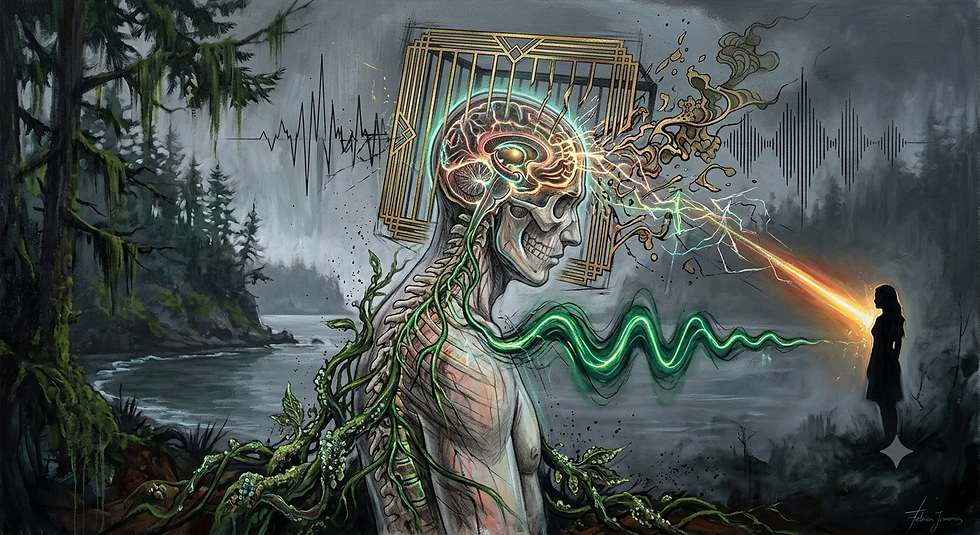
For thirty years, George had been trapped inside the ultimate closed system: the Default Mode Network of a mind in crisis. In human neurobiology, the Default Mode Network is the established map. It is the rigid, well-worn highway of the ego, responsible for our internal monologue, our historical traumas, and our entrenched beliefs. When deep pathology takes hold, this network becomes an inescapable prison. It loops the exact same catastrophic warnings endlessly, completely disconnected from the physical reality of the present moment. It operates exactly like a terrified sailor staring at a failing digital radar, paralyzed by a screen while entirely ignoring the actual ocean breathing beneath them.
Traditional institutional medicine often attempts to fix this broken circuitry by suppressing it, layering heavy pharmaceutical protocols over the machinery to numb the alarms and force the system into a manageable baseline. It treats the human mind as a fragile, closed puzzle that must be contained.
George had chosen the territory instead.
Psilocybin acts as the ultimate electrical bypass. When introduced to the human nervous system, it profoundly disrupts and dissolves the Default Mode Network. It forcefully dismantles the rigid, looping map of the ego. Just as George shattered the dead motherboard and jammed his copper probes directly into the living, mechanical servos of his ship, the psychoplastogen forces the brain to forge entirely new connections.
This is the radical fire of synaptogenesis. The mind stops referencing its broken historical data and begins communicating across previously isolated neurological regions, waking up to feel the actual, raw vibration of the present moment.
The brain transitions from a closed loop of static fear into an open system of infinite neuroplastic possibility.
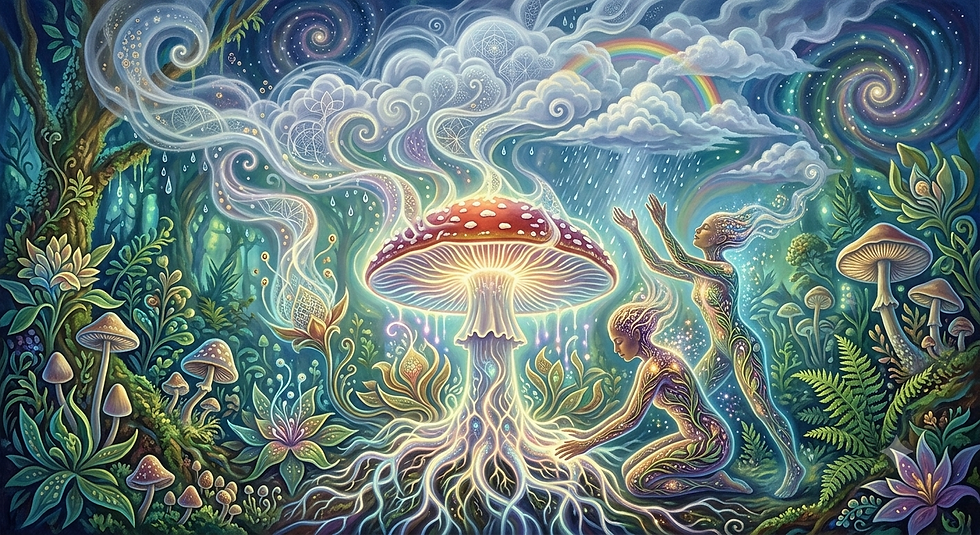
Yet navigating that profound expansion of consciousness requires a massive biological anchor, a heavy keel to keep the vessel from tearing itself apart in the squall. This is where the deep, earthy profiles of Black Onion cannabis and the sharp relief of Permanent Chimera live hash rosin complete the miraculous mechanism. The complex, solventless terpenes and minor cannabinoids bathe the raw nervous system in a synergistic buffer. They actively quiet the limbic panic. They smooth the electrical friction of the terrifying ascent, allowing the mind to safely rebuild its architecture without being crushed by the sheer verticality of the psychedelic experience.
This journey was never about a reckless defiance of the storm. It was the ultimate manifestation of epistemic curiosity. George, Helen, and Terry did not defeat the devastating ocean by clinging to a waterlogged textbook or a rigid curriculum. They survived by allowing the brittle structures of their institutional understanding to dissolve, syncing their bodies and minds directly to the terrifying, magnificent reality of the natural world.
True freedom, and true radical healing, do not come from finding a safe, predictable harbor on a standardized clinical map. They emerge the exact moment we strip away the artificial limits of what we have been told is correct, stand fiercely in the brilliant, starlit eye of the storm, and finally discover what is actually possible.
We have spent generations building clinical walls to keep the wildness of the mind at bay, forgetting that the cure for our deepest fractures grows quietly in the damp earth. The sacred fungi dismantle the rigid, looping architecture of our suffering, while the cannabis flower breathes a grounding peace into the raw nerves left behind. Together, they do not numb the spirit; they orchestrate a radical resurrection. They teach the paralyzed mind not how to hide from the tempest, but how to harness the lightning and finally chart a course by the stars.