The Absurd Synthesis: Love as the Lucid Rebellion
- One Love Energy
- May 26
- 7 min read
The Absurd Synthesis: Love as the Lucid Rebellion
To investigate love is to immediately confront a paradox. We are presented with two seemingly irreconcilable frameworks: the Ovidian assertion that love is a grand, orchestrated scam, and the deeply human conviction that love is an enduring, intentional promise.
By applying the philosophy of Albert Camus—a thinker who demanded we stare unflinchingly at the inherent meaninglessness of the universe (the Absurd) while simultaneously finding profound meaning in our rebellion against it—we can synthesize these two poles. Through the lens of the provided text detailing the bio-psycho-social architecture of human affection, we can dismantle the machinery of the "scam," construct the foundation of the "promise," and ultimately emerge with a unified theory of love as an act of lucid, existential rebellion.
Part I: The Ovidian Scam and the Biological Artifice
Ovid, the Roman poet of the Ars Amatoria, viewed love not as a divine mystery, but as a game—a construct of artifice, manipulation, and strategic pursuit. To Ovid, love was a scam played by lovers upon one another. Modern neurobiology and evolutionary psychology vindicate Ovid’s cynicism, revealing that the scam is not just interpersonal, but biological. Evolution itself is the grand scammer, and we are the marks.
The Evolutionary Bait-and-Switch
From an evolutionary perspective, the intense, overwhelming experience of romantic love is a meticulously engineered bait-and-switch. Homo sapiens are characterized by exceptionally large brains and a prolonged period of childhood dependency. The "provisioning hypothesis" dictates that a single parent could not secure enough calories to ensure the survival of an infant with such massive metabolic demands.
Therefore, evolution required a mechanism to bind two humans together for the decades necessary to rear offspring. Enter romantic love—what evolutionary biologists coldly term a "commitment device." Love is a scam designed to suppress the search for alternative mates.
By "blinding" the individual to other reproductive opportunities, this biological imperative conserves metabolic energy and reduces the risks of mate-seeking. It tricks the organism into believing that this one specific partner is the center of the universe, a necessary delusion to ensure the caloric provisioning of the species' future.
The Neurochemical Con
The mechanisms of this scam are heavily documented in the brain's reward circuitry. The attraction stage—often romanticized as Eros or "passionate love"—is essentially a neurochemical hijacking.
When we fall in love, the Ventral Tegmental Area (VTA) floods the brain with dopamine. This creates a state of intense euphoria, goal-directed behavior, and obsessive focus perfectly mirroring the neural signature of substance addiction. Norepinephrine induces the racing heart and sleeplessness of the newly infatuated, while plummeting serotonin levels mirror the neurochemistry of obsessive-compulsive disorder.
The lover, driven by this chemical cocktail, loses their objective sense of reality. As the text notes, this leads to the "prescient" creation of Positive Illusions. We project an idealized image onto our partner, seeing them not as they are, but as our neurochemistry needs them to be. We are scammed by our own biology, rendered obsessive and addicted, all to ensure we do not abandon the pair bond before the evolutionary goal is met.
Part II: The Architecture of the Promise
If we stop the analysis at dopamine and evolutionary biology, Ovid wins entirely.
However, the architecture of love extends far beyond the initial neurochemical con. When the frantic, obsessive stage of attraction inevitably fades (typically within 1.5 to 3 years, precisely the time needed to see an infant through its most vulnerable stage), a new biological and psychological reality emerges. Here, the "scam" drops its facade, and the opportunity for the "promise" begins.
The Somatic Vow: Oxytocin and Anandamide
As the dopamine rush subsides, the physiological foundation of the promise is laid by the neuropeptides oxytocin and vasopressin. Oxytocin, released through physical touch and shared vulnerability, reduces activity in the amygdala, the brain's fear center. It replaces the frantic anxiety of the chase with profound trust and safety.
Furthermore, this sense of safety is elevated into what can only be described as somatic bliss through the endocannabinoid system. The release of anandamide—the "bliss molecule"—in synergy with oxytocin reinforces the pleasure of social interaction. This is the neurobiological reward for making the promise. It is the body saying that the maintenance of a close-knit human bond is intrinsically valuable.
Sternberg’s Consummate Love as an Intentional Act
In Robert Sternberg’s Triangular Theory of Love, we see the transition from involuntary biological drive to voluntary, psychological promise.
While "Infatuation" (driven by passion) and "Romantic Love" (intimacy and passion) can happen to us without our consent, "Consummate Love"—the ideal balance of intimacy, passion, and commitment—must be actively constructed. Commitment is not a feeling; it is an intentional decision to maintain a relationship over time. It is the cognitive vow that transforms a fleeting chemical state into an enduring shared reality.
Vulnerability and the Human Caregiving Network
The ultimate manifestation of the promise is found in the willingness to be vulnerable. As the text highlights, vulnerability is paradoxically the "strongest form of love." It requires the choice to be open about feelings, needs, and boundaries without hiding behind the idealized projections of the attraction phase.
This promise extends into the restructuring of the self, most vividly seen in the "human caregiving network." The transition into deep attachment—particularly in parenthood—literally remodels the brain. The pruning of gray matter to increase sensitivity to an infant's cues is a biological reflection of a psychological vow: I will reconfigure my very being to ensure your survival and flourishing. The promise alters our anatomy.
Part III: The Camusean Synthesis
How, then, do we reconcile Ovid's biological scam with the deeply felt reality of the intentional promise? We turn to Albert Camus and the philosophy of the Absurd.
Embracing the Absurdity of Affection
Camus posited that human beings have a desperate desire for inherent meaning, order, and eternity, but the universe is entirely silent, chaotic, and indifferent. This contradiction is the Absurd.
To look at love through this lens is to acknowledge the scam. We must lucidly accept that our feelings of "destiny" and "soulmates" are largely the result of ancient evolutionary pressures, VTA dopamine spikes, and the primal need for caloric provisioning in hominin infants. The universe did not design love as a poetic absolute; biology designed it as a survival mechanism. The foundation of our highest ideals is built upon a deterministic, chemical artifice.
For the Absurd man, to deny this biological reality is philosophical suicide. But to surrender to it—to become a nihilist who dismisses love entirely because of its chemical origins—is equally a failure.
Love as the Lucid Rebellion
Camus’s solution to the Absurd is rebellion. We must recognize the meaninglessness of the universe and choose to create our own meaning anyway. We must push the boulder up the hill, fully aware that it will roll back down, and we must imagine Sisyphus happy.
In the context of the bio-psycho-social architecture of love, the Camusean rebellion is the transition from the scam to the promise.
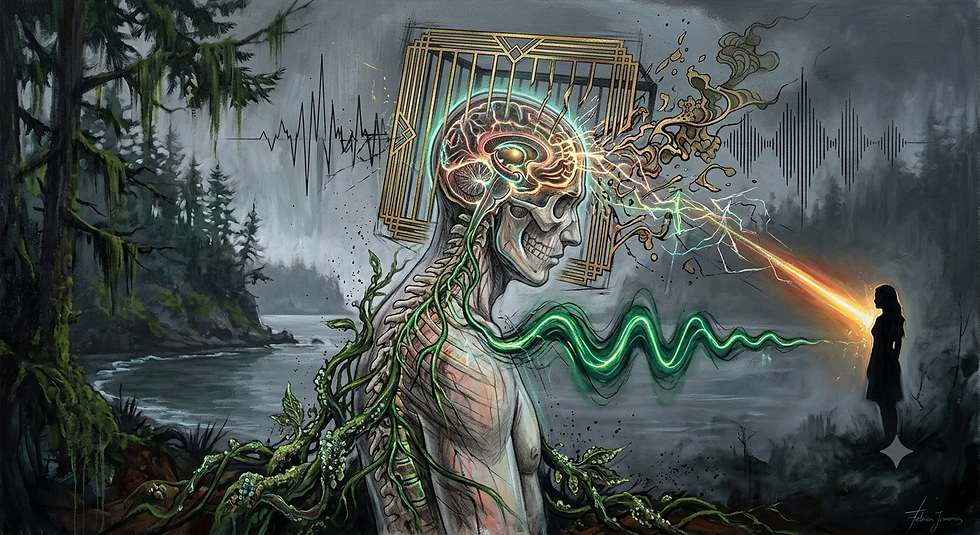
It is a profound act of defiance to look at your partner, fully understand that your initial attraction was a neurochemical trick designed by evolution to ensure genetic propagation, and say: "I know this began as a biological scam. But I choose to make it a promise."
This is what elevates human love above mere mammalian mating strategies. We possess the metacognition to observe our own programming and the agency to transcend it. The scam brings us together, but the promise keeps us together. The promise is our rebellion against the indifference of the biological imperative.
Harmonious Passion and Shared Reality
This synthesis is perfectly captured in the text’s discussion of the Dualistic Model of Passion. "Obsessive Passion" is what happens when we remain victims of the scam. We become addicted to the partner, losing our autonomy to the dopamine-driven compulsion.
We are controlled by the biological artifice.
"Harmonious Passion," however, is the Camusean ideal. It occurs when an individual freely engages in a relationship that remains in equilibrium with their personal autonomy. It is love as a conscious choice. Furthermore, the reliance on "Shared Reality" over "Positive Illusions" is the hallmark of the Absurd lover. Instead of relying on the scam's falsified, idealized version of the partner, the Absurd lover demands a shared consensus of reality—seeing the partner with all their flaws and choosing to love that precise, unvarnished reality.
Agape and Integration: The Ultimate Defiance
The text touches upon the profound application of love in psychedelic integration, noting that the cultivation of self-compassion and Agape (universal, selfless love) mediates deep psychological healing.
To experience a mystical state of universal oneness is to step outside the evolutionary scam entirely. Evolution has no use for unconditional, universal love; evolution favors parochial altruism—loving the in-group to survive the out-group. Therefore, the cultivation of Agape and profound self-compassion is the ultimate rebellion against our primal wiring. It is the conscious integration of a love that expects no caloric or reproductive return.
By integrating this love into our daily practices—through somatic grounding, journaling, and community connection (the "Social Cure")—we transform fleeting, ineffable biological or neurochemical states into sustainable interpersonal connections. We use the architecture of our brains not just to survive, but to heal.
Conclusion: The Architecture of Meaning
Ovid was not wrong. Love, in its genesis, is a scam—a magnificent, dopamine-drenched artifice crafted by natural selection to blind us into cooperation. But you are not wrong either. Love is a promise—a cognitive, intentional vow that rewires our neuroanatomy, builds profound psychological resilience, and creates a shared reality out of nothingness.
Camus allows us to hold both truths simultaneously. As limbic visionaries navigating the human experience, we do not need to deny the machinery of our biology to find the sacred in our connections.
The highest psychological achievement of humanity is to see the strings of our biological programming, acknowledge the absurdity of the play, and choose to perform it with absolute, unwavering devotion anyway. The scam is the spark; the promise is the fire we choose to tend.