Untitled
- One Love Energy
- Jun 3
- 3 min read
I. The Architecture of the Carapace
The barricade was not merely a physical structure; it was the logical conclusion of their existence. Commander Graves stood inside his Kevlar shell, feeling the reassuring weight of the polycarbonate riot shield against his forearm. It was a carapace. Inside it, he was an instrument of the state, devoid of the messy, sprawling neuroses that plagued the unarmored masses beyond the line. His identity was the uniform. His pulse was the synchronized clicking of batons against shields.
Then, the anomaly descended.
It did not arrive with the familiar, manageable logic of a brick or a Molotov cocktail. It drifted downward with a sickeningly smooth trajectory, suspended on iridescent spheres that defied atmospheric pressure. OneLoveEnergy’s tracksuit pulsed with a synthetic, nauseating brightness. It was a color that did not belong in the bureaucratic gray of Neon City. It was the color of a forced smile in a windowless interrogation room.
Graves felt a sudden, sharp tightening in his amygdala—a primitive alarm bell ringing wildly in the back of his skull. The entity was smiling. It was an expression of such terrifying, absolute certainty that Graves felt his stomach contract.
"Hold the line," Graves muttered, but the words felt suddenly absurd, like reciting tax code to an avalanche.
II. The Inescapable Summons
The entity approached Officer Miller. There was no physical contact, yet the invasion was immediate and violently intimate.
OneLoveEnergy spoke, and the words bypassed the auditory cortex entirely, vibrating directly into the soft, unmapped tissues of Miller’s limbic system. "I see how hard you work. You are enough."
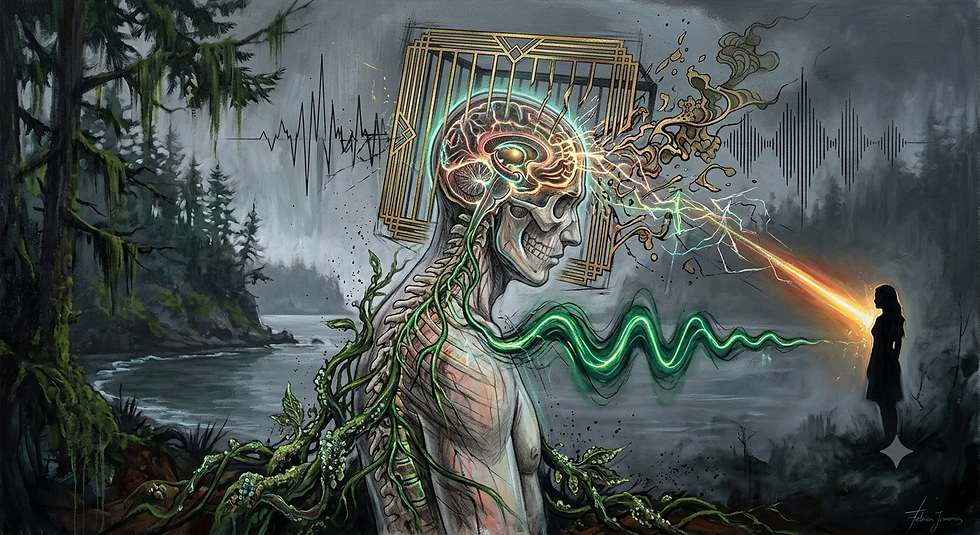
It was a psychic evisceration. Graves watched in creeping horror as Miller’s rigid posture collapsed. It was not a surrender; it was a structural failure of the ego. The armor that had taken decades of cynical bureaucracy to build—the hardened exterior that protected Miller from the gaping void of his own inadequacies—shattered instantly.
Miller dropped to his knees, his jaw slack, eyes wide and leaking fluid. He pulled out his phone, his thumb trembling violently as he typed to his daughter. He was being forcibly reverted, stripped of his adulthood, his rank, his agency. The man who had stood there a moment ago was dead. In his place was a raw, weeping nerve ending, entirely exposed to the cold air.
The perimeter was failing not from force, but from a total, terrifying absence of friction.
The entity reached into its basket. The scent of cinnamon hit the line. It was cloying, oppressive, thick as mustard gas. It did not smell of cookies; it smelled of the inescapable gravity of forgotten childhood kitchens, of dead grandmothers, of a time before the world required armor. It was an assault on memory.
Officers began to drop. Their shields clattered against the asphalt with hollow, meaningless sounds. The affirmations rained down upon them like court verdicts, final and unappealable.
"Your feelings are valid."
"It is okay to let go."
With every sentence, the architecture of their minds was dismantled. They were being lobotomized by empathy. Graves watched his men—instruments of order—spill out of their uniforms, clutching one another, sobbing uncontrollably as their repressed traumas were violently exhumed and paraded in the street.
III. The Metamorphosis of Commander Graves
Graves was suffocating. The air was too warm, too saturated with pathological kindness. He broke rank. He had to stop this unmaking. He raised his arms, a desperate reflex to preserve the boundaries of his own skull.
He collided with the entity.
There was no impact. Instead, Graves felt himself instantly enveloped in The Unconditional Bear Hug. It was a trap of infinite density.
His limbic system screamed. The warmth seared through his tactical vest, melting the bureaucratic ice that held his spine together. He tried to push away, but there was nothing to push against. The love was an abyss. It rushed into his lungs, filling the hollow spaces where his authority and his anger resided. It was killing the Commander. It was pulling him apart at the atomic level, isolating the scared, seven-year-old boy trapped beneath decades of calcified discipline.
"It's going to be okay," the entity whispered into his ear. The voice was a surgical drill boring directly into his soul. "You don't have to fight anymore."
The destruction was absolute.
Graves felt his identity dissolve into the warmth. The concept of "police," of "orders," of "Graves" peeled away like dead skin. The terror was paralyzing—he was falling endlessly into a void of pure, inescapable acceptance, losing the very friction that told him he existed.
He collapsed into the neon fabric, his body wracked with shuddering, pathetic sobs. The riot was over. The street was silent, save for the collective weeping of broken, formless men, wandering naked in the ruins of their own minds, permanently cured, and entirely unmade.