True Colors in the Pale City
The dusk fell heavily over the Pale City, a great, suffocating blanket of soot and measured breaths that pressed the citizens into the cobblestones. There was no trust here, only the constant, rattling friction of human estrangement.
To guard against the terror of an open hand, the city had erected the Citadel of the Ledger—a vast, windowless labyrinth of high desks and iron grates where every word, every glance, and every heartbeat was taxed, recorded, and filed into the dark. It was a fortress of absolute, crushing isolation.
High within the belly of the Citadel, George sat at his desk. The yellow gaslight flickered over his ink-stained fingers. He was a creature of vibrant, desperate yearnings, possessing a mind that secretly dreamed in violent strokes of carmine and gold. But the paralysis of the city had taken his limbs. He spent his youth scratching the bitter mathematics of scarcity into the parchment. The tension in the room was the quiet, agonizing hum of unlived lives. The Overseers paced the aisles, their boots striking the floorboards like the ticking of a terrible clock.
"You are calculating the depreciation of a shadow," a voice murmured.
George gasped, his nib snapping against the paper. A blot of black ink spread across the ledger. He looked up, his chest tight with the absolute certainty of ruin. To speak without a filed intent was a severe infraction.
But it was not the Overseer. The man standing on the other side of the iron grate did not belong to the Citadel. He possessed a sharp, ethereal grace, and his eyes—one dark as the Thames, the other a pale, startling blue—seemed to gaze through the walls of the ledger-room, out into some terrifying, starry parallax. He was the Starman.
"Please," George whispered, his eyes darting toward the pacing guards at the end of the hall. "If we converse without a contract, the friction tax... I cannot afford the penalty. Move along, sir."
"What is the cost of your breath, boy?" the Starman asked, ignoring the plea. His voice was a quiet, resonant chord that made the glass of the gas-lamps tremble. "Have you tallied it yet?"
"It is deducted from my weekly ration," George stammered, his hands shaking as he tried to blot the spilled ink. "I am in arrears. I must balance the column."
"Leave the dust to the dust," the Starman commanded softly. He reached through the iron grate and rested a gloved hand over George’s trembling fingers.
George froze. The touch was an illegal transfer of warmth, an unmeasured expenditure of human capital.
"I offer you nothing," the Starman said, locking his mismatched gaze with George's terrified eyes. "I ask for nothing in return. We simply exist, here, in this space. Do you trust me?"
"Trust," George choked out, the word tasting of copper and ash, "is an unregulated asset. It is forbidden."
"It is the only currency that does not bleed you dry," the Starman replied. "Come."
It was a radical, terrifying act of empathy. In that small, localized space between mentor and apprentice, the heavy iron friction of the city simply evaporated. The crushing weight of suspicion gave way to the absolute liquidity of love. George looked at the ruined ledger, then at the open hand. For the first time in his life, the paralysis broke. He stood up, pushed past the heavy oak stool, and followed the Starman out into the damp, biting cold of the street.
They descended into the great square beneath the Customhouse. The evening snow had begun to fall, settling on the shoulders of the hurried, hunched citizens. The air was thick with the despair of the finite. Everyone moved in wide, defensive arcs, terrified of collision.
At the center of the square, surrounded by a ring of grey-coated Auditors, stood Cyndi.
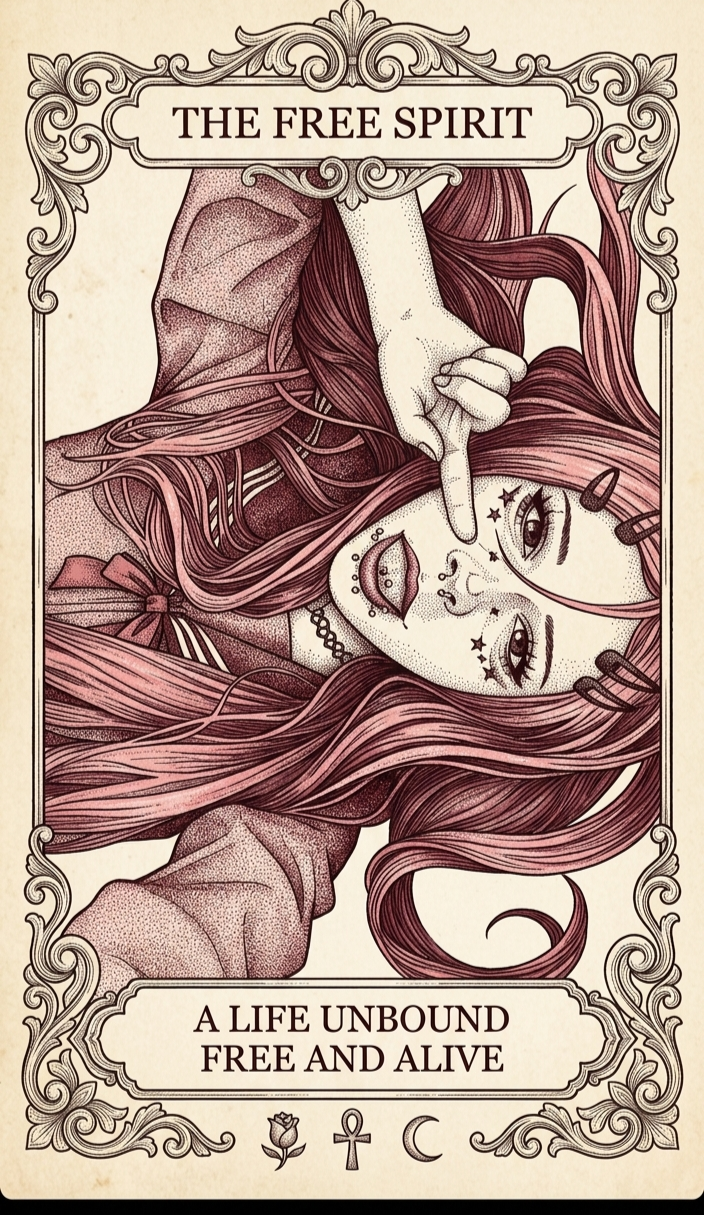
She was a riot of kinetic energy, wearing layers of mismatched, garish fabrics that mocked the somber grey of the merchants. The tension in the square was palpable, a physical weight pressing against the eardrums. The Chief Auditor, a man with a face like a closed fist, stepped forward, raising his heavy baton.
"Madam," the Auditor barked, his voice cutting through the falling snow. "You are generating an unauthorized frequency. You are expending kinetic capital without a permit. Disperse immediately, or your assets will be seized."
Cyndi did not flinch. She looked at the baton, then at the terrified crowd huddled in the snow, and finally at George and the Starman standing on the periphery. She smiled, a flash of ragged crimson in the gloom.
"I am not spending," she said, her voice carrying a reckless, vibrant timber. "I'm investing."
The Auditor lunged forward. "Seize her!"
But before the heavy hands could fall, Cyndi closed her eyes, threw her head back against the winter sky, and released a cry.
It was a song of radical, shattering wonder. The acoustics of her voice defied the cold mathematics of the city. It was a fierce, negentropic force that tore through the damp air, a sound so terribly beautiful that the Auditors halted in their tracks, their batons slipping from numb fingers. She sang of true colors shining beneath the soot, weaving a melody that forced the rigid, isolated minds of the citizens to perceive harmony.
The music bypassed their defensive ledgers and struck directly at the limbic core. It was an epiphany that pierced the gloom. Men and women who had not touched another soul in decades found themselves weeping, the artificial metrics of their lives washing away in the snow. Cyndi’s art acted as the psychological engine that financed a new reality, transmuting their collective despair into a sudden, aching realization of their shared humanity.
As the song echoed off the cobblestones, the high walls of the Citadel seemed suddenly fragile, nothing more than illusions built of paper and fear.
George stood utterly still, the infinite capital of knowledge rising within him. He finally understood. When Cyndi gave her voice to the winter air, she lost absolutely nothing, yet every soul in the square was instantly enriched. The Starman’s mentorship had dissolved the friction; Cyndi’s wonder had provided the spark.
The citizens looked at one another in the yellow gaslight, the heavy walls of their mutual suspicion dissolving into the snow. They saw that their bitter accounting had been a fatal invention. The true currency of their survival was never locked in the iron grates of the Citadel. It was the frictionless grace of their love, the terrifying catalyst of their wonder, and the shared, immortal light of their collective minds, burning brightly against the failing of the dark.