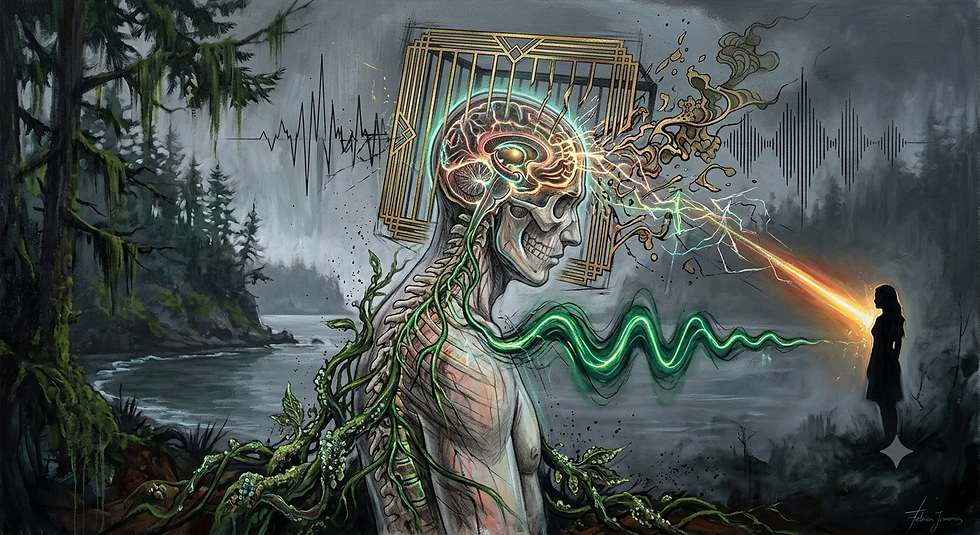
How Ancient China Used Cannabis to Build a Bridge to the Stars
- One Love Energy
- Mar 22
- 3 min read
The high-altitude silence of the Kunlun Mountains was once broken by the crackle of hemp seeds hitting white-hot bronze. Long before the ink of the Mandarins codified the world into rigid rows of behavior, the architects of Chinese spirituality were busy dissolving the boundaries of the self. They didn't just stumble upon cannabis; they recognized it as a biological skeleton key, a green fire capable of burning through the heavy dross of the physical ego to reveal the shimmering gears of the Tao beneath.
The Divine Farmer’s Translucent Secret
The story begins with a figure of mythic skin and mossy fingers: Shennong, the Divine Farmer. Legend says he possessed a transparent stomach, allowing him to watch the internal alchemy of every root and leaf he consumed. When he encountered the serrated leaves of the cannabis plant, he didn't just find a remedy for the aches of the joints. He identified a substance of the highest order—a botanical accelerant for the soul. To the ancient mind, this was a tool for thinning the veil. By incorporating the plant into a disciplined life, the seeker could achieve a state where the body felt light enough to drift. This wasn't a metaphor for weightlessness, but a description of a spiritual buoyancy that allowed a human to walk the thin line between the seen and the unseen.
The Manic Architecture of the Wu
In the era of the Wu—the primordial shamans—the ritual use of cannabis was a calculated descent into the divine. These spirit-mediums understood that the ordinary mind is a narrow cage. Inside darkened chambers, they would cast the flowering tops of the plant into censers, creating a thick, psychoactive atmosphere that acted as a medium for travel. To a casual observer, these shamans were lost in a chaotic frenzy, throwing their limbs about like madmen. But this was the ecstatic architecture of the trance. Every convulsion was a step taken in a different dimension; every shout was a conversation with a ghost. The plant wasn't inducing a breakdown; it was facilitating a breakthrough, providing the sensory override necessary to navigate the Nine Heavens.
The Solar Fire of the Cauldron
As the centuries turned, the practice shifted into the internal laboratories of the Taoist alchemists. They viewed the human form as a sacred vessel, a cauldron where the base metals of human experience could be forged into the gold of immortality. Cannabis was the ultimate Yang catalyst—a concentrated burst of solar energy. It was used to ignite the internal fire, burning away the stagnant Yin of the mundane world. This wasn't about a recreational buzz; it was a surgical strike against the illusions of the five senses. By shattering the mundane perspective, the alchemist could finally perceive the Tao—the underlying, vibrating frequency of the universe that remains invisible to the sober eye.
The Wisdom of the Invisible Tapestry
There is an enduring, radical logic in this ancient relationship with the herb. The Taoists didn't seek an escape from reality; they sought a more profound immersion into it.
To see ghosts was not to lose one's grip on the world, but to acknowledge that the world of the living is merely a single, thin thread in a much larger, more crowded tapestry of existence. By thinning the blood and lightening the spirit through the smoke of the plant, they stepped out of the claustrophobic confines of human logic and into the vast, breathing consciousness of the cosmos.
They understood that to truly understand the path, you must first be willing to let the smoke lift your feet off the ground.