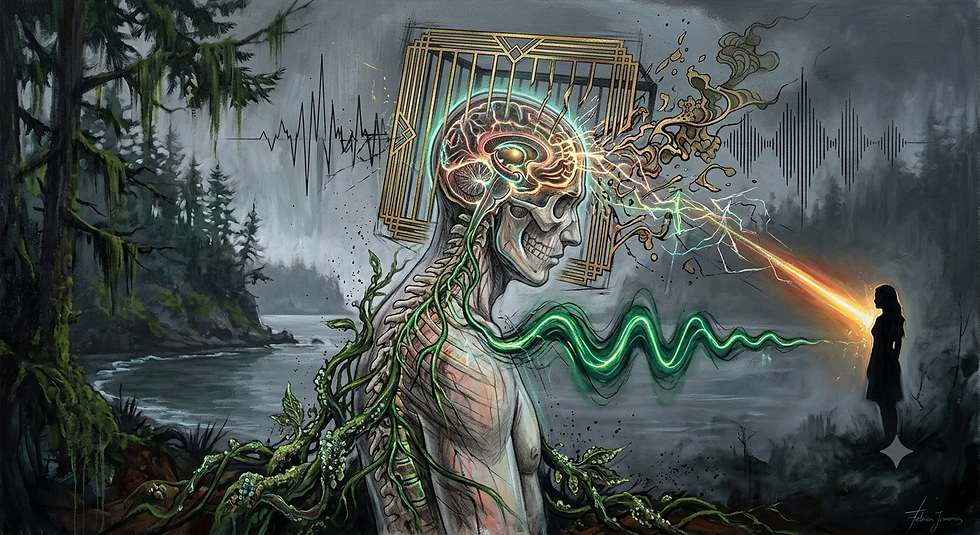
The Architecture of the Imaginal: Neuroscience, Biochemistry, and the Soulful Mind
- One Love Energy
- Mar 23
- 17 min read
The Architecture of the Imaginal: Neuroscience, Biochemistry, and the Soulful Mind
The Ontology of Imagination and the Realm of the Soul
In the contemporary scientific paradigm, imagination is frequently marginalized as a secondary cognitive function, often mischaracterized as mere fantasy, daydreaming, or the passive recombination of stored sensory data. However, a rigorous, exhaustive examination of cognitive neuroscience, psychopharmacology, and linguistic theory reveals that imagination is, in fact, the fundamental structural matrix of human consciousness. It is the active, dynamic mental workspace where memory, language, sensory simulation, and emotional valence converge to construct the ongoing narrative of reality and the self.
To truly apprehend the profound depth of this cognitive architecture, it is necessary to view the empirical data through a phenomenological and philosophical lens. The psychological framework provided by Thomas Moore’s Care of the Soul offers a vital paradigm for this synthesis, elevating the scientific data into a comprehensive understanding of human flourishing.
Moore postulates that the "soul" is not an abstract theological concept, nor is it strictly synonymous with the intellect or the physical body. Rather, it is a psychological reality that resides in an intermediate space, existing "midway between understanding and unconsciousness".
Crucially, Moore asserts that the primary instrument of the soul is the imagination. This conceptualization aligns seamlessly with the philosophical traditions of the French philosopher and theologian Henry Corbin, who introduced Western thought to the concept of the mundus imaginalis, or the imaginal world. Corbin, drawing extensively upon medieval and Sufi philosophy, delineated a strict ontological difference between the imaginal and the imaginary. While the imaginary (tawah'hum) refers to baseless hallucination or fantasy—such as mistaking a rope for a snake in the dark—the imaginal (takhayyul) represents a rigorous, cognitively real threshold where "matter is spiritualized and spirit is materialized". The mundus imaginalis is not a retreat from reality, but a mediating realm that possesses its own profound cognitive function, allowing access to a suprasensible world situated strictly between the empirical world of the senses and the abstract world of the intellect.
In this specific context, therapeutic efficacy and overarching cognitive health rely on the continuous, deliberate nourishment of this imaginal capacity. As Moore argues, psychological symptoms—ranging from an overarching sense of meaninglessness and vague depression to disillusionment with familial structures—arise precisely when areas of the human experience are completely devoid of imagination. When the imaginal capacity is starved, the neglected psyche is forced to express its malnourishment by "becoming more symptomatic". The cure for the excessive materialism of the modern age, which strictly divides the mind from the body, is not to retreat into ungrounded spirituality, but to reintroduce the soul as the vital third possibility. Therefore, by synthesizing Moore’s depth psychology with modern neurobiology, we can define imagination not as a fleeting neural artifact, but as the brain’s highest-order integration mechanism. It is the biological and spiritual engine of meaning-making, requiring rigorous maintenance through the "care of the soul".
The Neural Correlates of the Mental Workspace
Modern neuroimaging, particularly the advent of functional magnetic resonance imaging (fMRI) and positron emission tomography (PET), has catalyzed a paradigm shift in cognitive neuroscience. The field has moved definitively away from "localizationism"—the search for a single, discrete anatomical center for isolated functions—toward a holistic, network-based understanding of human cognition. The neurological substrate of Moore’s "midway" state of the soul is remarkably analogous to the Default Mode Network (DMN). The DMN operates as the definitive "mental workspace," the highly complex neural infrastructure that fires when an individual is engaged in imaginative processes.
The DMN is a large-scale, widely distributed brain network comprising several key interconnected cortical regions: the anterior medial frontal cortex, the ventral medial prefrontal cortex (vMPFC), the posterior cingulate cortex (PCC), the precuneus, the inferior parietal lobule, and the middle temporal gyrus. Historically, the discovery of the DMN arose from the observation that a specific constellation of cerebral areas consistently reduced their activity when a subject was engaged in demanding, externally goal-directed tasks, yet exhibited profound metabolic activity during resting states of visual fixation or when the eyes were closed. Consequently, the DMN acts as the brain's "default setting," generating our internal, autonomous mental life.
The primary function of the DMN is the construction and maintenance of the "narrative self". The narrative self is the ongoing, internally generated story that creates a consistent sense of identity across time. The DMN builds this narrative by continuously integrating episodic memories, linguistic constructs, and emotional valence. This network operates in a dynamic, highly regulated anti-correlation with the Dorsal Attention Network (DAN) and the frontoparietal control networks. When an individual is forced to focus on the external environment—navigating a crowded street or solving a localized mathematical equation—the DAN activates and the DMN is suppressed. Conversely, when external demands cease, the DMN reactivates intermittently, returning the mind to its internal imaginal landscape, allowing for daydreams, future simulations, and deep introspection.
This alternating neurophysiological rhythm—the continuous shifting between the DAN and the DMN—mirrors Moore’s conceptualization of the soul oscillating between the literal, temporal concerns of everyday life and the deep, reflective resonance of eternity. Moore notes that the soul is "partly in time and partly in eternity," and that mental health requires us to access the eternal part of the soul when we face despair in our temporal lives. The DMN effectively provides the biological workspace for this eternal reflection.
When the DMN is functioning optimally, it allows the individual to seamlessly weave disparate cortical representations into novel mental constructs, achieving the "increase of imagination [which] is always an increase in soul". However, if the DMN becomes hyper-rigid or fails to properly anti-correlate with task-positive networks, the narrative self becomes inflexible, leading to the relentless rumination characteristic of severe depression. In such states, the individual loses access to the fluid, restorative properties of the imagination, resulting in the "painful emptiness" and "vanishing of enthusiasm" that Moore identifies as a profound crisis of the soul.
The Mechanics of Visualization and Top-Down Processing
While the Default Mode Network orchestrates the broad narrative and temporal aspects of the imagination, the specific, phenomenological act of visual mental imagery requires a highly intricate interplay between higher-order cognitive networks and primary sensory regions. Mental visualization is not a purely bottom-up perceptual event driven by external photons hitting the retina; it is a profound top-down generative process that utilizes the visual cortex as a blank canvas for internal simulation.
The Prefrontal Cortex (PFC) acts as the primary source of these top-down signals, dictating behavioral goals and selectively modulating extrastriate visual processing. During the act of mental visualization, the PFC initiates a complex cascade of neural signals descending through the parietal lobe, eventually reaching the visual cortices. This top-down signaling activates the exact identical neural representations in the high-level visual cortex—specifically regions such as the lateral occipital complex—that are activated during authentic external visual stimulation. In essence, the brain employs the same neural population codes for both seeing and imagining, differing only in the origin of the signal (retinal vs. prefrontal). The Frontal Eye Fields (FEF), a critical node in attentional control networks, also play a vital role in providing attention-related signals to the extrastriate cortex, increasing the contrast sensitivity of neuronal responses to imagined features.
This top-down generative process can be modeled computationally as a Variational Autoencoder (VAE) within a predictive coding framework. In this model, imagination is achieved by sampling "bottleneck states" from a standard normal distribution, prompting the VAE decoder to generate various outputs that simulate the bottom-up response of the primary visual cortex (V1) to authentic images. The predictive-coding mechanism continually updates the bottleneck state to minimize the difference between the top-down generated image and the anticipated response in V1.
The physical anatomy and baseline excitability of V1 play a highly counterintuitive role in the subjective, phenomenological experience of imagination. The primary visual cortex, which receives sensory input directly from the lateral geniculate nucleus, is highly variable in size and structure across individuals.
Neuroimaging reveals a distinct inverse relationship between V1 size and subjective imagery strength: individuals with a smaller anatomical V1 report significantly stronger, more vivid mental imagery. However, a larger V1—which typically possesses smaller, more precisely tuned receptive fields—is linked to increased precision of the imagined content, even if the subjective, self-reported vividness is lower.
Furthermore, the baseline resting activity and excitability levels of the early visual cortex (V1-V3) dictate imagery strength. Lower resting activity in these areas paradoxically predicts stronger sensory imagery. When neuroscientists utilize transcranial direct current stimulation (tDCS) to artificially decrease visual cortex excitability, subjects experience an immediate increase in imagery strength, demonstrating a causative role of visual cortex excitability in controlling the clarity of the imaginal workspace.
Feedback from higher-order visual areas selectively amplifies these weak sensory-evoked responses in V1, allowing for robust processing of internal stimuli. When PFC function is intentionally disrupted—such as through repetitive transcranial magnetic stimulation at the inferior frontal junction—the top-down modulation of the posterior cortex diminishes rapidly, resulting in a quantifiable, immediate decrement in working memory accuracy and the ability to sustain clear mental images. From the perspective of Care of the Soul, this intricate top-down signaling represents the active, conscious intent of the individual to bring imagination fully into the physical locus of the body, transforming abstract thought into deeply felt, almost sensory reality. Without the PFC's ability to drive the visual buffer, the soul's attempt to converse through internal imagery is rendered mute.
The Neurochemistry of the Imaginal Realm
The structural and network architecture of the imagination is heavily dependent upon a finely tuned, highly sensitive neurochemical milieu. The neurotransmitters and neuromodulators that govern mood, motivation, and perceptual precision are the biochemical architects of the imaginal workspace. Without their precise calibration, the mental workspace dissolves into noise or locks into pathological rigidity.
Dopamine and Serotonin: Motivation and Affective Tone
Dopamine, traditionally recognized in popular science as the "pleasure hormone," is fundamentally a molecule of motivation, anticipatory simulation, and reward prediction. In the context of imagination, dopamine drives the anticipatory visualization of future events. Imagining a positive future encounter, anticipating a reunion with a loved one, or envisioning the successful completion of a complex creative task triggers significant dopamine release in the brain. This dopaminergic surge fuels the behavioral drive and executive function required to realize that imagined state in physical reality. Dopamine essentially serves as the bridge between the imaginal and the actual. Conversely, individuals suffering from low dopamine activity experience substantially reduced motivation, an inability to feel rewarded by their accomplishments, and an overarching lack of excitement about future goals. When dopamine is depleted, the imaginal workspace stagnates; the mind cannot generate the anticipatory simulations required to propel the individual forward.
Serotonin operates in a complementary fashion, modulating the emotional stability, self-confidence, and long-term affective tone of the imagination. While dopamine provides the acute, energetic spark of creative insight and desire, serotonin provides the sustained emotional resilience necessary to dwell within the imaginal realm without being overwhelmed by anxiety or fear. Interestingly, during the early stages of romantic love—a state Moore defines as being deeply "in imagination"—serotonin levels frequently fluctuate, resembling the neurochemical profiles of individuals with obsessive-compulsive disorder, which explains the all-consuming, highly focused nature of romantic infatuation. In the long term, however, stable serotonin levels cultivate what the Greeks termed eudaimonia—a good spirit and deep-seated happiness. Low serotonin levels are intrinsically linked to persistent low mood, irritability, and heightened sensitivity to stress, which severely constrict the imagination, trapping the individual in repetitive, negatively valenced mental loops.
Acetylcholine: The Master of Signal-to-Noise Ratio
For a mental image to crystalize out of the chaotic, continuous baseline activity of the brain, the neural signal must be aggressively sharpened. Acetylcholine (ACh) is the primary neuromodulator responsible for improving the signal-to-noise ratio in the visual cortex. ACh is secreted from cholinergic neurons residing in the basal forebrain and influences neuronal activities across all six layers of the primary visual cortex via a mechanism known as volume transmission.
ACh acts as the ultimate top-down weighting agent. When top-down signals arrive at the visual cortex, high cholinergic levels cause direct nicotinic enhancement of thalamocortical afferent synapses, massively amplifying weak pre-synaptic inputs. Simultaneously, ACh activates specific muscarinic receptors (M1 and M2). The activation of M1 receptors directly stimulates the postsynaptic neurons, while the activation of M2 receptors aggressively suppresses intrinsic, background GABAergic inhibition. This synergistic action—amplifying the desired top-down signal while silencing the surrounding cortical noise—allows the intended mental image to emerge with striking clarity. Furthermore, this cholinergic pathway acts synergistically with the opening of NMDA receptors, a critical prerequisite for long-term cortical plasticity and the laying down of new imaginal memories. Without optimal acetylcholine transmission, the mental image dissolves into neural static, rendering complex visualization impossible.
Glutamate and GABA: Excitation and Sculpted Inhibition
Glutamate and Gamma-aminobutyric acid (GABA) provide the foundational excitatory and inhibitory balance necessary to physically sculpt these images in the cortex. Glutamate is the central nervous system's primary excitatory neurotransmitter. The localized concentration of glutamate in the early visual cortex correlates strongly and positively with visual cortex excitability, directly mediating the intensity and vividness of mental imagery. Imbalances in glutamate, particularly abnormal or hyperactive transmission, are closely linked to severe psychopathology, including the cognitive disorganization seen in schizophrenia and treatment-resistant depression.
However, unchecked excitation would lead to cognitive chaos. GABAergic inhibition ensures that this glutamatergic excitation does not spread uncontrollably across the cortex. By providing highly specific, localized inhibition, GABA sculpts the edges of the mental image, preventing the imaginal construct from bleeding into adjacent neural networks and devolving into pathological hallucination. The interplay between glutamate and GABA maintains the delicate boundary between a rich mundus imaginalis and the terrifying unreality of the imaginary.
| Neurochemical Agent | Primary Mechanism in the Brain | Phenomenological Role in Imagination |
|---|---|---|
| Dopamine | Reward prediction error; anticipatory neural firing. | The engine of desire and motivation; fuels the simulation of positive future outcomes. |
| Serotonin | Emotional regulation; affective memory consolidation. | Stabilizes the affective tone; enables the soul to dwell in deep, sustained reflection. |
| Acetylcholine | Modulates signal-to-noise ratio in V1 via nicotinic/muscarinic receptors. | Clarifies the mental image; filters out cognitive static to allow top-down signals to manifest. |
| Glutamate | Primary excitatory neurotransmission; heavily correlates with BOLD-fMRI signals. | Provides the energetic intensity and raw vividness required for visual mental imagery. |
| GABA | Primary inhibitory neurotransmission; suppresses lateral excitation. | Sculpts the mental image; prevents imagination from escalating into uncontrolled hallucination. |
The Linguistic Architecture of Thought: Inner Speech and Conceptual Blending
Imagination is profoundly multimodal; it is not exclusively restricted to visual imagery. For a massive portion of the human population, the imagination manifests heavily as an internal monologue, a phenomenon formally termed "inner speech." Phenomenological sampling research indicates that between 30% and 50% of individuals regularly experience their thoughts as unspoken words, a continuous "little voice in the head". This internal narrative serves critical functions in language development, working memory encoding, and executive self-regulation.
Inner speech can be phenomenologically categorized as either monologic (a single, unified internal narrator) or dialogic (a simulated, back-and-forth conversation involving multiple distinct internal voices). Neurocognitive assessments reveal that dialogic scenarios exhibit significantly higher rates of cognitive switching and a much greater vividness of imagined "other" voices compared to monologic thought, suggesting a highly complex, multi-layered imaginal workspace dedicated to social simulation.
Furthermore, the specific modality of language structurally alters the very nature of the imagination. Groundbreaking research comparing spoken English users to British Sign Language (BSL) users demonstrates that language modality dictates the degree to which visual imagery is inherently invoked during linguistic processing. BSL signers naturally incorporate rich, visuo-spatial imagistic properties into their semantic networks when making meaning similarity judgments. Conversely, spoken language users process words with far less immediate visual imagery. However, when English speakers are explicitly prompted to visualize the words, their neural behavior closely mirrors that of BSL signers. This proves that linguistic and imagistic cognition are not strictly separate, isolated modules, but are deeply intertwined from the earliest stages of cortical processing.
The cognitive mechanism that successfully explains how language, memory, and imagery seamlessly fuse to create complex imagination is articulated by Gilles Fauconnier and Mark Turner’s Conceptual Blending Theory. According to this robust framework, human creativity and linguistic evolution arise from the subconscious integration of disparate "mental spaces." Mental spaces are small, dynamic conceptual containers built on the fly as we think, talk, and interact, used to structure human reasoning.
In a conceptual blend, elements, vital relations, and roles from two or more distinct "Input Spaces" are mapped onto each other. This projection yields an "Emergent Structure" inside a newly created "Blended Space". This blended space possesses logic, meaning, and emotional resonance entirely distinct from its original inputs. Fauconnier and Turner define four main types of integration networks: simplex, mirror, single-scope, and double-scope networks, the latter being responsible for the most profound leaps in human imagination.
For example, the creation of a powerful poetic metaphor requires the mind to take the input space of "human eyes" (carrying connotations of staring and feeling) and the input space of "natural phenomena" (such as a sunset or palm woods). By blending these spaces, the mind creates an emergent imaginal entity—eyes that radiate the energetic, atmospheric qualities of a sunset. Conceptual blending is not merely a specialized linguistic trick reserved for poets; it is the fundamental instrument of the everyday mind, responsible for everything from basic social construals to advanced mathematical and scientific breakthroughs.
Viewed meticulously through the lens of Care of the Soul, conceptual blending is the exact neuro-cognitive mechanism required for "myth-making." Moore argues eloquently that the profound alchemy of soul work involves extracting myth from the hard, literal details of family history. Neurologically, this therapeutic process requires taking the rigid, factual Input Space of an individual's autobiographical memory and aggressively blending it with the culturally rich, symbolic Input Space of ancient archetypes (e.g., the Odyssey, the Divine Child, the Father Archetype). By integrating the mundane with the mythological, the brain generates a highly resonant Blended Space—a personalized family myth that imbues everyday life with a sense of sacredness, depth, and transcendent meaning.
Pharmacological Perturbations: Psilocybin and the Dissolution of the Neural Self
Psychoactive compounds provide a unique, highly specific neurobiological window into the mechanisms of imagination by acutely altering the brain's network dynamics and neurochemical balances. By examining the profound influences of psilocybin, we can observe how the extreme modification of the mental workspace impacts the subjective experience of the soul.
Psilocybin, a classic serotonergic psychedelic and the active compound in "magic mushrooms," induces profound alterations in imagination by fundamentally destabilizing the Default Mode Network. Functional magnetic resonance imaging (fMRI) reveals that psilocybin temporarily scrambles and completely desynchronizes the DMN, wiping out the brain's distinct functional "fingerprint". Normally, an individual's functional brain network is as highly distinctive as a physical fingerprint. However, during acute psilocybin intoxication, the brains of completely different individuals look more neurologically similar to each other than to their own baseline, pre-dose states.
A critical, recently identified mechanism in this profound desynchronization is the modulation of the claustrum, a thin, highly connected sheet of neurons that acts as a central routing hub for the cortex. Psilocybin acutely and significantly decreases the functional connectivity between the claustrum and the core nodes of the DMN. This chemically induced blockade disrupts the established networks that typically support standard perception, memory, and cognitive control. Simultaneously, while the DMN fractures, psilocybin aggressively increases functional connectivity between localized sensory regions and expansive thalamocortical networks.
Electroencephalography (EEG) studies further illuminate this phenomenon. During a psilocybin experience, signal complexity across the brain increases dramatically, particularly in visual areas. However, this complexity is highly frequency-dependent. Researchers observe a notable decrease in signal complexity within the alpha band, but a massive increase in synchrony within the gamma band inside the DMN. This specific gamma-band hyper-connectivity is strongly, statistically correlated with the subjective psychological feeling of "oceanic boundlessness"—the complete disintegration of the boundary between the self and the external environment.
This neurobiological desynchronization forces a dramatic, involuntary shift in the imaginal workspace. Because the DMN is biochemically unable to maintain the rigid "narrative self," the individual experiences profound ego loss, visual hallucination, and a severe distortion of space and time. From Thomas Moore's perspective, this pharmacological event physically manifests the psychological necessity of "dropping the salvational fantasy"—the rigid, exhausting ego-project of trying to achieve perfection or invulnerability. By biochemically dismantling the networks responsible for the ego, psilocybin forces an immersion into the deeper, uncharted waters of the psyche. It replaces literal, everyday concerns with a flood of raw, unmediated archetypal imagery. The magnitude of the participant’s subjective feelings of transcendence tracks directly with the magnitude of network desynchronization.
Crucially, the effects of psilocybin are not entirely transient. The persistence of small, measurable network changes weeks after the acute experience suggests a neuroplastic "pinpoint effect". This extended window of increased cognitive flexibility represents an optimal state where new, healthier conceptual blends and personal myths can be established, offering immense therapeutic potential for treatment-resistant depression and post-traumatic stress disorder, conditions characterized by a hyper-rigid, suffocating DMN.
Cannabis, Cognitive Flexibility, and the Modulation of the Inner Narrative
Cannabis exerts a highly complex, decidedly dose-dependent influence on the architecture of the imagination. Its effects are primarily mediated by the extensive endocannabinoid system, which features dense concentrations of CB1 and CB2 receptors in the prefrontal cortex, hippocampus, cerebellum, and basal ganglia. Upon consumption, Delta-9-tetrahydrocannabinol (THC), the primary psychoactive compound, rapidly enters the bloodstream and dramatically boosts blood flow and activation in the frontal lobe.
The cultural relationship between cannabis and creative imagination is pervasive, yet empirical research presents a highly nuanced reality. Cognitive science utilizes standardized measures of divergent thinking (the ability to generate multiple, novel solutions to a single problem) and convergent thinking (the ability to synthesize disparate information to deduce a single correct answer) to quantify creative output. Research confirms that low-to-moderate doses of THC can transiently enhance divergent thinking, facilitating cognitive flexibility and the spontaneous generation of novel conceptual blends. This aligns with anecdotal reports that minor cannabis intoxication can spark new, unusual ideas.
However, this enhancement operates on a strict inverted-U curve. High doses of highly potent THC consistently and significantly impair divergent thinking, leading to severe mental fog and rigid, unproductive cognition. Furthermore, while cannabis acts as a stimulant to certain brain areas, it paradoxically weakens the sustained concentration and executive function required for convergent thinking.
The largest neuroimaging study ever conducted on cannabis use, published in JAMA Network Open, examined over 1,000 young adults. The data revealed that 63% of heavy lifetime cannabis users (defined as having used the substance more than 1,000 times) exhibited markedly reduced brain activity during complex working memory tasks. This reduction in activity directly translates to worse performance in the ability to retain, mentally visualize, and manipulate information—the exact cognitive load required to sustain a complex imaginal workspace.
Cultivating the Imaginal: Psychotherapy, Myth, and the Care of the Soul
The convergence of advanced neuroscience and depth psychology establishes an undeniable truth: imagination is not a mere aesthetic luxury or a childish vestige; it is a critical biological, psychological, and spiritual necessity. The Default Mode Network requires rich semantic and emotional data to construct a resilient narrative self; the primary visual cortex requires precise, top-down prefrontal signaling to accurately render intern realities; and conceptual blending requires profound cognitive flexibility to map meaning onto the chaotic, unpredictable events of human life.
In this integrated paradigm, Thomas Moore defines psychotherapy not as a sterile medical procedure designed to surgically "cure" or "fix" the ego, but as its etymological root implies: psyche-therapeia, the act of serving and attending to the soul. This service is accomplished specifically by bringing active imagination back to the localized areas of life that have been completely stripped of it.
Modern society suffers from a profound, polarizing dualism, systematically separating the mind from the body, and isolating sterile secularism from ungrounded spirituality. The imaginal realm—Corbin’s meticulously defined mundus imaginalis—is the crucial third possibility that bridges this destructive divide.
When individuals fail to engage this rigorous imaginal capacity, they inevitably fall into a state of narcissism. In this degraded state, imagination is reduced to mere self-projection in a psychological "house of mirrors," generating endless, fruitless desires rather than true, substantive soul.
Cultivating the soul requires active, conscious participation in the imaginal. This involves recognizing the massive archetypal forces constantly at play in the minutiae of everyday life. For instance, transforming the literal, often painful details of one's family history into a "family myth" utilizes the brain's conceptual blending networks to assign profound, transcendent meaning to mundane suffering.
Encountering the "father archetype" becomes an ongoing, internal odyssey of self-authorship, rather than a literal, unending grievance against a biological parent.
Furthermore, Moore emphasizes that even severe psychological pain, such as the crushing emptiness of depression or the sting of betrayal, serves the soul. The neurobiological dampening of serotonin, the chaotic fluctuations of dopamine, and the pathological rigidity of the DMN during severe depression represent a deep retreat of the psyche. Rather than viewing this retreat strictly as a mechanical failure to be immediately eradicated via a "salvational fantasy," the care of the soul advocates for courageously entering into that darkness. The pain provides the raw, unrefined material necessary to forge a fresh, more complex imagination.
The deliberate practice of the daily arts—taking the time to observe beauty, engaging in heartfelt, carefully composed correspondence, recording the chaotic imagery of dreams—serves as the top-down cognitive intent that physically rewires the visual cortex. These practices are not mere hobbies; they replenish the neurochemical wellsprings of dopamine and acetylcholine, coaxing the brain back into a state of optimal neuroplasticity.
Conclusion
The architecture of the imagination represents a breathtaking, infinitely complex synthesis of biological machinery and profound psychological depth. It is masterfully orchestrated by the shifting tides of the Default Mode Network, brought into vivid reality by the aggressive top-down modulation of the visual cortex, fueled by the delicate, shifting balance of dopamine, serotonin, and acetylcholine, and structured by the miraculous linguistic mechanics of conceptual blending.
Pharmacological agents, particularly the contrasting profiles of psilocybin and cannabis, reveal the sheer, astonishing malleability of this architecture. They demonstrate precisely how the temporary dissolution of neural hubs can precipitate profound shifts in human identity, and how the chemical alteration of working memory can either momentarily spark or severely suppress creative, divergent thought.
The empirical mechanics of the brain find their ultimate purpose only when viewed through the lens of human meaning. As Thomas Moore and Henry Corbin so beautifully articulate, the imagination is the true, enduring habitat of the soul. It is the vital intermediary realm where the raw, chaotic sensory data of the physical world is alchemized into the enduring, deeply resonant myths that sustain human consciousness through tragedy and triumph.
To care for the soul, therefore, is to tend relentlessly to the imagination—to ensure that the vast, intricate neural networks of the mind are continuously fed by the deep, resonant, and archetypal mysteries of existence.