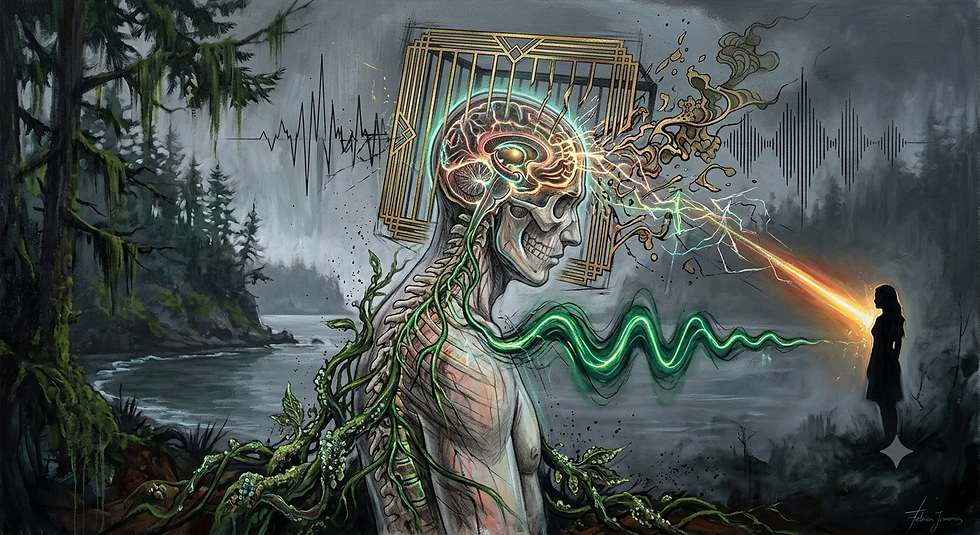
The Unseen Economy: A Treatise on Potential, Ethics, and the Architecture of Human Flourishing
- One Love Energy
- Apr 15
- 8 min read
The Unseen Economy: A Treatise on Potential, Ethics, and the Architecture of Human Flourishing
To observe an economy merely through the lens of realized transactions is to mistake the map for the territory. Standard metrics—GDP, trade volumes, and consumer price indices—measure only what has crossed the threshold from possibility into reality. They are the artifacts of an economy, not its essence. A truly perspicacious understanding of economic life requires us to look beyond the "seen" and investigate the potential—the vast, unmapped territory of beneficial exchanges that remain dormant due to structural, institutional, or conceptual friction.
I. The Shadow of the Unseen
Every transaction that occurs is a triumph over friction. However, for every success, there are countless "ghost transactions"—synergistic trades and collaborative efforts that fail to materialize because the costs of discovery, trust, or logistics are too high.
Efficiency is not merely the speed at which current goods change hands; it is the ratio of actualized utility to potential utility. When an economy leaves a massive reservoir of human talent, creative energy, or communal need untapped, it is not merely stagnant; it is failing its primary purpose. To measure the health of a society, we must develop a "calculus of the unseen," questioning why certain bridges between supply and demand are never built.
II. The Architecture of Facilitation
If we identify a gap between potential and reality, we must interrogate the "interstitial structures" that govern our interactions. Beneficial exchange does not happen in a vacuum; it requires:
Institutions of Trust: Legal and social frameworks that reduce the risk of cooperation.
Interfaces of Discovery: The digital and physical spaces where needs find their solutions.
Cultural Concepts: The prevailing "stories" we tell about value, which either encourage or stifle innovative communion.
When these structures are rigid or outdated, they act as a tax on human potential. By redesigning these interfaces—be they urban spaces that encourage spontaneous communion or digital platforms that prioritize depth over "clicks"—we can lower the activation energy required for new forms of wealth to emerge.
III. The Hierarchy of Value: Beyond the "Widget Factory"
An economy that efficiently produces vapid or harmful goods is an economy that is technically proficient but morally bankrupt. True wealth is not a tally of objects produced, but a measure of individual utility and societal well-being. We must expand our definition of "supply" and "demand" to include the intangible but essential pillars of a flourishing life:
Art and Music: Not as luxury commodities, but as the fundamental "supply" of human meaning.
Nature and Security: The "demand" for a sustainable environment and a stable future.
Communion: The economic value of social cohesion and shared purpose.
A "synergistic trade" might not always involve currency; it may be the exchange of a teacher's insight for a student's growth, or a community’s effort for a restored ecosystem.
IV. The Mandate for Innovation
To move forward, we must stop treating the economy as a closed system of factories and warehouses. It is a living ecosystem of human desires and capabilities. Our task is to innovate the way we talk and think about value.
We must champion:
Equity as Efficiency: Recognizing that concentrated wealth often leaves potential supply (talent) and potential demand (needs) stranded on the margins.
Qualitative Growth: Prioritizing the health, pleasure, and security of the individual over the mere velocity of capital.
By illuminating the unseen potential of our collective creativity and spirit, we can build an economy that doesn't just function, but vibrates with the fullness of human possibility. We must look into the shadows of what isn't happening, for that is where the future of our wealth resides.
The federal legalization of psilocybin represents perhaps the most profound opportunity to bridge the gap between "the seen" and "the unseen" in the modern economy.
By moving this substance from the shadows of prohibition into the light of regulated facilitation, we do not merely create a new "widget" market; we recalibrate the very cognitive and emotional infrastructure upon which all other economic activity rests.
The Psilocybin Treatise: Healing the Architecture of the Mind
I. Mapping the Unseen Mental Friction
In our current seen economy, we measure the cost of antidepressants and the billable hours of therapists. What we fail to measure—the unseen—is the massive cognitive tax paid by millions living in states of rigid despair, PTSD, and burnout. This friction acts as a drag on every sector of society.
Psilocybin acts as a biological reset, a mechanism that facilitates a beneficial exchange between the individual and their own consciousness. By dissolving the rigid Default Mode Network (DMN)—the brain’s center for the ego and repetitive thought patterns—psilocybin allows for a surge in neuroplasticity. This is the ultimate interface of discovery, where an individual can finally trade their trauma for perspective, and their paralysis for purpose.
II. The Economic Multiplier of a Whole Society
The widget factory model of the economy views the worker as a tool. The Perspicacious Economics model views the human as the source of all value. When we legalize and integrate psilocybin, the economic gains are not merely found in the sales tax of the fungus, but in the restoration of human utility:
The Productivity of Presence: A worker freed from the grey fog of treatment-resistant depression is exponentially more innovative and collaborative. They transition from surviving the clock to contributing to the mission.
The Reduction of Social Externalities: Happier, healthier citizens place less strain on the seen costs of the state—emergency rooms, justice systems, and disability services—allowing capital to flow toward art, nature, and communion.
The Innovation of Empathy: Psilocybin often fosters a sense of connectedness. In economic terms, this lowers the barriers to trust, facilitating more synergistic trade and communal problem-solving.
III. Growth Through Communion, Not Just Consumption
Legalization provides the institutional structure necessary to move from risky, underground use to a healthy, ethical society. This is not about the demand for escapism, but the demand for healing.
The Facilitation Center: Imagine a new architecture of wellness—not sterile clinics, but centers of communion where nature, music, and guided psilocybin therapy converge. These are the new factories of the 21st century, where the product is a resilient human spirit.
The Equity of Access: Federal legalization ensures that this cognitive breakthrough is not a luxury for the elite, but a foundational right. True economic equity begins with the democratization of mental well-being.
Final Synthesis: The Bold Leap
By legalizing psilocybin, we are not just adding a line item to the GDP. We are investing in the biological and social capital of the nation. We are deciding that a healthy society is one that values the unseen interior life of its citizens as much as its physical exports.
When the mental friction of a population is reduced, the potential for supply—the supply of ideas, of kindness, of art, and of labor—becomes limitless. We move from a scarcity of spirit to an economy of abundance, where the most valuable exchange is the one that allows a human being to feel, once again, fully alive and integrated into the fabric of the world.
The federal legalization of cannabis serves as a landmark case study in transitioning an economy from a state of artificial friction to one of maximized potential. By ending prohibition, we do not simply greenlight a new industry; we dismantle a system of institutionalized inefficiency and replace it with a structure that prioritizes individual liberty, cognitive sovereignty, and communal wealth.
The Cannabis Treatise: Dismantling Friction, Cultivating Equity
I. Reclaiming the Unseen Opportunity Cost
For decades, the unseen in the cannabis economy has been the staggering opportunity cost of prohibition. We have measured the seen—the cost of policing, the building of prisons, and the destruction of lives through the criminal justice system. What we have ignored is the untapped supply of human potential locked away or marginalized by a failed social policy.
Legalization is the ultimate institutional interface. It replaces the friction of the black market—where trust is low and risks are high—with a regulated framework of safety and transparency. This shift allows for the actualization of potential demand for medicine, relaxation, and creative stimulation that was previously stifled by fear or stigma.
II. The Economic Engine of Cognitive Diversity
A healthy, ethical society recognizes that individuals have diverse needs for wellness and inspiration. Federal legalization transforms cannabis from a contraband widget into a tool for societal utility:
The Architecture of Relief: For millions dealing with chronic pain, inflammation, or sleep disorders, cannabis provides a biological mechanism for recovery. A worker who can manage pain without the debilitating side effects of opioids is a worker who can re-enter the economy with vigor and longevity.
Cognitive Liberty and Creativity: By removing the legal threat, we facilitate a cultural concept where responsible use can drive art, music, and lateral thinking—the intangible exports that define the wealth of a modern civilization.
III. Restorative Justice as Economic Efficiency
We cannot talk about an efficient economy while ignoring systemic inequity. True efficiency requires that all members of society have the interface to participate and thrive.
Equity and Reinvestment: Federal legalization must include the social concept of restorative justice. By reinvesting tax revenue into the communities most harmed by prohibition, we bridge the gap between their dormant potential and the active economy. This is not just a moral imperative; it is an economic strategy to activate sidelined talent and demand.
The Death of Shadow Markets: Moving cannabis into the seen economy ensures that quality is controlled, workers are protected, and the "synergistic trade" happens within a framework that contributes to the public good through infrastructure, education, and health.
Final Synthesis: Cultivating the Common Good
Federal legalization of cannabis is an act of economic perspicacity. It is a bold acknowledgment that the old structures of control are less productive than the new structures of facilitation and freedom.
By removing the legal and social friction surrounding this plant, we unlock a massive reservoir of individual utility and societal wealth. We move away from the "seen" metrics of arrests and toward the "unseen" potential of a society that is more creative, more equitable, and more physically resilient. In this new landscape, the study of supply and demand finally accounts for the most important variable: the unhindered flourishing of the human spirit.
The Synthesis: An Architecture for the Human Renaissance
The study of economics, when stripped of its obsession with the visible and the mechanical, reveals itself as the study of human liberation. By weaving together the threads of structural perspicacity, the cognitive reset of psilocybin, and the dismantling of cannabis prohibition, we arrive at a singular truth: a society’s true wealth is found in the absence of friction between a human being and their highest potential.
To move from the widget factory to a healthy, ethical society, we must commit to three fundamental shifts in our economic architecture:
I. From Extraction to Facilitation
We must stop viewing the economy as a machine that extracts labor and start viewing it as a garden that facilitates growth. The unseen potential of our world—the dormant art, the unwritten code, the unformed communities—is currently trapped behind walls of outdated policy and mental exhaustion. By legalizing these botanical and fungal catalysts, we aren't just creating markets; we are refining the human interface. We are lowering the activation energy required for an individual to move from a state of survival to a state of contribution.
II. The Valuation of the Intangible
An economy that ignores the interior life is an economy operating in the dark. The "supply" of neuroplasticity, empathy, and physical relief is just as vital to our national security and prosperity as the supply of steel or silicon. When we integrate psilocybin and cannabis into the federal framework, we acknowledge that a worker’s peace of mind and a citizen’s creative agency are the primary drivers of utility. We recognize that the most "productive" transaction is often the one that happens within—the trade of trauma for clarity, and pain for presence.
III. The Harmony of the Seen and Unseen
The ultimate goal of this treatise is to harmonize the ledger. We must measure our success not just by the volume of what is sold, but by the absence of what is suffered. When we remove the friction of prohibition, we reclaim the billions of hours lost to the justice system and the billions of dollars lost to chronic despair. We replace them with a synergistic trade of ideas, music, nature, and communion.
The Bold Mandate
The federal legalization of these substances is the first bold step in a larger economic revolution. It is a declaration that the study of supply and demand must finally include the supply of human wholeness and the demand for a meaningful life.
If we have the courage to see the unseen—to value the health of the mind as much as the output of the factory—we will unlock a societal wealth that is both profound and permanent. We are standing at the threshold of a new era where equity is efficiency, healing is growth, and the most valuable asset in our economy is a human spirit that is finally, and fully, free to flourish.