The Alchemy of the Unfolding: Psilocybin and the Restoration of Biological Vitality
- One Love Energy
- Apr 15
- 4 min read
The Alchemy of the Unfolding: Psilocybin and the Restoration of Biological Vitality
To be alive is to be in a state of perpetual chemical and emotional negotiation. We often mistake "stability" for the absence of conflict or the cessation of movement, but true stability is more akin to a suspension bridge—a structure that maintains its integrity precisely because it is designed to sway, distribute tension, and respond to environmental stressors.
Psilocybin serves as a profound catalyst for this structural flexibility, shifting our internal orientation from a defensive, static posture to one of active engagement with the parts of ourselves that are still unfolding.
The Neuro-Architecture of Rigidity vs. Entropy
In our daily lives, the human brain relies on the Default Mode Network (DMN) to maintain a cohesive, predictable sense of self. This network is the seat of our ego, the curator of our past, and the architect of our future anxieties. While necessary for basic navigation, the DMN often becomes a "closed loop," reinforcing rigid narratives and fossilized habits that treat change as a threat to be mitigated rather than a process to be integrated. When we reside too long in this state, we become "stable" in the sense of being stagnant—secure, perhaps, but increasingly brittle.
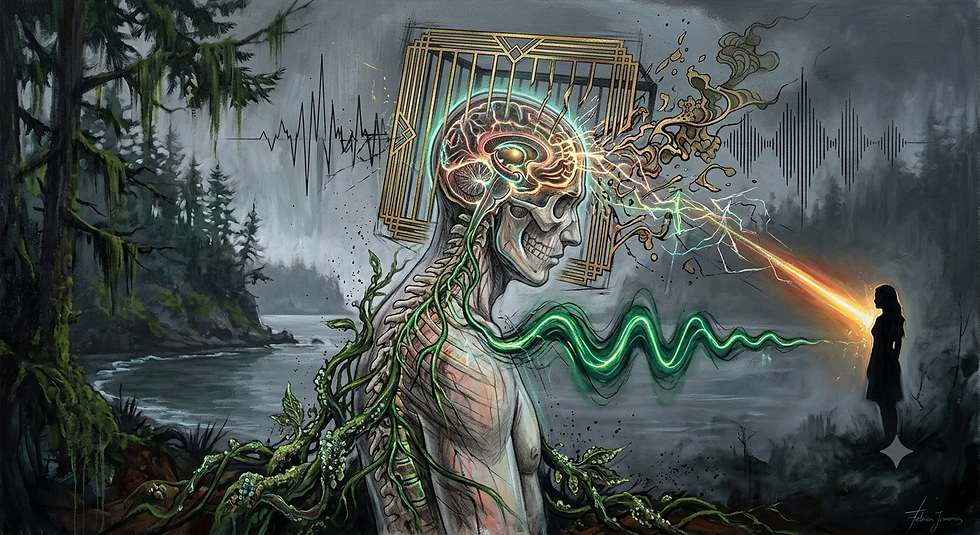
When psilocybin enters the system, it acts as a molecular "reset" button. By agonising the 5-HT2A receptors, it induces a temporary state of high entropy. This is not chaos; it is a loosening of the cognitive grip.
The rigid boundaries of the ego dissolve, and the brain enters a state of global functional connectivity. Regions that are typically compartmentalized—the seats of deep memory, sensory perception, and abstract thought—begin to communicate directly. In this space, the "disruptions" of life are no longer viewed through the narrow keyhole of the ego. Instead, they are seen as part of a vast, interconnected landscape. This is the physiological prerequisite for reimagining.
The Kinetic Nature of Repair
Relationship, in the context of the psilocybin experience, is stripped of its abstract sentimentality and returned to its roots in Biological Safety. We often think of "repair" as fixing something that is broken, returning it to its original state. However, psilocybin teaches us that repair is a kinetic, forward-moving process. It is not a return to the past, but an integration of the disruption into a new, more complex form of wholeness.
When the DMN is quieted, we can approach our internal disruptions—our traumas, our grief, and our unresolved changes—without the immediate interference of the amygdala’s alarm system. This creates a window of "limbic safety" where the following can occur:
Somatic Re-patterning: The body often holds onto uncertainty as physical tension.
Psilocybin allows for a visceral release of this
clench, translating the mental concept of "letting go" into a tangible, physical sensation of relief in the tissues and nervous system.
The Dialogue with Change: Rather than trying to outrun change, the psilocybin state forces a direct encounter with it. We begin to see change not as an external force acting upon us, but as the very fabric of our being. We stop asking how to stop the change and start asking how to participate in it.
Narrative Fluidity: Because the brain is no longer filtered through "the way things have always been," we can visualize new responses to old stimuli. This is the essence of neuroplasticity—the literal rewiring of our reaction to uncertainty.
The Mycelial Baseline and Social Regulation
The "One Love" philosophy is often dismissed as a platitude, but through the lens of psilocybin and Social Baseline Theory, it is revealed as a biological truth. Humans are not designed to self-regulate in isolation; our nervous systems are wired to co-regulate with others. The mushroom highlights this interconnectedness by blurring the line between the individual and the environment.
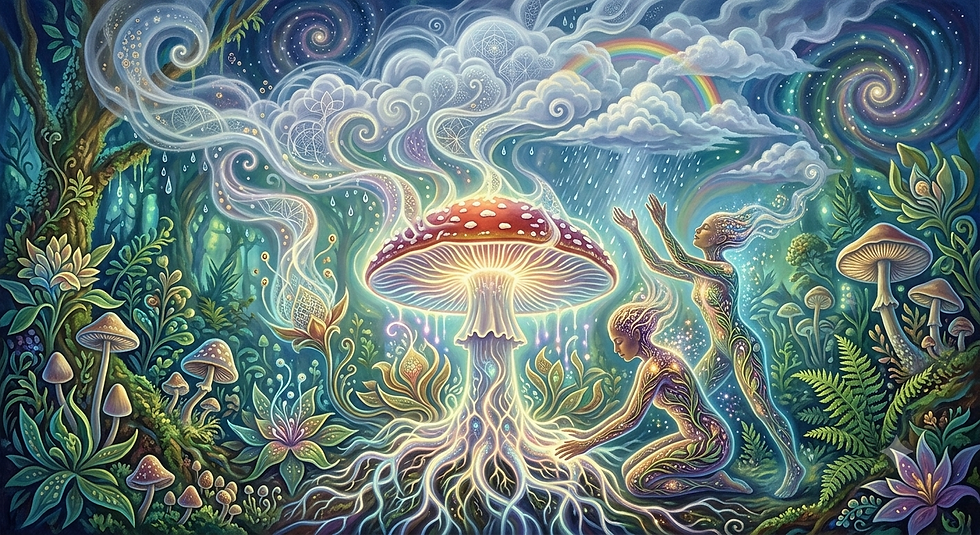
In a psilocybin-assisted state, the "relationship with others" expands to include the entire living system—the Mycelial Intelligence. We recognize that our capacity to meet disruptions is amplified when we acknowledge our interdependence. We are not solitary nodes struggling against uncertainty; we are cells within a larger organism that has been navigating change for eons. This realization provides a profound sense of security that is not based on knowing what will happen, but on belonging to the process of what is happening.
Conclusion: The Vitality of the Unfinished
To "begin again" is not to start from a blank slate, but to re-enter the flow of life with a restored capacity for feeling. Psilocybin does not provide a map that eliminates the fog of uncertainty; rather, it strengthens the legs of the traveler. It transforms the disruptions into the nutrient-dense soil required for our continued unfolding.
By meeting the world differently—with a brain that is more connected and an ego that is less defensive—we move from a state of brittle security to a state of dynamic vitality.
We find that the only way to feel truly alive is to embrace the relationship with the unfinished parts of ourselves, trusting that the act of repair is, in itself, the most beautiful expression of being human.
We do not find stability by resisting the sway; we find it by becoming the movement itself.