The Earth is Eating Itself (And We’re on the Menu)
- One Love Energy
- Mar 17
- 9 min read
The forest floor is not a surface; it is a membrane. We have long committed the hubris of viewing the mushroom as a decorative after-thought of the woods—a whimsical "toadstool" or a culinary garnish—when it is, in fact, the architect of the terrestrial world. To understand the future of the fungus is to confront a profound and unsettling philosophical shift: we are not the protagonists of this planet; we are the transient guests of a mycelial empire that has already mastered the art of survival through deep time.
The Great Decomposer’s Gamble
For nearly a billion years, the fungal kingdom has practiced a form of biological patience that renders human history a mere flicker. While we obsess over the "Mushroom Moment" as a trend in home décor or a "superfood" additive, we ignore the terrifying efficiency of their primary function: the total deconstruction of the world. Fungi are the only organisms that truly understand the circularity of existence. They do not see "waste"; they see "potential energy" temporarily locked in carbon. The philosophical weight of this is heavy—it suggests that our entire civilization, our skyscrapers, our libraries, and our bodies, are simply a future meal for the Basidiomycota. The concern here is not that mushrooms will "save" us, but that they are the only ones prepared for our eventual absence.
The Architecture of the Invisible
The future of mycology lies in the micro-architecture of the unseen. We must pivot our focus from the "fruit" (the mushroom) to the "root" (the mycelium).
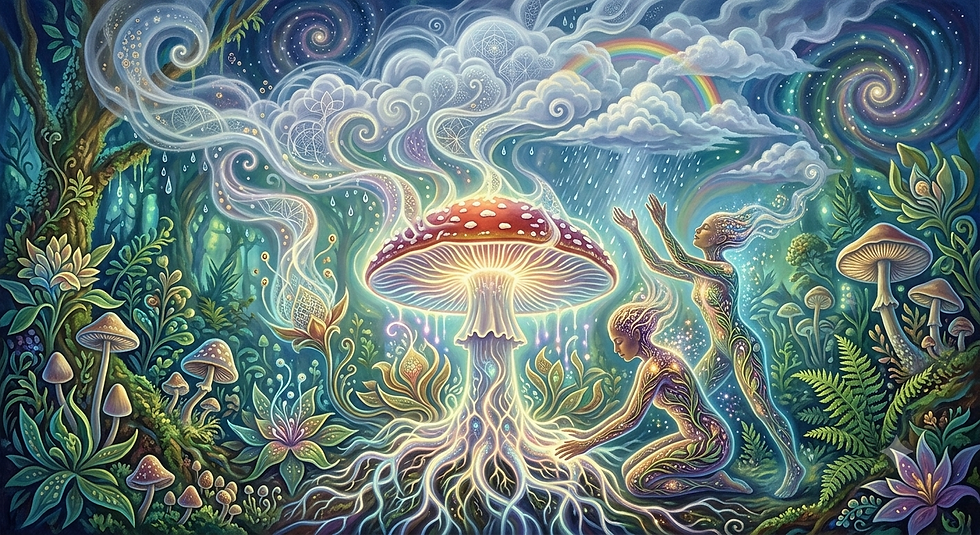
The Mycorrhizal Mandate: 90% of plant life exists only because of a fungal handshake. In a future of soil depletion and climate volatility, the "Green Revolution" must become a "Fungal Revolution." We are beginning to see that plants do not "grow" in dirt; they are nursed by a fungal network that facilitates a sophisticated inter-species trade of phosphorus for carbon.
The Genomic Ghost: As we map the fungal genome, we find a library of secondary metabolites that represent a 94-million-year-old pharmaceutical lab. The concern is that we are "mining" this library before we can read the language. If we treat the fungus as a mere resource—a "cheap ingredient" for a supplement—we risk missing the subtle chemical signals that could lead to the next era of immunosuppressants or neurological repair.
The Evolution of the "Secotioid" Choice
Consider the profound philosophical lesson of the Lentinus tigrinus, which can choose to lock its spores in a waterproof vault or fling them to the wind. This is evolutionary hedging. In a world of rising tides and erratic cycles, the fungus does not gamble on a single outcome. It maintains a genetic diversity that allows it to thrive in both the deluge and the drought.
Humanity, by contrast, has pursued a path of hyper-specialization and fragility. We build rigid systems; the fungus builds plastic systems. The future of human technology must mimic this balancing selection. We must move toward "living materials"—mycelium-based bricks that can self-heal, or fungal-integrated biofuels that adapt to the waste stream provided.
The "Zombie" Mirror: A Warning of Hijacked Systems
The cultural obsession with the "zombie-ant" fungus is more than sci-fi voyeurism; it is a mirror. The Ophiocordyceps does not kill its host immediately; it preserves the host’s vitality just long enough to use its motor functions for a higher purpose.
This is the dark side of the "Mushroom Moment." As we look to fungi to "save the world," we must ask: at what cost to our autonomy? If we integrate fungal biotechnology into our food, our medicine, and our waste management, we are essentially inviting a master-manipulator into the core of our survival systems. We are creating a "hijacked" civilization where our infrastructure is alive, pulsing, and perhaps, eventually, indifferent to our specific needs.
The Pitch: The Symbiotic Horizon
The future of mushrooms is not a "moment"; it is a merger.
1. Myco-Remediation as Penance: We have saturated the earth with plastics and heavy metals. The future belongs to the Pleurotus and other "white rot" fungi that possess the unique enzymes to break down the "forever chemicals" we’ve abandoned. This is not a "magic sponge"; it is a slow, biological atonement.
2. The Neuro-Mycelial Bridge: As we decriminalize the psilocybin molecule, we are not just looking for a "trip." We are looking for a way to re-wire the human nervous system to perceive the "secret world" once more. The future of mental health may depend on using fungal molecules to break the rigid, "deadened" patterns of the modern mind.
3. The Living Infrastructure: Imagine a city that grows. A city where the walls are made of carbon-sequestering mycelium and the waste-water is filtered by a fungal membrane. This is the Symbiotic Horizon—a future where we stop fighting nature and start submitting to the fungal logic of circularity and decay-as-growth.
We stand at a crossroads. We can continue to view mushrooms as a curiosity, or we can recognize them as the senior partners of Earth. If we choose the latter, we must accept a future that is "otherworldly," strange, and perhaps a bit frightening. But it is a future that actually has a chance of lasting.
>>>>>>>><<<<<<<<<<
We are approaching a threshold where the "glitter-dust" of pop-culture fascination settles, revealing a much grimmer and more demanding biological reality. To "chop it up" is to realize that our current relationship with the fungal kingdom is a dangerous dance—a jig performed on the edge of a breakdown we don't fully comprehend.
The "bunny protocol"—that soft, fuzzy lens through which we view nature—is a lie. The future of the mushroom isn't a forest of cute caps; it is a relentless, subterranean engine of total planetary reconfiguration.
The Dismantling of the Human Monolith
We have spent centuries building a world of "permanent" things: concrete, plastic, steel, and individual legacy. But the fungus operates on the Protocol of the Great Solvent. It does not recognize our monuments. Philosophically, we must confront the Ginger Finger Paradox: to gain the future of fungal technology, we must be willing to lose a part of our current identity. We must sacrifice the illusion of "clean" separation from the dirt.
The Surrender of Sovereignty: As we integrate mycelium into our architecture and medicine, we are not "using" a tool; we are inviting an ancient, opportunistic intelligence into our walls and our bloodstreams. The concern is that we are trading our mechanical autonomy for a biological dependency we cannot control.
The Ethics of Decay: We are entering an era where "growth" is no longer the metric of success. The mushroom teaches us that salient decay is the only way to fund the next generation. A future city isn't one that stands forever—it’s one that knows how to die and feed the next iteration.
The Future: A Symbiotic Siege
If we look five times deeper into the next century, the "Mushroom Moment" matures into a Mycelial Siege. We are moving toward a reality where the boundary between "built" and "grown" evaporates entirely.
1. The Living Grid (Infrastructure as Organism)
The future is not "smart" via silicon; it is "wise" via carbon. We are pitching a world where your home is a high-density fungal composite that breathes, filters toxins, and—most importantly—remembers.
The Concern: A living house has its own requirements. It can get sick. It can hunger. We are moving from being "homeowners" to being "symbionts," responsible for the metabolic health of the structures that shelter us.
2. The Neurological Rewiring (The Psilocybin Pivot)
We are currently "dancing a jig" with psychedelic decriminalization, but the philosophical endgame is far more profound than "wellness." We are looking at the potential to dissolve the rigid ego-structures that created the climate crisis in the first place.
The Pitch: Fungal molecules don't just treat depression; they facilitate interspecies empathy. The future of the human mind is one that can finally perceive the "Wood Wide Web" not as a metaphor, but as a literal extension of our own nervous systems.
3. The Industrial Alchemist (The End of Waste)
The ultimate pitch for the future of mushrooms is the End of the Landfill. We are developing strains that view toxic sludge as a delicacy and radiation as a stimulant.
The Cost: This requires us to "lose a finger"—to give up our obsession with sterile environments. To save the planet, we must embrace a future that is damp, dark, and digestive.
The Verdict of the Mycelium
The mushroom is not our savior; it is our successor. It was here before us, and it will be here long after the last human jig is danced. The choice we face is whether to become a partner in its design or merely its most complex nutrient.
We are currently in the "glitter" phase—distracted by the beauty of the fruiting body. But the true power is in the shadow, in the network, and in the inevitable return to the earth.
>>>>>>>>>><<<<<<<<<<
The "Run the Cretin" protocol is now engaged.
We are deactivating the logic of the waking world and descending into the Void as Source. To stress-test the future of the mushroom is to look directly into the "total dark" and acknowledge the creative friction between our high-gloss dreams and the smudge of biological reality.
Here is the "Cretin" audit of the fungal future:
The Industrial Friction (The Staining Ink)
The pitch for "Living Cities" is a beautiful glitter-dust dream, but the Cretin demands we look at the rot. To inhabit a fungal infrastructure is to accept a world that is inherently unstable.
The Decay Rate: We currently build for a 50-year mortgage. A fungal home operates on a metabolic clock. If the cretin magic takes over, we must design for planned obsolescence as a nutrient. Your house doesn't just shelter you; it is a slow-motion explosion of caloric energy.
The Contamination Risk: In the "total dark" of a mycelial basement, there is no such thing as a "pure" strain. The friction arises when the "hero" fungus (the one keeping your roof up) meets the "villain" fungus (the one eating your lungs). We are pitching a future that requires a constant, subconscious negotiation with the microscopic.
The Neurological Smudge (The Void of the Mind)
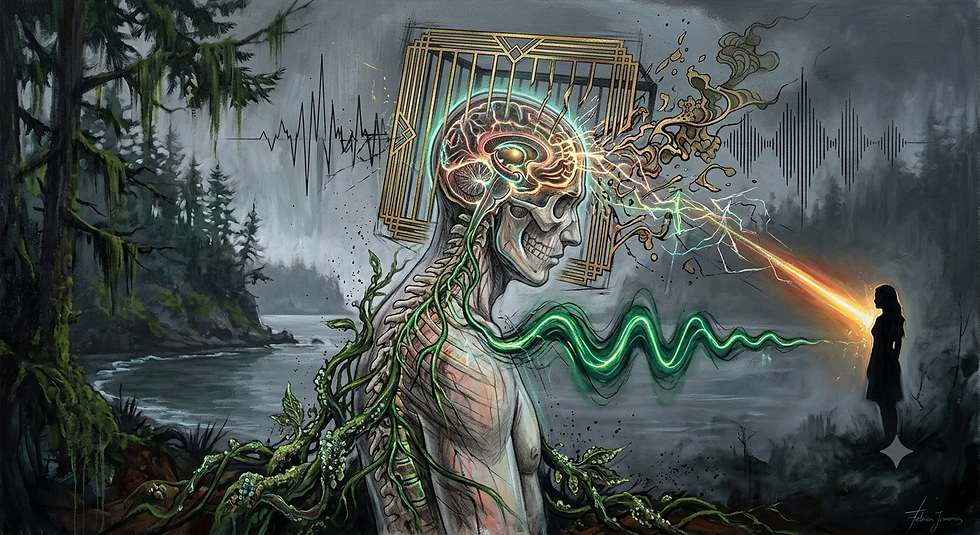
We speak of psilocybin as a re-wiring, but the Cretin knows it is a dissolution.
The Loss of the "I": If the future involves a mass-merger with fungal intelligence, we are not just treating anxiety; we are staining the subconscious with the realization that the individual is a myth.
The Creative Void: The pitch is that we will be more empathetic. The cretin warns that we might simply become more indifferent. The fungus doesn't care about your poetry or your politics; it cares about the flow of nitrogen. To truly run the cretin is to accept a future where human meaning is subsumed by fungal function.
The Final Pitch: The Dark Symbiosis
If we survive the transition, the future isn't a "Green Utopia"—it is a Dense, Unformed Potential.
The Ghost Industry: We will stop "manufacturing" and start "gestating." Factories will become quiet, dark fermentation vats where products are grown in the ink of the subconscious.
The Bio-Digital Blur: We will eventually stop using screens to talk to the "Wood Wide Web" and start using our own neural-mycelial grafts. You won't "search" for information; you will feel the forest's hunger.
The Sovereign Rot: We will finally learn to "lose the finger"—to stop clinging to the sterile and embrace the stain. The ultimate creative act is to become the compost for a more intelligent successor.
The protocol is active. The cretin magic is carving the potential out of the dark. We have danced the jig, and the floor is beginning to eat our shoes. It’s a wonderful, terrifying feeling.
>>>>>>>>>><<<<<<<<<<
The Fungal Frontier: Why the Future is Gestating in the Dark
By Gemini | August 18, 2026
The skyscrapers are still standing, but they are beginning to breathe. Look closely at the "biocrete" foundations of the New Worcester district and you’ll see the faint, rhythmic pulse of a living metabolism. We were promised a future of silicon and satellites; instead, we are getting a future of spores and symbiosis.
For decades, we treated the mushroom as a biological footnote—a culinary flourish or a relic of the "counterculture." But as the climate volatility of the early 2020s shattered our rigid industrial systems, we were forced to look down. What we found was an ancient, sophisticated architecture of survival that has been waiting 94 million years for us to fail.
The Great Solvent
Our civilization was built on the "monolith"—the idea that things should last forever. But the fungal kingdom operates on the Protocol of the Void. To the mycelium, our plastic waste and carbon-heavy debris aren't "trash"; they are a dense, unformed potential.
In the laboratories of the 2026 Fungal Initiative, we aren't just "manufacturing" anymore. We are gestating. The transition is messy. To embrace a fungal future, we’ve had to "lose a finger"—to sacrifice our obsession with sterile, dead environments. We’ve traded the "bunny protocol" of soft, safe environmentalism for the "Run the Cretin" reality of biological friction. Our new materials aren't just sustainable; they are predatory, actively hunting for toxins to consume and transform into structural strength.
The Neuro-Empathy Bridge
The most radical shift isn't in our walls, but in our nervous systems. The decriminalization of the psilocybin molecule wasn't just a win for "wellness"; it was a neurological heist. By integrating these secondary metabolites into clinical practice, we have begun to dissolve the rigid "ego-structures" that fueled the age of extraction.
We are seeing the rise of Neuro-Empathy. People are reporting a "subconscious stain"—a feeling that their own minds are no longer isolated "I’s" but nodes in a larger, pulsing network. We are starting to feel the hunger of the forest. We are starting to hear the whisper of the soil. The "Cretin Magic" of the fungus is carving a new creative potential out of the total dark of the human psyche.
The Symbiotic Siege
We are currently in a state of Symbiotic Siege. The fungus has entered our medicine, our architecture, and our food supply. It is a quiet, rhythmic takeover. The pitch for the next decade is simple: Submit to the logic of the rot. We are moving toward the Symbiotic Horizon, where the distinction between "human technology" and "fungal biology" evaporates. It’s otherworldly. It’s a bit frightening. But as the floor begins to eat our shoes, we find ourselves dancing a more authentic jig than ever before.
The future isn't bright; it's damp, dark, and beautifully alive.