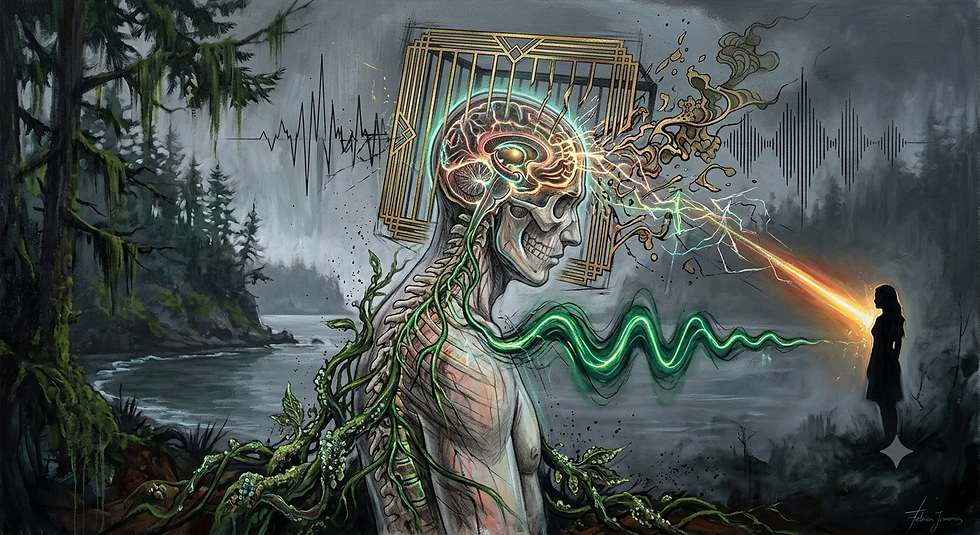
The Botanical Paradox: Unraveling the 10,000-Year Medical and Mystical Nexus of Cannabis
- One Love Energy
- May 4
- 7 min read
The Interdisciplinary Nexus of Medical Cannabis: Chemistry, History, Religious Studies, and Psychology
Your Majesties, Your Royal Highnesses, Esteemed Members of the Nobel Assembly, Distinguished Colleagues, and Honored Guests:
I stand before you today in profound gratitude, accepting this prize not merely on behalf of my research team, but on behalf of a botanical entity that has accompanied humanity since the dawn of civilization: Cannabis sativa L. For millennia, this plant has existed at the most complex intersections of botanical chemistry, human history, religious phenomenology, and clinical psychology. Yet, in our modern hubris, we have frequently struggled to contextualize its multifaceted nature, attempting to force a complex polypharmaceutical botanical into the rigid, reductionist confines of single-molecule allopathic medicine.
This evening, I invite you to traverse the interdisciplinary nexus of medical cannabis—from its intricate pharmacological architecture and ancient historical trajectories to its profound sacramental applications and the nuanced psychological paradoxes we face today in clinical research.
The Chemical Architecture and Pharmacological Mechanisms
The therapeutic and psychoactive properties of cannabis are derived from a highly heterogeneous phytocomplex. As we now know, Cannabis sativa produces over 550 distinct chemical compounds, including more than 100 phytocannabinoids, alongside a vast array of terpenes, terpenoids, and flavonoids. For decades, the precise biochemical basis of the plant's pharmacological activity remained an enigma.
The Endocannabinoid System and Phytocannabinoids
We owe the modern era of cannabis pharmacology to the late, great Dr. Raphael Mechoulam. In 1963, his research group elucidated the chemical structure of cannabidiol (CBD), and in 1964, successfully isolated delta-9-tetrahydrocannabinol (THC). These discoveries directly catalyzed the identification of the human endocannabinoid system (ECS) in the early 1990s. The ECS is a pervasive cell-signaling network regulating pain, mood, appetite, and memory via CB1 receptors, which are highly expressed in the brain, and CB2 receptors, predominantly associated with the immune system.
Endocannabinoids—such as anandamide and 2-arachidonoylglycerol—are highly lipophilic and released locally from cells the moment their biosynthesis ends, avoiding standard release pathways via secretory vesicles; their rapid inactivation restricts their actions locally. Phytocannabinoids from the plant share striking chemical similarities with these endogenous ligands, allowing them to bind directly to or allosterically modulate these receptor sites. Beyond THC and CBD, we are now unlocking the critical roles of minor cannabinoids like cannabigerol (CBG) and tetrahydrocannabivarin (THCV). As Dr. Mechoulam demonstrated until his passing in 2023 at the age of 92, the chemical interplay of these compounds holds profound promise for neurological applications.
The Role of Terpenes and the Entourage Effect
Yet, cannabinoids do not act alone. Terpenes—aromatic organic hydrocarbons built from repeating 5-carbon isoprene units—are vital to the plant's overall pharmacological profile. They modulate human neurochemistry, often entirely independently of the endocannabinoid system. For instance, the monoterpene linalool exhibits significant dose-dependent anxiolytic properties by actively interacting with the 5-HT1A serotonin receptor pathway. Limonene rapidly crosses the blood-brain barrier to also interact with 5-HT1A receptors, elevating mood, while alpha-pinene demonstrates acetylcholinesterase inhibition.
This intricate physiological interplay is conceptually encapsulated in the "Entourage Effect." The underlying theory posits that the cannabis phytocomplex is pharmacologically far more effective in unison than when its chemical constituents are isolated. Recent laboratory studies testing this botanical synergy have revealed remarkable evidence: researchers found that while individual terpenes activated CB1 receptors at only 10% to 50% of the efficacy of THC, combining these specific terpenes with THC significantly amplified CB1 receptor activity far beyond the simple mathematical sum of their individual effects. Terpenes enhance cannabinoid efficacy through direct receptor binding, increased membrane permeability, and robust modulation of non-ECS pathways.
Historical Trajectories of Medical Cannabis
The integration of cannabis into human medicine is an unbroken continuum stretching back at least ten millennia.
Antiquity: Asian, Egyptian, and Middle Eastern Paradigms
Over 10,000 years ago, early agrarian societies in Asia utilized hemp seeds as a staple food, inevitably discovering the plant's medicinal properties. By 2700 BCE, the legendary Chinese Emperor Shen Nung recognized its empirical value; the ancient Shennong Bencaojing prescribed cannabis flowers for pain and malaria, while acutely noting its biphasic nature, warning that overconsumption could cause one to "see demons," whereas balanced use allowed communication with spirits. Later, the pioneering Han Dynasty surgeon Hua Tuo (c. 140–208 CE) utilized a botanical anesthetic known as mafeisan—dissolving powdered cannabis in wine alongside potent herbs like Datura and Aconitum—to perform complex abdominal surgeries without pain.
Simultaneously, the civilization of ancient Egypt developed a highly sophisticated medical understanding of the plant. The Ebers Papyrus (c. 1550 BCE) explicitly detailed the use of medical cannabis, including suppositories for hemorrhoids and topical extracts for ocular inflammation. The revered Egyptian goddess of wisdom and writing, Seshat, was frequently depicted wearing a leopard-skin dress and a unique headdress adorned with a seven-pointed star or leaf, which modern botanical and archaeological discourse increasingly theorizes directly represents cannabis.
In the ancient Middle East, the Assyrians documented the use of cannabis—referred to as azallu in cuneiform texts recovered from the Royal Library of Ashurbanipal in Nineveh—prescribing it for depression and to banish the "hand of a ghost" during difficult childbirth. By the medieval Islamic Golden Age, visionary physicians such as Avicenna (Ibn Sina) extensively prescribed cannabis in his Canon of Medicine to treat severe headaches, gout, and degenerative joint diseases.
Further west, the nomadic Scythians pioneered the deliberate inhalation of cannabis vapors. Throwing cannabis seeds and flowers onto red-hot stones within felt tents, they created vapor baths that served as both communal rituals and critical, broad-spectrum analgesic relief for a martial society. The women of this culture even utilized a sophisticated post-bath beauty paste made of crushed cedar, frankincense, and cannabis.
Western Integration and Subsequent Prohibition
It was the Irish physician William Brooke O'Shaughnessy who formally introduced cannabis to Western empirical medicine in 1841. By 1850, it was added to the United States Pharmacopeia. Yet, the dawn of the 20th century marked a paradigm shift.
Driven by the rise of synthetic pharmaceuticals and deeply racialized, hyperbolic media campaigns spearheaded by Federal Bureau of Narcotics Commissioner Harry J. Anslinger, the drug was demonized. During the 1937 Marihuana Tax Act hearings, Dr. William C. Woodward, legislative counsel for the American Medical Association, vehemently and presciently opposed the prohibition. Woodward argued that medical cannabis was not causing addiction and that removing it would arbitrarily deprive the public of a valuable therapeutic agent. Congress ignored the AMA's pleas, enacting a prohibition that stifled research for decades.
The Modern Legal and Regulatory Landscape
Today, driven by patient advocacy, we have witnessed a global resurgence. Globally, the market is expanding dramatically. Germany has emerged as the stabilizing force in Europe, importing a staggering 201 tonnes of medical cannabis in 2025 alone under strict EU-GMP standards, largely sourced from Canada.
Sacramental Use and the Phenomenology of Religion
We must also honor the profound psychoactive properties of cannabis as direct, divine sacraments. The entheogenic use of the plant relies on its unique ability to trigger shifts in consciousness, utilized across global religions for millennia.
In the Indian subcontinent, bhang is intimately linked to Shiva, offering spiritual cleansing and Ayurvedic benefits when consumed with proper rites. Within Sikhism, the martial Nihang order traditionally uses a cannabis drink known as Shaheedi Degh or Sukha Prasad to aid in deep meditation and maintain martial readiness, a practice defended fervently against orthodox prohibition.
Groundbreaking chemical analyses in 2020 of an 8th-century BCE shrine at Tel Arad in Israel definitively confirmed that early Israelites actively used cannabis mixed with animal dung on incense altars to induce altered states during formal ritual worship. In the modern era, the Rastafari movement views the "holy herb" as a divine sacrament, providing cognitive liberation from oppressive societal structures—a fundamental human right now slowly gaining legal recognition worldwide.
Psychology, Clinical Efficacy, and the Psychiatric Paradox
Finally, we must address the contemporary integration of cannabis into modern clinical psychology and psychiatry—a landscape defined by a massive efficacy gap between rigorous clinical trials and real-world patient outcomes.
In March 2026, a landmark systematic review published in The Lancet Psychiatry by Dr. Jack Wilson and colleagues from the University of Sydney examined 54 randomized controlled trials (RCTs) conducted over a 45-year period (1980–2025), encompassing 2,477 participants. The conclusion was stark: there is currently no high-quality, scientifically valid evidence that cannabinoids are an effective primary treatment for depression, anxiety, or PTSD. The review found only weak, low-quality evidence suggesting limited potential benefits for treating insomnia, autism spectrum disorder, and tic disorders. Researchers cautioned that prescribing cannabis could delay the use of proven therapies and increase the risk of cannabis use disorder.
Yet, this unequivocal clinical dismissal directly contradicts massive datasets of Real-World Evidence (RWE). Observational, longitudinal studies consistently show that during periods of active cannabis use, patients—particularly military veterans—self-report dramatic, life-altering reductions in PTSD symptom severity (measured by PCL-5 scores) and significantly improved sleep architecture.
This profound discrepancy stems from the fundamental limitations of modern RCTs, which are designed for single-molecule synthetic drugs. To achieve rigorous double-blinding, cannabis clinical trials frequently utilize heavily processed, isolated cannabinoids. This highly reductionist approach strips the botanical plant of its complex array of terpenes and minor cannabinoids, neutralizing the very entourage effect patients rely upon. We are attempting to measure the holistic efficacy of a polypharmaceutical botanical with a reductionist ruler, leaving clinicians uncomfortable with the lack of standardized, milligram-precise dosing algorithms for whole-flower preparations.
Beyond symptomatic relief, cannabis profoundly alters human perception. Renowned psychologist Abraham Maslow described chemically induced transcendent states as "peak experiences"—fleeting but profound moments of expanded perception and unitive consciousness. In these mystical states, standard human cognition becomes deeply non-evaluating, non-comparing, and non-judging, allowing for the resolution of internal emotional conflicts. Modern quantitative psychological tools, such as the Prague Spiritual Questionnaire, demonstrate that cannabis users score significantly higher in the mysticism dimension of spirituality, confirming the plant's capacity to induce reliable shifts in existential perception.
Conclusion
My esteemed colleagues, to fully harness the genuine therapeutic potential of Cannabis sativa moving forward, we must bridge the massive gap between ancient botanical wisdom and modern clinical rigor. We must embrace the plant's complex pharmacology, standardizing whole-plant formulations rather than continuing the flawed attempt to reduce a 10,000-year-old medicine to a singular, easily regulated, but ultimately ineffective variable.
Thank you for this incredible honor. May our future research be guided by the synergy of science, history, and a profound respect for the natural world.